
How 3.1 liters of water became an act of economic resistance.
When the Portuguese government decided to add a 10-cent deposit to the price of every plastic bottle under 3 liters (101 fl oz), a small family business in central Portugal did the math and launched a 3.1-liter (105 fl oz) bottle.
In the European Union, the environmental agenda is advancing rapidly. The European Green Deal, launched in 2019, committed the 27 member states to ambitious recycling targets: separately collecting 77% of plastic bottles by 2025 and 90% by 2029. Countries like Germany and Norway had their own deposit systems long before the Green Deal. The German Pfand (deposit) system has been in place since 2003 as a national decision. The Green Deal simply made this model mandatory for countries that had not chosen it voluntarily, as the packaging regulation approved in February 2025 made deposit systems obligatory across the entire EU by 2029.
In countries where the decision was voluntary, the systems have been effective thanks to dense infrastructure and established consumer habits. However, in countries like Portugal, where adoption of this system was a centralized European decision to avoid an EU infringement procedure, the process was implemented suddenly and in a disorganized way.
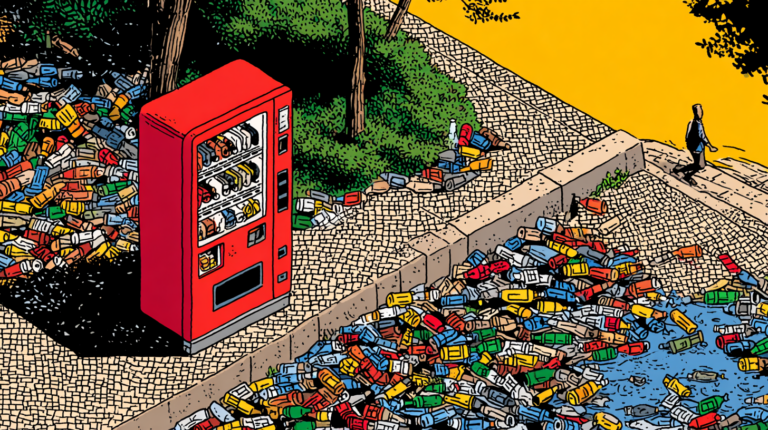
Under pressure to meet its European obligations, in April of this year, the Portuguese government launched Volta, the national deposit return system. The mechanism works as follows: every single-use plastic bottle or metal can under 3 liters now costs an extra 10 cents at purchase. This deposit is refunded when the empty container is returned to a collection machine, which issues a receipt so the consumer can get his 10 cents back.
There is a curious irony in a system that requires printing a paper receipt as a requirement for an action done in the name of ecology. But the problem goes further: at launch, there were only 2,500 collection machines for a population of 10 million people. Instead of setting up the infrastructure first (in Germany and the Netherlands, there are collection points at most supermarkets), the Portuguese authorities scrambled to launch the system in time, assuming that they could catch up with the details later.
Outside major urban centers, finding a return point near where you shop remains an exercise in patience. The acceptance rules are strict for those who manage to overcome this obstacle: the container must be returned intact, with its cap, and with a legible barcode. On top of that, for months, packaging with and without the Volta symbol coexisted on the market, leaving consumers unsure how to tell them apart. The widespread feeling was that Portuguese society was now playing a game whose rules it did not know, and from what it did know, it had little chance of winning.
Portugal has a median net monthly salary of around 980 euros (USD 1,140), the tenth lowest in the European Union, and one of the highest tax burdens in Europe. The 10 cents per container was immediately perceived as an unusually visible tax. Unlike regulatory costs that are normally hidden in prices or absorbed by companies, this one appears clearly on the sales receipt and on some supermarket labels. The DECO consumer protection group warned that implementation problems would cause Portuguese consumers to lose about 36 euros per year, the equivalent of a gas cylinder in the country. Social media was filled with complaints, indignation, and confusion.
It was in this context that Caldas de Penacova, a small family-owned company in central Portugal, provided the response that challenged the regulators. They launched a new 3.1-liter water bottle, exactly 100 milliliters above the legal limit of the Volta system, thereby allowing consumers to avoid the 10-cent deposit. The company announced it on social media as the most versatile on the market, directly mentioning the deposit-free advantage.
The initiative went viral within days. Consumers celebrated it as a hack of the system. The brand maintains that it simply responded to market needs, and the move sparked a major debate among marketers, national business newspapers, and even the founder himself, who admits that he is receiving free publicity amid criticism from SDR Portugal.
It is revealing that consumers only became aware and outraged by a government-imposed cost when it became explicit, imposed in a rushed manner and without the infrastructure that would give it credibility as an ecological solution. Penacova did not bypass the spirit of the law; it responded to the price signal that the regulation itself created. This is what markets do when a cost becomes visible: someone has an incentive to eliminate it. A well-designed regulation would not need to be bypassed, and a poorly designed one can never prevent it.
The regulatory instinct will likely be to close the loophole and extend the rules to larger containers, in an eternal dance between excessive regulation and innovation.