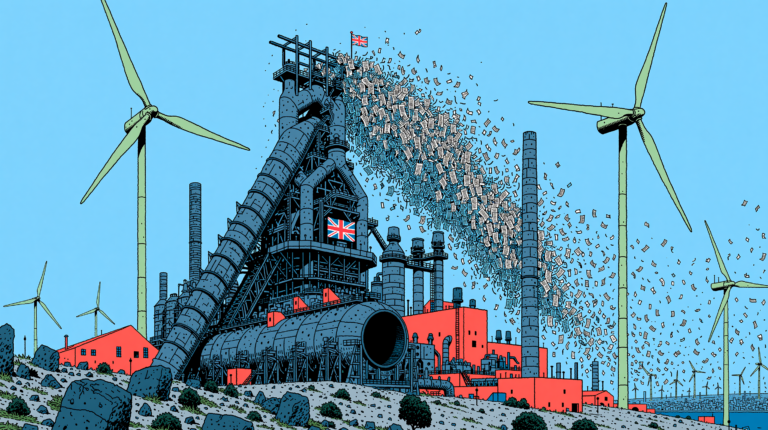

Nationalization shifts risk to taxpayers.
The UK government has completed the forced nationalization of British Steel, the company that owns the Scunthorpe plant in Lincolnshire, the last facility in the United Kingdom capable of producing virgin steel in traditional blast furnaces. Celebrated by sectors on both the left and the right, this move represents a definitive transfer of risk from private shareholders to taxpayers, ignoring that many of the problems that led to it were largely created by the state itself and its aggressive green policies.
The UK government passed the Steel Industry (Nationalization) Act, a law designed specifically to enable the expropriation of British Steel. On July 16, 2026, just one day after the act received royal assent, the company formally passed into state ownership. Scunthorpe left the control of the Chinese private group Jingye and became public property. This is, in practice, an expropriation disguised as public interest, officially justified by national security concerns in the context of the war in Ukraine and American tariffs on steel. However, there is more to say about the reasons behind the nationalization.
The government had already been directing operations since April 2025, after Jingye found itself unable to reconcile the environmental requirements imposed by the state with its natural goal of making a profit. According to the National Audit Office (NAO), British taxpayers spent £377 million ($509 million) between April 2025 and January 2026 to keep the plant open, roughly £1.3 million ($1.76 million) per day, with no fixed budget and no exit date for state support. The NAO projected that spending would reach £615 million ($830 million) by June 2026 and could exceed £1.5 billion ($2.03 billion) by 2028 if the current pace continued. The situation was, and remains, a bottomless pit.
It is important to note that net-zero policies were not the only cause of British Steel’s difficulties. External factors, such as massive Chinese overproduction and tariffs imposed by the United States, also worsened the situation. Nevertheless, domestic decarbonization policies played a fundamental role in the outcome.
To meet emissions-reduction targets, the government promoted renewable energy through high subsidies and introduced the UK Emissions Trading Scheme, a system that forces companies that emit carbon dioxide to buy emissions allowances, creating an additional cost for carbon-intensive industries.
These measures made industrial electricity significantly more expensive, directly affecting the business. Producing steel from iron ore in blast furnaces is an extremely energy-intensive process. In the United Kingdom, industrial electricity prices have become among the highest in Europe. According to data from the industry body UK Steel, the average price paid by British steelmakers in 2025–26 was £59.48 ($80.30) per megawatt-hour, compared to £52.04 ($70.25) in Germany and £47.76 ($64.48) in France. As a result, British companies currently pay more for electricity than their direct competitors, making British Steel’s blast furnaces structurally uncompetitive.
If, on one hand, the state created many of the conditions that made the business unviable, then, on the other, it presented itself as the savior through forced nationalization by legislative decree.
While British Steel was under private ownership, Jingye had a direct interest in good management, maximizing production and profit where viable, or exiting the operation if it was not. This alignment between risk and control is what allows markets to identify and eliminate economically unsustainable activities. Market incentives do not guarantee that all decisions are correct, but they ensure that those who decide poorly largely bear the cost of that decision.
This accountability disappears with nationalization. What was once a private problem becomes one funded by all taxpayers.
Although the Steel Industry (Nationalization) Act was tailor-made for British Steel, setting a precedent for the future, this nationalization does not currently mean the nationalization of the entire British steel industry. The Port Talbot plant, operated by Tata Steel in Wales, remains in private hands. However, Scunthorpe was the last unit with traditional blast furnaces for virgin steel production. While Port Talbot accepted a state support package to transition to electric arc furnaces, a move that also involved substantial job losses, Jingye resisted the transition, which it considered economically unsustainable under the imposed conditions. This resistance ultimately led to the full nationalization.
The state can now subsidize the plant indefinitely because politicians do not directly bear the cost of their choices. Politicians respond to electoral and media incentives. Protecting visible jobs in a specific region and invoking national security makes perfect sense from a political strategy perspective, but not from an economic one.
Furthermore, a foreign investor like Jingye, which injected more than a billion pounds into the United Kingdom, now sees its asset taken by the state against its will, after having been heavily constrained by rules imposed by that same state. Jingye is claiming compensation, with industry sources pointing to more than £1 billion ($1.35 billion) in debts and losses. The British government has already signaled that it may limit or refuse this payment, generating diplomatic tensions with China. This precedent weakens the security of property rights in the country.
If the state can expropriate a private company because it cannot meet the regulatory and energy requirements that the state itself imposed, and then unilaterally decide how much, or whether, to pay for it, all investors, domestic and foreign, understand that investing carries an inherent risk in the United Kingdom.