
Another train crash in Spain raises questions about the country’s infrastructure.
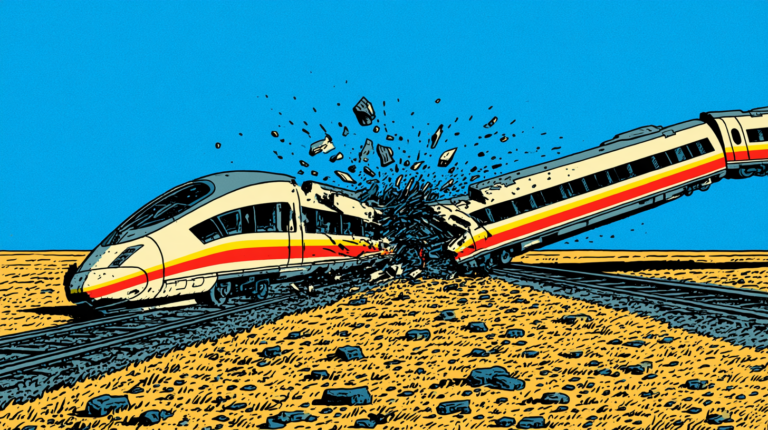
On October 28, 69 people were killed in a train crash in the Toledo province of central Spain. The collision occurred on the high-speed line connecting Madrid with the southwestern city of Seville, just one month before a general election on November 29. It is the second disaster on the Madrid–Seville corridor this year, after a crash near Córdoba in the south in January killed 46 people. Due to its timing, the Toledo collision is likely to be even more politically contentious than the last, further diminishing Socialist prime minister Pedro Sánchez’s chances of reelection. Both tragedies suggest that a once cutting-edge rail network is now showing its age—and that successive Spanish governments have failed to invest in its maintenance.
Both the Socialists and conservative Popular Party (PP) halted their campaign activities on the day of the collision, which occurred just before 9 AM near the village of Urda, about 90 miles south of Madrid. Hostilities between Sánchez and PP leader Alberto Núñez Feijóo were suspended, while both leaders visited the crash site and expressed solidarity with the victims’ families. Sánchez announced that his government was working to ensure that such a catastrophe “never happens again”—a promise he also made after the crash near Adamuz in January (alongside an admission that Spain’s railway safety protocols were “not infallible”). Both he and Feijóo are locked in a battle for first place on November 29, with most polls putting the PP a few points ahead of the Socialists.
Only Vox, a party to the right of the PP that’s currently placed third in the polls, refused to halt campaigning. Just a few hours after the collision, its leader Santiago Abascal gave a wild speech in the northern city of Santander, expressing his “absolute rage” at a government that he described as a “criminal organization” (a reference to the corruption scandals surrounding Sánchez’s inner circle, one of which centers on the now-jailed former Transport Minister). Abascal assured his listeners that Sánchez would “use the pain and mourning” to “silence the people’s protests.” If that was the prime minister’s plan, it didn’t work: demonstrators clashed with police outside the Ministry of Transport on the night of October 28, demanding that both Sánchez and Transport Minister Óscar Puente resign.
Unlike the January crash, which was attributed to a faulty section of track, last month’s disaster seems to have been caused by a combination of technological failure and human misjudgment. A glitch in the computer system halted several trains along a 60-kilometer (37-mile) stretch of track, after which Spain’s state railway administrator Adif took manual control. As heard on audio files leaked to Spanish media, a Madrid-based controller then instructed the driver of a train from public operator Renfe to proceed southbound “at normal speed,” despite a red light. These recordings also reveal that the driver of a privately-operated Iryo service, also headed for Seville, told the same controller several minutes before the crash that she was stalled and couldn’t restart her train. But no one told the Renfe driver to brake, and 25 kilometers (15 miles) down the line, his train slammed into the Iryo’s stationary rear carriages at an estimated speed of between 160 and 200 kilometers (94 and 124 miles) per hour.
Puente, desperate to deflect blame from the government, called the controller’s decision to green-light the Renfe train “inexplicable.” This outraged CSIF, one of Spain’s main public sector unions: “We demand that the government respect the investigation and presumption of innocence for the head of traffic at Adif,” it said in a post on X. CSIF joined the calls for Puente’s resignation, claiming that it was unfair to blame one person before the complex nexus of causal factors has been examined.
The Adif controller’s decision does need to be explained—but the underlying problems here, as in January, are with the state of Spain’s high-speed railways, especially the 35-year-old Madrid–Seville line (the first to be opened in 1992). SEMAF, Spain’s main train drivers’ union, has repeatedly raised concerns about the deterioration of the country’s high-speed infrastructure, describing “severe wear and tear” in a letter to Adif last August—but to no avail. The union went ahead with a strike last Thursday, which was planned before the previous day’s crash, and has called for two more on November 10 and 12.
Adding to the October 28 tragedy (and making things even worse for Sánchez) is that the driver of the Renfe train killed on impact was himself a left-wing activist, who had criticized the government’s level of investment in railway infrastructure.
A member of Izquierda Española (“Spanish Left”), Antonio Acedo, 36, helped launch the party’s transport platform. According to party leader Guillermo del Valle, Acedo echoed SEMAF’s concerns by highlighting “overcrowding of passengers following a failed liberalization, the glaring lack of funding for maintenance, and years of neglect that have resulted in a disastrous deterioration of railway infrastructure.” Lawyer Paula Fraga, an associate of Acedo’s in Izquierda Española, told El Mundo that he was “very worried” after January’s crash, “saying that if things didn’t change, we were doomed to repeat the same mistakes. And look, it’s happened to him. It’s unbelievable.”
Sánchez has one fact to cling onto—namely, that his government has invested much more in railways than its conservative PP predecessor. But of the €1.5 billion annual average spent on high-speed tracks under Sánchez, most is channeled into new projects. Between 2018 (the year he took power) and 2022, only about 16% went to maintenance, compared to between 34% and 39% in France, Germany, and Italy. As one EU rail expert recently told Politico: “Maintenance is vital—but also politically invisible.” The Madrid–Seville line has recently received a €700 million renovation, but not along its entire length, as Puente himself admitted after the Adamuz crash.
The Toledo tragedy has also refocused attention on railway signaling and safety systems, part of a wider issue across the EU. Neither of the trains involved were using the European Rail Traffic Management System (ERTMS), a more sophisticated replacement of the German-made LZB system that apparently failed on the morning of October 28 (although it has yet to be ascertained whether the new system could have prevented the collision). The Madrid–Seville line is currently being upgraded to ERTMS, but progress is far behind schedule, as it is across the EU as a whole. By the end of 2024, ERTMS signaling technology was active on only about 10% of Europe’s rail network.
In the run-up to the Spanish election, though, voters are likely to remain fixed on the domestic situation. Sánchez has been in power for almost a decade—plenty of time, one might have thought, to improve a railway network fast approaching its 40th birthday. Yet he is merely the most recent Spanish prime minister to have prioritized, along with the EU, building new lines over the maintenance of existing ones. Hopefully, Spain’s next government won’t make the same mistake.