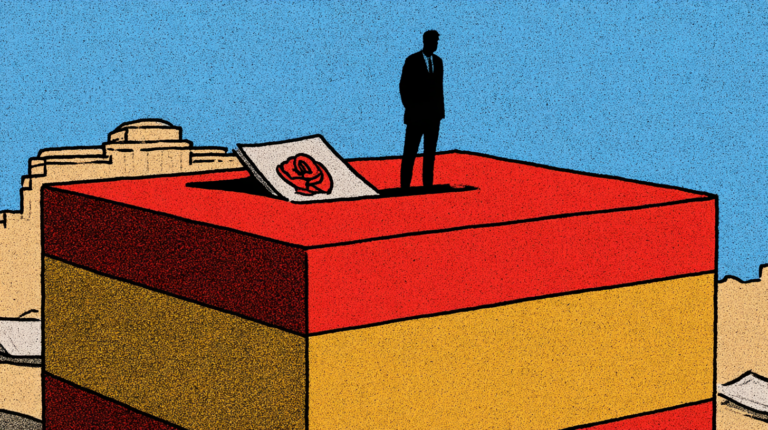

Spain’s Socialist prime minister calls a long-overdue election.
Over the next couple of months, you’ll hear a lot about Pedro Sánchez. On October 5, prompted by his failure to secure parliamentary support for measures addressing Spain’s housing crisis, the country’s Socialist prime minister called a general election for November 29, several months ahead of schedule. Sánchez seeks a proper mandate for his minority coalition and hopes to get more Socialists elected by capitalizing on public anger over the housing situation. But polls currently put the Conservative Popular Party (PP) first with 34% of the vote, followed by the Socialists with 26%. To govern, the PP would need the support of Vox (a center-right party that has already partnered with the Conservatives in several regional administrations), which is expected to come in third with around 18%.
Public anger over Spain’s housing crisis flared up last month, when an 87-year-old woman was evicted from her Madrid flat because she couldn’t afford a rent increase (she has since died). The Spanish right’s rejection of the measures Sánchez hastily prepared in response—including a ban on evictions until 2030, higher taxes on tourist flats, and restrictions on private investment firms active in the residential sector—fueled this outrage. Sánchez hopes to pass a modified version of the emergency package through a reduced parliament before the election; but even if he does, he won’t solve Spain’s housing problems.
The emergency measures are exactly that: short-term holdovers that fail to address the fundamental structural issues. Spain is running a deficit of around 700,000 homes, which has caused rental rates to double and house prices to rise by 44% since 2020. In a report published last November, the Bank of Spain identified historically sluggish construction as a key factor in the deficit. One conclusion to draw is that Sánchez has not done enough to stimulate activity in the construction industry. As one PP minister said: “Housing doesn’t become more affordable through decrees; it becomes more affordable by building more homes.”
This snap election seems premised on the belief that voters have extremely selective or short-term memories (which might well be true). Sánchez has had almost a decade to tackle the housing situation, during which period it has only worsened. But now he’s hoping that the only thing voters will remember is the Spanish right (in conjunction with the Vox, labeled by the Socialists as “far right”) blocking his last-ditch attempt at a solution. It’s a risky move, but Sánchez is often described as a consummate political gambler. This is the third snap election he’s called since coming to power in 2018. (The others were in April 2019 and July 2023. The repeat vote held in November 2019 was triggered automatically by parliamentary deadlock.)
Between now and November 29, there will be widespread speculation about whether the “Houdini” of Spanish politics, as Sánchez is sometimes called, can extricate himself from another tight spot; and there will be hand-wringing editorials in the center-left press about the potential demise of Europe’s only “progressive” leader and the deterioration of European democracy. All of which misses the point—because Sánchez himself has done a lot to damage Spain’s democracy. The key question posed by the snap election is “Why didn’t Sánchez call one sooner?” Or, to put it the other way around: “Why is he still in power?”
Sánchez took office in June 2018 by winning a no-confidence vote against his Conservative predecessor, Mariano Rajoy. In the run-up to the vote, Sánchez applied relentless pressure on Rajoy to step down. His criticism focused on two key issues: legislative impotence, as manifested by Rajoy’s inability to pass a budget, and corruption within the PP.
But since regaining power for the third time in 2023, after a snap election in which he narrowly lost to the Conservatives, Sánchez has not been able to pass a national spending plan. During the same period, some of his closest political allies have been charged with or suspected of corruption. None of this has prompted him to act on the same principles which he demanded of Rajoy eight years ago. The opposition also deserves criticism for its baffling failure to table a no-confidence vote against the Spanish premier.
“Approving a state budget,” declared Sánchez while in opposition, “is the first and principal obligation of a government.” On 10 separate occasions between February 17 and March 6, 2018, he demanded that Rajoy call elections. A government unable to pass a national spending plan, he said, was “as useful as a car without gas.” Clearly, for Sánchez, that only applies to center-right governments.
It’s now been more than 1,000 days since Spain had a new state budget. Due to his coalition’s lack of support in parliament, Sánchez has rolled over the 2023 spending plan three times, over-extending a Constitutional mechanism designed to apply for a year at most. His government has been out of gas since squeezing back into power three years ago (via a deal with Catalan separatists that caused nationwide protests); yet were it not for the PP and Vox voting down his housing measures on October 2, Sánchez would likely have remained in office until next August, rolling over the 2023 budget a fourth time. If it takes power after the November vote, the PP has promised to tweak the law so that such prolonged abuse of democracy is not possible.
Sánchez is now also unable to criticize the Conservatives for corruption without being charged with hypocrisy (although so far that hasn’t stopped him). In the debate preceding the no-confidence vote against Rajoy in 2018, José Luis Ábalos, at the time the Socialists’ organizational secretary, took aim at the Conservatives over the so-called Gürtel case, a huge cash-for-contracts scandal which saw one former party treasurer receive a 33-year jail sentence: “Through your use of power,” Ábalos told Rajoy, “you created a veritable circle of corruption… We have long lived in the universe of ‘presumed innocent,’ but that period is over.”
Ábalos became transport minister when Sánchez took over from Rajoy. Now he too is in jail. In June, Spain’s Supreme Court sentenced him to 24 years for taking bribes on face-mask contracts during the pandemic. His former aide Koldo García was given a 19-year sentence in the same case. The court said that “the seriousness of the charges derives from the fact that they erode the fundamentals of a democratic state and distort the purpose of public power into an instrument at the service of individual interests”—precisely the accusation Ábalos leveled at Rajoy eight years ago.
Santos Cerdán—another member of Sánchez’s inner circle, who succeeded Ábalos as the Socialists’ organizational secretary—is also under investigation for bribery, influence-peddling, and participation in a cash-for-contracts scheme. When Cerdán was arrested in June 2025, Sánchez publicly apologized for trusting him; but he refused the opposition’s call for early elections, claiming that “this isn’t a crisis of government; it’s only affecting the Socialist party, not the government.” A double-standard is disguised by this perplexing identity riddle: the Gürtel scandal “only” affected the PP, and was largely concentrated on activities that occurred years before Rajoy became prime minister. When, then, did Sánchez insist on his resignation?
Hopefully, a different government will have the opportunity to tackle Spain’s housing crisis after November 29. Because according to his own principles (or at least those he had when in opposition), Sánchez should have gone a long time ago.