
European nations clash over new rules-of-origin proposals.
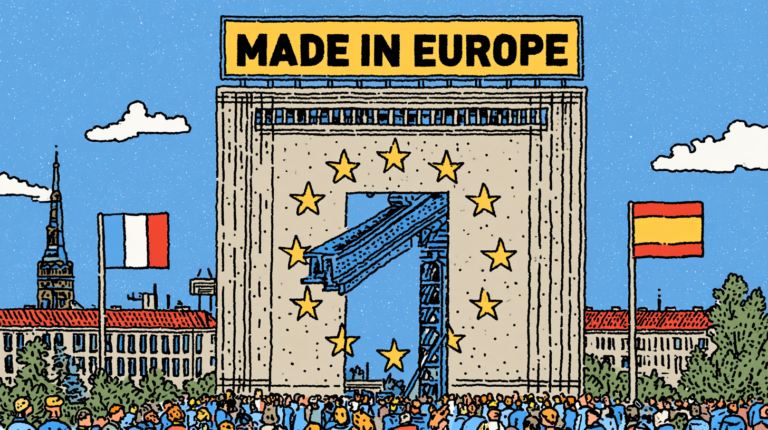
If the EU Commission didn’t take itself so seriously, you might think that the so-called Industrial Accelerator Act (IAA) had been given its name as a self-deprecating joke. Unveiled in March, the initiative aims to boost the bloc’s industrial capacity and decarbonization efforts, in order to compete with China and achieve Brussels’s stringent climate goals; but seven months on, its progress through the EU’s bureaucratic obstacle course is steadily decelerating. Like many EU initiatives before it, the IAA is causing internal division—in this case over the scope of the phrase “Made in Europe.” The question at the center of the dispute is whether protectionist measures will help or harm flagging EU industries.
The main idea behind the IAA is simple. Low-carbon and/or EU-made requirements will be placed on products bought through public procurement or auction, or manufactured with the aid of state subsidies. The aim is to channel more of the €2.6 trillion ($2.9 trillion) spent annually by European public authorities into strategic sectors such as steel, aluminum, cement, electric vehicles, solar and wind power, and hydrogen technology.
Specific criteria will depend on whether the goal is to increase or maintain a sector’s productivity, or to accelerate its decarbonization. Inverters and cells for solar panels, for example, would need to be EU-made within three years of the IAA becoming law; steel, however, could still be bought from outside the EU, but would need to be 25% low-carbon. Brussels wants manufacturing to account for 20% of the bloc’s GDP by 2035, compared to 14% at present.
The sweeping deregulation initiative announced by the EU leadership last year is also intended to boost the bloc’s competitiveness and put it on a more equal footing with China. According to the EU, its onslaught on red tape has already saved businesses around €15 billion ($17 billion), almost halfway to the €37.5 billion ($42.5 billion) savings target set for 2029.
Disagreement over the “Made in Europe” requirement, however, threatens to push negotiations over the IAA well into 2027. France interprets the phrase most intuitively, as meaning goods produced within the 27-member union, or at least in countries located on the continent of Europe, which would include around 20 European nations not formally affiliated with Brussels. According to French Industry Minister Sébastien Martin, “[I]t will still be possible to have products with some of their added value coming from elsewhere [i.e. components made outside the bloc], but production must take place in Europe in order to qualify for public support.” Controversially, France wants to exclude the UK, which exited the EU in 2020 but retains a free trade arrangement with the bloc. “Fundamentally,” said Martin, “there are those who have chosen the European project and those who have decided to leave.”
Germany, however, rejects what it sees as the “protectionism and discrimination” of this approach, and favors broader “Made with Europe” criteria. This would include the approximately 80 countries (including the UK) that have free trade agreements with the EU, as well third parties willing to forge reciprocal public procurement arrangements. An opt-in clause such as this, of course, potentially allows any country in the world to enter the “Made with Europe” group, which seems self-defeating. A product assembled in Berlin, say, but 90% constituted by components from Beijing, could just as well be labeled “Made with China” as “Made with Europe.” It’s hard to see how the IAA will really boost EU competitiveness unless it mandates some degree of positive discrimination toward local industries.
That said, Berlin’s proposal speaks to concerns that a substantial restriction of the market for the EU’s public bodies would reduce competition within the bloc, raise costs for businesses and consumers, and damage multinational supply chains, especially for car manufacturers. The UK’s Society of Motor Manufacturers and Traders has said that excluding Britain from the “Made in Europe” club would jeopardize shared investment and a trading relationship worth €80 billion ($90.1 billion).
EU origin requirements might also strain some of the bloc’s domestic industries, by suddenly creating a demand that outstrips supply capacities. According to the European Automobile Manufacturers’ Association, “Limited supply will remain the key constraint to expanding the number of cars that would be eligible for the ‘Made in the EU’ incentives.” The IAA, apparently, will contain exemptions for companies that can’t comply with “Made in Europe” requirements without significant cost increases; but the danger is that such exemptions become so numerous that they dilute the IAA’s practical impact.
Germany’s stance is aligned with that of the EU Commission, which recently signaled its intention to broaden out the union itself. In the annual State of the Union address last month, attended by Canadian president Mark Carney, Commission president Ursula von der Leyen proposed that Canada become an “associate” member of the EU. It was surely a suggestion made with the IAA in mind, as well as a snub to Donald Trump, who called the idea “laughable.” Von der Leyen has yet to provide details of what exactly an “associate member” would look like, or state whether a similar invitation will be extended to the US when Trump is replaced by a president of whom Brussels approves.
Spain, meanwhile, has proposed what it says is a “more granular” compromise, in which the “Made in Europe” group would feature three tiers. The top tier would consist of the 27 EU member states; the second of members of the European Economic Area (the EU plus Iceland, Lichtenstein, and Norway) and other “trusted” partners; and the third of countries with free trade or public procurement arrangements with Brussels, possibly including the UK (a point on which Madrid hasn’t been specific). On closer inspection, though, this isn’t as much of a compromise as it appears, at least without details about how the tiers would actually work: it is essentially a restructuring of Germany’s proposal, incorporating as it does a rejection of the restrictions favored by France.
Some analysts claim that the debate over “Made in Europe” is largely redundant, as the European industries targeted by the IAA import from just a handful of countries. Still, the dispute highlights the challenges to be overcome if the act is to foster closer competition with China—namely, bolstering domestic demand without cutting off key partners, and ensuring that compliance loopholes don’t result in a policy that is effectively voluntary. Potentially, though, the IAA could inject some much-needed dynamism into European industry, especially in conjunction with Brussels’s deregulation drive.