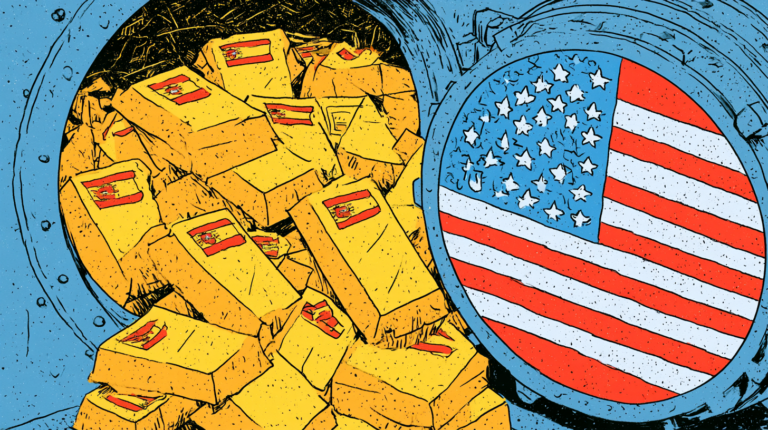

Central banks are buying—and moving—more gold than ever before.
For decades, the Federal Reserve Bank of New York has been seen by the world’s governments as a safe haven for a portion of their gold deposits. But under the mercurial reign of President Donald Trump, and in a general atmosphere of geopolitical turbulence, that is quickly changing. Several European countries have already relocated—or are under pressure to relocate—their gold from New York to domestic vaults, prompted by concerns about the stability of the regulatory environment under Trump. According to the World Gold Council, 59% of the world’s central banks now prefer to keep their gold at home, compared to 41% just two years ago.
Trump’s tariff wars and his attack on Iran have both contributed to the run on New York’s foreign gold reserves. But Vladimir Putin’s invasion of Ukraine in February 2022, and the G7 nations’ retaliatory freeze of Russian assets held abroad, have also played a major role. Nonaligned countries were especially spooked by the unprecedented economic sanctions imposed on Russia: India has carried out one of the largest gold repatriations since 2022, and now holds around 77% of its total stash in Mumbai and Nagpur. According to Carsten Menke, a researcher at the Swiss private banking group Julius Baer, the war in Ukraine is “the main factor that has caused the change in gold’s role as a geostrategic asset.” Menke believes that a reversal of the repatriation trend is unlikely, even when a peace agreement is finally reached over Ukraine.
The dollar’s international convertibility into gold ended under Richard Nixon in 1971, amid fears of a run on US reserves. But gold’s reputation as a safe investment, especially during geopolitical turmoil, remains undiminished. Increased demand from central banks has caused the precious metal’s price to soar by 140% over the last three years. In 2025 alone, it increased by roughly 65%, and it hit a record price of just over $5,000 per ounce in January this year. According to a report by the European Central Bank (ECB) in June, gold has overtaken US Treasury bonds as the world’s top reserve asset and now accounts for 27% of the total, up from 20% in 2025. Central banks purchased a record 289 tons in the second quarter of this year alone, five times the amount bought in the first quarter.
As well as buying more bullion, some of Europe’s central banks are busy moving it around. The Netherlands has recently relocated 86 of the 313 tons it held in the US and Canada to London “in view of increasing geopolitical unrest.” It sold 59 tons of gold in New York to buy new bars in London, but physically transported over 27 tons to the Bank of England—the most popular vault for international gold, holding around 400,000 bars worth an estimated $200 billion. “We expect that we will never need to use [this gold],” said Olaf Sleijpen, the governor of the Dutch central bank, “but we do need to strengthen our resilience and preparedness.”
France has recently completed a gold repatriation project that began in the 1960s under President Charles de Gaulle. Fearing a devaluation of the dollar (correctly, as it turned out), de Gaulle converted all France’s American currency into gold and had it transported back to Paris from London and New York between 1963 and 1966. Operation “Vide Gousset,” as it was called (“Empty Pockets”), required 44 top-secret boat trips and 129 flights to repatriate over 3,000 tons of gold. This lengthy homecoming was completed between January 2025 and 2026, with the French central bank’s sale of 129 (metric) tons of gold bullion held in New York—about 5% of the country’s total reserve—and purchase of new, higher-quality bars in Paris. France made around $15 billion from this conversion, which it says was performed for logistical, rather than political, reasons.
Not all EU nations, however, are bringing home the gold. Germany’s reserve of 3,350 tons—worth about $475 billion—is the second-largest in the world after North America’s. Just over half is held in Frankfurt, with around 37% stashed in New York and 13% in London. In March, the center-right AfD party called for all of Germany’s gold to be returned to Berlin, a suggestion now backed by some of the country’s leading economists. Both Emanuel Mönch, former head of research at Germany’s federal bank, and Michael Jäger, head of the European Taxpayers’ Association and the Association of German Taxpayers, have said that the 1,236 tons held in New York are not safe under Trump. So far, the German government and central bank have resisted these calls, arguing that the Frankfurt stash guarantees the country’s ability to withstand international crises. Some German economists have also suggested that a portion of the gold should be sold off and the proceeds injected into the country’s struggling economy.
Despite having Europe’s fifth-largest economy, Spain’s gold stash is embarrassingly small compared to those of its neighbors—just 281 tons, valued at about $40 billion, placing it 20th in the global rankings. Spanish gold reserves were severely depleted during the 1936–39 Civil War, when the Republican government raided the coffers to combat Francisco Franco’s (ultimately victorious) Nationalist troops. Between 2004 and 2007, the Socialist leadership of Prime Minister José Luis Zapatero authorized the sale of over half of Spain’s remaining gold reserves, claiming that the precious metal was no longer profitable (a crazy decision in hindsight, and one which violated central bank autonomy). Although the majority of its remaining hoard is held by the Bank of Spain, the exact disbursement is kept secret, with smaller amounts stored in London, Basel, and New York. Some commentators have suggested that the repatriation of Spanish gold would help bolster the eurozone’s fiscal autonomy, but so far neither the country’s central bank nor its government shows any signs of doing so.
Italy’s gold reserve of 2,452 tons, worth around $350 billion, is the world’s third-largest, and distributed between Rome (45%), New York (43%), and London and Bern (both 6%). But in Rome, the debate is centered on the question of gold reserve ownership, rather than repatriation. Prime Minister Giorgia Meloni’s center-right government claims that the Bank of Italy’s stash belongs to the state and Italian people—whereas a country’s gold reserves are typically seen as the exclusive property of its central bank, operating independently of the government. Meloni’s Brothers of Italy party claims that it wants to ensure that the reserves are not used recklessly or sold off; but the EU has warned that any dilution of central bank autonomy would violate the bloc’s fiscal regulations, under which gold, along with foreign currency reserves, underpins the stability of the euro. For that reason, it is off-limits to central governments.
As a global fixed benchmark, the gold standard has long since ceased to exist. But the precious metal has lost none of its allure for human beings, either as a symbol of indestructible wealth or a dependable investment in troubled times. New York’s vaults might be slightly emptier than they were a few years ago—but many across the rest of the world now house more gold than ever before.