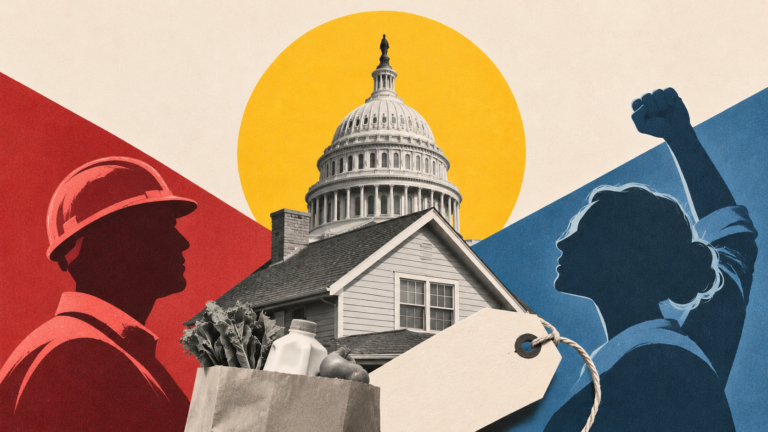

The 2026 midterms were a referendum on the failure of the current administration to deliver affordability. One poll showed that about 9 in 10 voters considered the cost of living a major factor in their vote. For voters under 30, “inflation/prices” was considered the most important issue, far above civil rights and civil liberties, which topped previous polls.
Democrats won both chambers and flipped seven Senate seats in several unlikely places, including Kansas, Iowa, Texas, Ohio, and South Carolina. They painted my state, Georgia, blue. But the blue wave has not formed a new political continent yet. The fact that so many Americans punished the current administration’s failure to reduce the cost of living does not mean they have endorsed a new economic theory of how to do so. A vote against something is not a vote for something.
The lesson for the losers, as well as the winners, of these elections, is that the voters’ verdict on how to address the affordability crisis is still open. Americans are not nostalgic for the Biden years, either. Unfortunately, the public debate is trapped between two illiberal, zero-sum views of how the economic world works, both resting on the belief that someone out there is to blame for why prices are too damn high. For the post-liberal right, that someone is usually a foreign country, an immigrant, or an international competitor. For the socialist left, it is the landlord, the billionaire, and Big Tech. Despite their different enemies, both share the same economic imagination.
What both sides ignore is that modern civilization has discovered institutional mechanisms for making life more affordable and abundant. The great economic achievement of the past 150 years is that humanity gave ordinary people access to comforts and opportunities once reserved for the wealthiest people of past centuries or unimaginable to earlier generations. That achievement was not a miracle of redistribution. It was a revolution in human productivity and access, made possible only by the institutions and culture of economic liberalism.
What the 2024 election showed us is that the promise of continuous enrichment under economic liberalism was not reaching everyone. President Trump showed voters that he understood that many Americans felt poorer and that the old promise had faded.
That pain is very real. If you don’t remove bottlenecks from the economy, many of the gains from trade and increased productivity might not reach some of those most affected by economic displacement. A big part of the administration’s answer to that pain, however, was not to reform economic liberalism but to recover lost prosperity through national economic control. Tariffs, his favorite word in the dictionary, were going to protect American industries and restore manufacturing employment. ICE raids and increased deportations would return jobs to American workers. It was a vision of industrial nostalgia combined with geopolitical competition. We would make America prosperous again by reclaiming what had supposedly been taken away.
The problem with this approach is that international trade is not simply a contest over who controls the most resources. It is first and foremost a system of cooperation that leverages specialization to make businesses and individuals more productive. You cannot reform economic liberalism by abandoning it.
Tariffs illustrate the contradiction especially well. Protecting one domestic industry may benefit particular firms and workers, but it also raises costs for industries that depend on imported materials, equipment, and intermediate goods. A July 2026 NBER study of the 2025–26 tariffs found that they increased consumer prices through both direct import costs and indirect effects on domestic producers.
Manufacturing employment continued to decline after Trump introduced his tariffs in 2024, before recovering slightly in 2026, mainly because of AI capex expansion. In a recent Cato survey, 74% of Americans said Trump’s tariffs raised the prices of what they buy at the store. That included 66% of Republicans.
The same kind of economic misunderstanding appears in immigration policy. In a zero-sum world, a construction worker simply takes a job that previously belonged to someone else. But jobs are not a fixed pie. When that construction worker helps build homes, he’s expanding the housing stock and, in turn, making other workers and investments more productive. A study of the Secure Communities program found that an increase in restrictive enforcement on immigrant labor added a year’s worth of construction time over four years. Fewer framers and drywallers mean fewer jobs for electricians and inspectors, and fewer homes for everyone.
A July 2026 NBER study found that greater exposure to H-1B workers increased incomes for native-born workers, especially in non-STEM occupations. The most important economic question is not who gets the existing jobs. It is what allows people to become more productive and create jobs and opportunities that did not previously exist.
However, the failures of the post-liberal right should not be exacerbated by the economic illiteracy of the socialist left. Yes, the DSA made gains in the midterms. They want to freeze rents, ban data centers, tax billionaires, and break up tech companies. But compare those gains with the success of more moderate Democrats, and it becomes visible that those victories do not amount to a national mandate for a new kind of socialism.
The data center fight shows how much slop economics now drives this debate. On Election Day, voters opposed data center development in 40 of 41 local ballot races. Ad after ad told voters, in fact, that data centers can only drive up our electricity bills. The evidence tells a different story.
A September 2026 Congressional Research Service report explained how additional electricity demand from compute can actually lower retail rates by spreading fixed utility costs across more customers. When new demand brings in more revenue than it costs to serve, utilities can lower their rates. An EPRI study estimated that each 10% increase in electricity demand was associated with lower residential rates.
The lesson is not that every data center will lower costs. There are also studies showing how they can raise electricity prices. The lesson is that they can pay for the infrastructure they (and we) use. What we need in the long run is more generation and transmission, more competition, and faster permitting. And we need contracts that ensure developers bear the costs they create.
More importantly, much of the recent growth in the American economy has come from capital spending on this new technological revolution. Banning it in the name of affordability would cut off one of the most promising sources of productivity growth we have.
The post-liberal right says Americans are poorer because foreigners, immigrants, and trading partners took what was ours. The socialist left says Americans are poorer because landlords, billionaires, and tech companies took what was ours.
And both run into the same political economy problem. Each intervention in the market creates a constituency that will depend on and defend it. Protectionism pushes steel mills to defend their tariffs. And rent controls create a constituency of incumbent tenants who become dependent on them. Organized special interests are quick to learn the game and even build intellectually sophisticated justifications for their privileges. The outcome is stagnation, not affordability.
The answer to the affordability crisis is not to return to an imagined industrial past or to wage class warfare over the prosperity we already possess. It is to unlock prosperity.
Reforming economic liberalism begins by acknowledging the forces of modern economies: capital that makes labor more productive, competition that makes capital more useful, and innovation that makes both capital and labor more valuable. None of this means today’s markets are perfect. Some bottlenecks will only be overcome through disruption and innovation. But many bottlenecks are artificial. They are political. Zoning that forbids new homes, permitting that takes a decade, and queues that keep new power plants waiting are political bottlenecks. Endless wars that disrupt the world’s energy supply and tariff and nontariff barriers to trade are political bottlenecks. These can be removed by policy, and removing them is the most direct path to lower costs.
This is not only an American problem. Democracies across the Western Hemisphere have struggled to deliver for their citizens because they cannot clear these bottlenecks. Autocracies trample bottlenecks whenever they want, and they trample rights whenever they want, too. The classical liberal project is to do the first without the second. Preserve rights. Trample bottlenecks.
I was reminded of all this as I spent this week on a game show set with my team at FEE. We had more than 160,000 completions of our quiz on the economics of the cost of living, and we narrowed that pool down to 12 randomly selected participants for the show. I want you to watch it when it comes out later this year.
One of the games was built on Bryan Caplan’s Build, Baby, Build. It was a playful way to show what housing regulation does, and it worked. When you put young people inside the problem, even in a gamified fashion, they can see how the shortage is a choice.
The experience convinced me of something else. FEE should build an affordability economics course, and we should use our competitions to bring it to young people at scale. MAGA might go away. The DSA might go away. Affordability economics is not going away anytime soon, because the bottlenecks are still with us, in the United States and throughout the Western Hemisphere.
Three visions of affordability now compete for American voters.
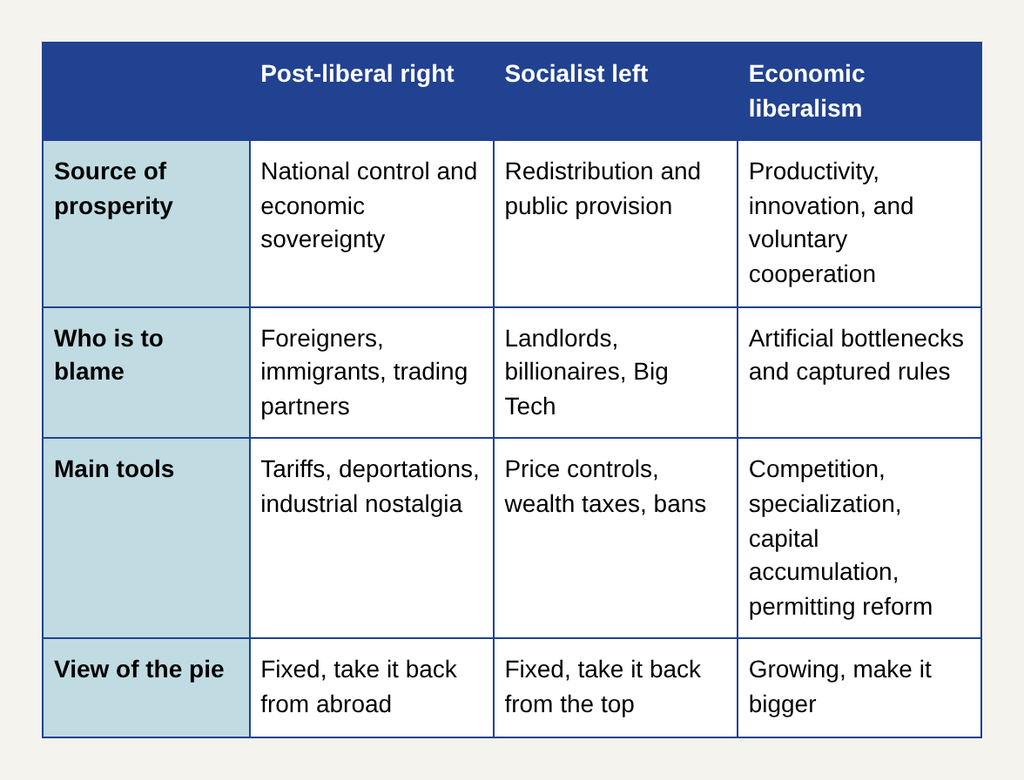
The midterms punished the first vision for failing to deliver affordability. The second gained ground in a pragmatic vacuum. But neither has an answer to the arithmetic of the cost of living, because you cannot redistribute your way out of a shortage.
I hope both parties move away from these illiberal extremes and closer to economic liberalism. We need an agenda of removing bottlenecks to prosperity and unlocking productivity, competition, innovation, specialization, capital accumulation, and voluntary cooperation. That is what made America rich. It is what can make America affordable again. And it is what FEE is teaching the next generation.