
It’s all about how and where.
It seems that everyone is talking about data centers these days; they’ve taken over the Internet with memes and conspiracy theories. As a computer professor, I decided to apply an academic research regimen to the situation and cut through the exaggeration and emotion that often accompany these current polarizing issues.
Two important points to begin with: AI’s water and power usage. As I have demonstrated in my previous article, data centers use about 0.02% of the water supply in the US according to recent sources, and most future data centers are already planned to use advanced cooling technology that requires very little water. While it is true that data centers require a lot of electricity, their impact on power systems and customers has been greatly exaggerated. Bloomberg’s often-cited piece on the subject mentions that at the highest instance, one area of the country experienced a 267% increase in wholesale costs. This data describing one area in one instance has been used incorrectly to state that it is the expected or average raise (rather than the high end), and it doesn’t even account for the fact that this is wholesale power costs, which does not translate directly into consumer costs. (Often the tech companies will offset these increases.) What this data does tell us is that there are places where we simply should not build data centers. This is one problem that should be avoided. The other problem is companies acting unethically.
One of the most egregious examples of unethical data center implementation is xAI’s Colossus near Memphis, Tennessee. The company promised years ago that it would not rely on local water supply for cooling. Not only does it continue to use local water daily, but the proposed solution has been delayed. In addition, xAI ran as many as 35 unpermitted methane gas turbines at Colossus 1 beginning in June 2024, generating up to 421 MW without any preconstruction or operating air permits under the Clean Air Act. If there was ever an example of how not to build a data center, it is this one.
Another prime example is Project Blue in Tucson, Arizona. Beale, the project developer, actively deceived the city and used the local water supply to clean dust from the data center. And they used a lot of it. This caused Tucson to shut down its water supply. Not only that, but city staff and Amazon had signed an agreement to keep knowledge about the center secret from its residents for three years. It’s no wonder that many communities are suspicious of tech companies coming into their neighborhoods and deceiving them about their plans and the benefits they will bring.
There are cases where companies are unethical in their approach to data centers, and there are cases in which the location is just not suitable. Sometimes, both points of failure occur. Colossus 1 is an example of both, where the deception was extreme and its use of water is actively causing problems with the local aquifer.
An example of poor location choice but good ethics is Microsoft’s West US 3 in the Phoenix area. Microsoft separately agreed to invest $40 million directly into the water utility. Microsoft is testing a new zero-water cooling strategy, and it published its water use and other relevant information in its Environmental Sustainability Report. However, it built these data centers in the middle of an extremely arid, low-water area. There are reasons for doing this, but, generally speaking, drawing water from a nearby desert city’s supply is not ideal. It’s not entirely bad news, in that it has spurred Microsoft to invest in new cooling strategies that do not draw on the local water supply. This problem should not affect future data centers as much because of the new cooling technologies that require little to no water from the local supply.
You probably haven’t heard of too many examples of successful data center developments, and that’s partly because “something worked; everything is just fine” is not a common news story. However, CNN recently reported on exactly that: Quincy, Washington, is home to over 30 data centers and has experienced an incredible boom as a result.
The data centers now cover an estimated 57% of Quincy’s property tax revenue, funding a wave of public infrastructure projects: a $15 million aquatic center, a 143,000-square-foot indoor sports complex, a $120 million high school, a new hospital, library, police and fire stations, paved sidewalks, sewage systems, and a wastewater treatment plant.
Residential electricity rates in the county rose 3.5% last year, while large industrial users, such as the data centers themselves, absorbed a 9.1% increase. The data centers there are paying for their own added infrastructure and generation costs rather than spreading those costs to households.
Another advantage of this site is that it has abundant cheap hydroelectric power. As for water, Microsoft partnered with the city to build a $30 million water reuse facility. The only real caveat here is that the data centers generated so much revenue and development that housing prices have risen across the area.
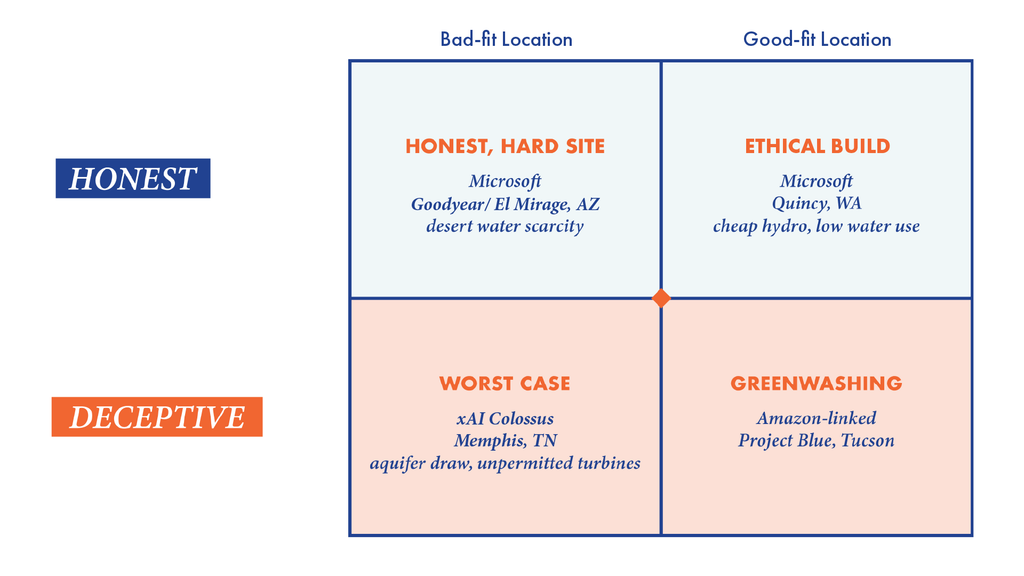
As you can see, there are definitely ways to build, and examples of ethical and beneficial data centers. The benefits to a local community are substantial. Not only do local tax revenues increase, but data centers come with the benefit of being a generally low-traffic, relatively quiet development. Revenues can increase without needing to build many new roads, or bring large amounts of noisy traffic.
This goes along with the fact that we simply need more data storage. Yes, AI is driving much of the current surge, but we have continually created more data and need a place to store it. We take pictures with our cell phones, leave voice notes, and write emails. With self-publishing, so many people now are writing books. So many songs are written and digital videos made. All of that goes into data centers. All of your apps: data centers. All of the Internet: data centers. Nearly all human knowledge is now stored in these data centers; they are the modern archives of human creativity, education, and achievement.
Efficiency gains in AI are real and dramatic. OpenAI’s Sam Altman has pointed out that ChatGPT models have become roughly 1,000 times more efficient at a given level of intelligence in less than two years. But this doesn’t mean data center demand will eventually shrink; it means the opposite. Every time a computing resource has gotten this much cheaper, historically we haven’t used less of it; we’ve found a thousand more uses for it. Drops in data-storage prices didn’t lead to people using less data; now no one deletes anything. Altman’s prediction that we will use AI and data in the same way that we use utilities such as water and the Internet will likely come true, and in some ways, it already has.
This is not only happening in the United States. China, Europe, the Middle East, and Southeast Asia are all rushing to build data centers, and they are encountering very similar issues. This is a global phenomenon, and, the way things are going, data centers will be as much a part of modern infrastructure as airports, phone lines, and railroads, which people once opposed. Farmers once believed sparks from railroad tracks would burn their land, and doctors at the time warned the human body couldn’t survive driving at speeds over 20 miles per hour. We see the same patterns of resistance to new technology repeated throughout history.
The truth is, data centers themselves aren’t the problem. Poor location choices and unethical business practices cause the failures we’ve seen. If we’re wise about where we build and who we trust, we can avoid the pitfalls and reap the rewards.