

But AI is not to blame.
Recently there have been a lot of memes and social media posts going around that claim that AI (because of its cooling requirements) is using up all of our water. Suggesting that, in fact, the crisis is so bad that we will soon be unable to take showers. Since I work in this field, I can tell from the surface that this is likely exaggerated, and I decided to take a deep look at the numbers, new AI cooling technologies, and what is causing the real global water crisis.
US Water Usage
Let’s just start off with some simple math. The United States uses about 81 trillion gallons of water a year. (US water usage has been going down in recent years.) Computer datacenters, the places where AI computing occurs, use about 17.5 billion gallons a year for cooling. (They aren’t directly using up water; it evaporates after absorbing heat.) This gives us:
17.5 billion gallons ÷ 81 trillion ≈ 0.000216 ≈ 0.02%
The 0.02% is one five-thousandth of all water usage in the United States. Also worthy to note, datacenters are not fully committed to AI. In fact, the two most common uses of computing power in datacenters are cloud services and the Internet. AI workloads are around 20% or less of datacenters, which is about one fifth. One fifth of our 0.02% is 0.004%, or one twenty-five-thousandth of all water usage.
It is true that AI use is predicted to grow in the future, but even if it grew to ten times the current amount, it would only be 0.04% of all US water usage. This is what simple math tells us.
New Cooling Technologies
Even though water usage is small for AI in a wide perspective, technology giants are aware that cooling solutions are inefficient. New technologies have already been implemented by Oracle and Microsoft that decrease water use in cooling up to 90%. These solutions involve closed-loop cooling, which means water that is used for cooling stays in the loop and does not evaporate. It is already being implemented in datacenters, so we should start seeing improvement in water use data soon. Besides that, there are other solutions on the way including direct on-chip cooling which cools the chips themselves, since they are the big heat generators.
The UN recently released a report that there are several regions in the world facing “water bankruptcy.” Irreversible damage has been done to some water systems that will cause drought and difficulty, now and in the future. The main culprits of this crisis: human mismanagement and climate change. Cities in South America and the Middle East have already experienced nearly complete depletion of water supply. Governments and citizens in these stressed regions must act quickly, make compromises, and adapt to the situation with a long-term view to move forward.
Around the world, about 72% of water used is for agriculture. Next, we have electrical power generation. The US uses less water for agriculture, but has a similar breakdown.
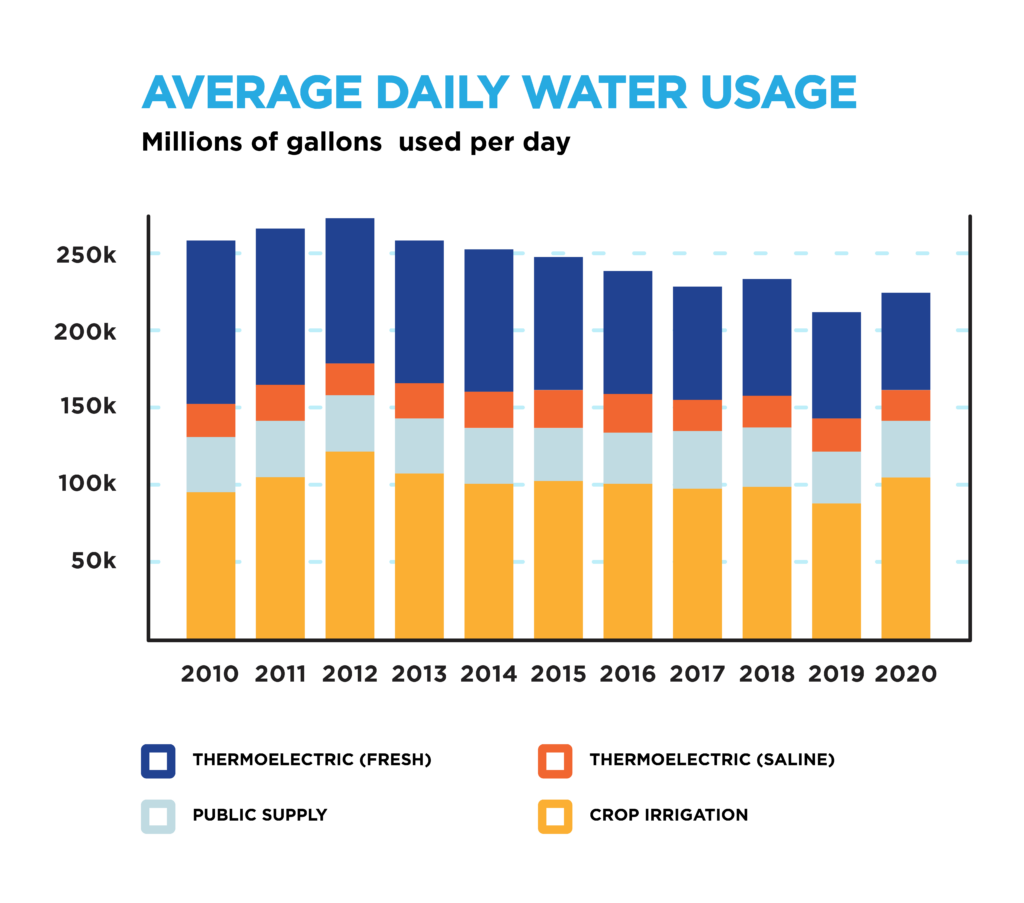
To make a real impact on water conservation, it would stand to reason that you would work on finding ways to use less water for agriculture and power generation. Datacenters are considered industrial use of water, and take up such a small percentage that they are not even depicted in the graph above.
Besides the governmental level dealing with the categories of agriculture and power, individuals can take steps that actually have a significant effect on water consumption. The main culprits of human domestic water use are lawn care and in the bathroom. If you have a lawn, and you’re watering all or part of it, this will be your main use of water. When I lived in California during a drought, I saw many people convert their lawns to rock and plant gardens, something referred to as xeriscaping. This can save up to 75% of a household’s water use.
The next biggest culprit is our toilet. In fact, I would like to make the toilet the new main villain in this drama. Older toilets are not efficient and can use up to four gallons per flush. Have you ever heard the toilet running when it should have stopped? That also can be a huge source of water waste. You may have lived in a drought area in the past where you were instructed to flush the toilet only when there is solid waste in it—that’s because it’s the best method (besides lawn conservation) to conserve water.
I’d like to end with some more simple math. Let’s put our new villain, the toilet, up against the original suspect, AI. For our experiment we will use the average standard US toilet which is 1.6 gallons per flush. For our AI we will use standard ChatGPT queries, and to make it worth comparing, we will use the benchmark of 10 queries, since most people usually ask more than one question at a time.
Toilet flush = 1.6 gallons ≈ 6 liters = 6,000mL
10 ChatGPT queries ≈ 250mL
6,000 ÷ 250 = 24
So, our single flush uses around 24 times as much water as 10 ChatGPT queries, or to make it simpler, it is the same as 240 ChatGPT queries. This is using an estimate of direct and indirect AI water usage, so it is on the higher end. Even image generation is only estimated to use a little bit more than a standard query (though estimates for this vary). This means that to have a real water-saving impact, it is more powerful simply to flush less, manage your lawn use, and take shorter showers.
There is a water crisis in many regions across the world, but AI is not the cause or even a contributor to it. The main causes of the water crisis are climate change and mismanagement.
We have seen that AI water estimated usage is less than 0.02%. Other sources of water use such as agriculture and power (on the national level), then lawns and bathrooms (on an individual level), greatly dwarf any use by datacenters. One more fact for you, the cost in water to produce just one piece of standard paper: 5 liters. So the next time you waste a piece of paper, it’s about the same as 200 ChatGPT queries, or one flush of the toilet.