
EU regulations may block easyJet sale.
On August 6, the budget airline easyJet formally announced its acceptance of a £5.7 billion ($7.7 billion) takeover bid from the US private equity firm Apollo Global Management. Apollo topped a rival offer of £5.5 billion ($7.5 billion) from Castlelake (another US private equity firm), and received the backing of easyJet’s Cypriot-British founder Stelios Haji-Ioannou, whose family retains a 15% stake in the company. If completed, the deal would return the airline to private ownership after 26 years on the London Stock Exchange—but doubts about its compliance with EU regulations look likely to delay the process.
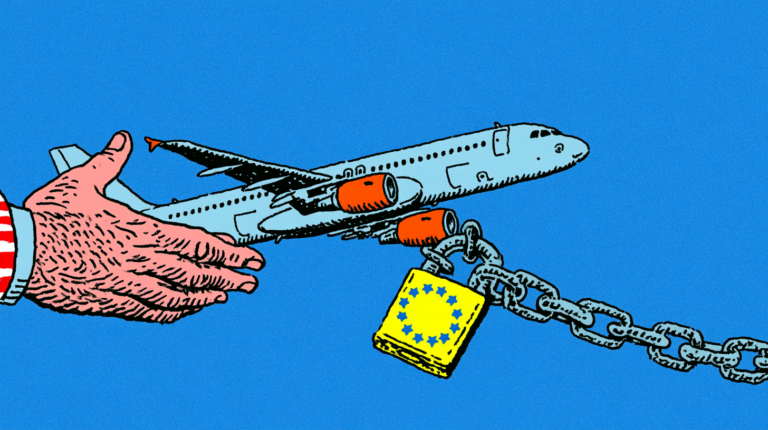
Under EU law, European airlines must be majority-owned by EU citizens or entities. On July 22, Reuters reported that the EU Commission is scrutinizing the Apollo bid to ensure that it complies with these regulations, causing easyJet’s shares to drop by almost 12%. They have since rebounded, but would likely take another hit if the EU Commission blocks or delays Apollo’s takeover. If Brussels gives its approval, the deal is expected to be finalized by March 2027 (assuming also that it receives majority approval from easyJet’s shareholders).
This is a reversal of the situation after the 2016 Brexit referendum, when the airline itself was placed under scrutiny by EU officials. Following Britain’s vote to leave the EU, both easyJet and Ryanair were told by Brussels that they needed to relocate their headquarters and/or sell the majority of their shares to EU citizens in order to keep operating across the continent. easyJet solved the problem by opening a European office in Vienna, although its overall base of operations has remained in Luton, 30 miles north of London. New York-based Apollo has revealed few details about how it proposes to adhere to Europe’s airline ownership regulations, under which its stake is capped at 49.9%.
Some aviation experts have noted that Apollo could satisfy Brussels by leaving majority voting rights with EU stakeholders, but still restructure or break up the airline to gain overall economic control. It would probably take the EU years to review the new ownership structures, prompting one analyst to tell Reuters: “It might even be that Apollo achieves its target of exiting and relisting easyJet by 2034 with a 20%+ return before the EU has worked out its review.”
Ownership and antitrust legislation are the main reasons why there has been just one serious attempt to acquire easyJet in recent years, from rival low-cost carrier Wizz Air in 2021. But the company’s attractiveness to investors is obvious. Founded in 1995 by the then-28-year-old Ioannou, easyJet initially operated just two routes, from Luton to Glasgow and Edinburgh. Easily recognizable with its distinctive orange-and-white branding, its 356 aircraft now transport almost 100 million passengers between 164 European destinations annually. In 2025, easyJet posted pre-tax profit of £665 million ($901 million), a 9% increase on 2024 and the third consecutive year of growth. The airline’s operating margins increased from 5.8% in 2023 to 7% last year, boosted by its package-holiday operation, easyJet holidays. Last year, this part of the business generated 38% of easyJet’s total profits on around 11–12% of the revenue.
easyJet also has assets that could potentially be broken up and sold off to increase the return on Apollo’s investment. A 2024 study by the International Air Transport Association found that 60% of the world’s commercial aircraft are leased rather than owned by airlines, a figure that rises to almost 70% in Europe. easyJet, however, owns 205 of its 356 planes, equivalent to 58%. It also holds valuable departure and arrival slots at several of Europe’s most congested airports, including Gatwick (London), Paris, Milan, and Amsterdam, and has increased its capacity in this area by 20% compared to pre-pandemic levels. These slots are big business in themselves: in 2016, Oman Air paid Air France–KLM a record $75 million for a pair of slots at London’s Heathrow Airport. If Apollo is in this for a quick buck, the options are plentiful.
One can see why the easyJet board was impressed by Apollo’s bid. The private equity giant offered the airline £7.15 ($9.70) per share, an 81% premium compared to easyJet’s closing share price of £3.94 ($5.30) on May 28, the last business day before Castlelake’s takeover attempt became public. That would yield a profit of £3.21 ($4.40) per share, although shareholders have also been given the option to roll over their stock into the new financial structure (whatever that might be). In making its offer, Apollo said that easyJet’s strong brand and budget offering would not be changed, although its fleet will be “upgauged,” a development that rival low-cost carriers like Ryanair and Jet2 will follow with interest. Apollo also wants to scale the airline’s booming holidays business into a “structurally differentiated earnings stream”—although again, it’s not clear what, if any, changes that will bring for customers.
Some analysts have speculated that Apollo will use EU proxy operations to satisfy ownership rules while effectively gaining economic control of easyJet, emulating the setup at International Airlines Group (IAG). A Spanish-registered company based in London, IAG owns British Airways, Spanish carriers Iberia and Vueling, and Ireland’s Aer Lingus. It lists shares on the London and Madrid stock exchanges, with Qatar Airways holding the largest stake at 25.1%. Though IAG’s subsidiary entities preserve their brand identities and accountability to local management, the group’s directors are “responsible for managing and allocating capital, driving overall Group performance and setting the agenda for sustainability and innovation.”
Within Europe, strict competition regulations are the biggest hurdle to airline takeovers, as IAG discovered a few years ago. In 2019, it announced plans to acquire the Spanish carrier Air Europa for €1 billion ($1.2 billion), initially planning to incorporate it into Iberia while retaining the former airline’s unique branding. The EU objected on the basis of reduced competition, not only on domestic and European routes, but also on those connecting Spain with the Middle East, as well as North and South America. IAG dropped its bid in 2024, having decided that the extra requirements to appease the EU Commission made the deal financially unviable. (More recently, Spain’s Socialist prime minister Pedro Sánchez was cleared in a conflict-of-interest case related to Air Europa’s €475 million—$555 million—state bailout in 2020.)
Perhaps the most crucial part of the Apollo takeover will only begin if the EU determines that further ownership and control conditions have to be met. But whatever Brussels decides, this case is already testing limits in Europe’s intensely competitive budget airline industry. If the deal goes through, Apollo will have set new limits.