
Spain opposes the EU’s deregulation drive.
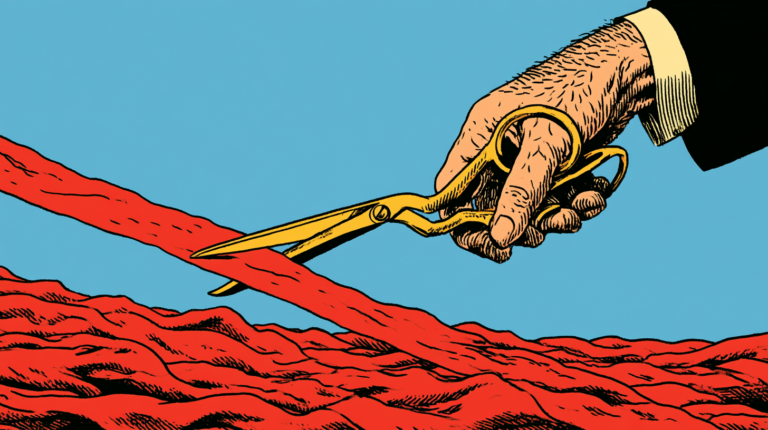
For the last couple of years, the EU has been on a mission to make European businesses more competitive through a process it calls “simplification.” This means slashing red tape—especially in the form of reporting and compliance obligations—by 25% for all companies, and at least 35% for SMEs. Backed by Germany, Italy, and the Nordic countries, the project is said to have already saved EU companies €15 billion in administrative costs, almost halfway to the €37.5 billion savings goal set by Brussels for 2029.
Europe’s deregulation revolution started with a 2024 report by former president of the European Central Bank Mario Draghi. Draghi recommended an overhaul of the EU’s regulatory system, as well as increased investment, to enable the bloc to compete on a more equal basis with the US and China. The EU Commission responded last year by unveiling ten “omnibus” packages, each of which targets a specific industry. Coming from an institution that has been infatuated with bureaucracy for most of its history, some of these are surprisingly aggressive: removing 80% of European businesses from the Corporate Sustainability Reporting Directive, for example, and conducting just one on-the-spot check per year of each of the bloc’s farms.
For Spain’s Socialist prime minister Pedro Sánchez, this is not a liberation for EU businesses, so long entangled by centralized compliance procedures, but a threat to the bloc’s stability. Speaking via video link at the EU parliament on June 9, he said: “Some will say that to compete, you must deregulate. Those who say that are often the very same people who [led] the world into the financial crisis with that same regime.” Sánchez claimed that the real question was not “about having more or fewer laws or rules,” but “having good rules and laws”—and that, by implication, the deregulation initiative risks throwing out lots of “good” rules.
But what makes “good” laws in this context? For industry lobbyists and the EU right (which dominates the bloc’s parliament), ones that enable companies to grow and innovate, so that they can compete better with China and the US. But for the European left, of which Sánchez has emerged as the unofficial leader, regulation must further Brussels’s aim to be the world’s first climate-neutral continent by 2050. On the way to that milestone, the EU wants renewables to account for 42.5% of its energy mix by 2030 (currently, that figure is at 25%).
Inspired by the Draghi report, the EU leadership wants to do both. It is convinced that regulatory “simplification” will boost companies’ competitiveness as well as their climate credentials, by freeing up more of their budgets to make the technological changes necessary for both. But this seems overly optimistic. To take just one example, there is widespread anger in Europe’s agriculture industry at Brussels’s environmental regulations, which farmers say severely hamper their competitiveness—especially given the proliferation of cheap imports from South America’s Mercosur bloc.
These frustrations have triggered large-scale tractor protests over the last few years, most notably in France, Belgium, and Spain. Yet if the EU expects its climate agenda to be unaffected by a relaxation of compliance regulations within the agriculture sector (as detailed in the relevant omnibus, announced last May), it is surely deluded. This, of course, applies to every other industry too. If increased competitiveness is the priority, then climate goals will have to take second place, at least until 2029.
Sánchez is right to say that lack of effective regulation contributed to the financial crisis of 2008 (although it wasn’t the sole cause). But adherence to unbending, blanket legislation can also cause fiscal stagnation. In 2010, the economies of the US and EU were roughly the same size—but since then, they have diverged significantly. One report identifies a comparative lack of trade dynamism in the EU as a factor, “suggesting regulatory and administrative barriers in the single market.” Centrally-imposed fiscal rules can exacerbate problems, too: the eurozone debt crisis of 2009 was significantly worsened by countries’ lack of fiscal autonomy—for example, by their inability to devalue their own currencies as a recovery mechanism. Sánchez knows this. In 2022, he successfully lobbied the EU for the so-called “Iberian Exception,” which helped Spain and Portugal deal with the energy crisis triggered by Russia’s invasion of Ukraine. What was this if not an admission that EU regulations can be too restrictive?
German chancellor Friedrich Merz is the most enthusiastic advocate of EU deregulation. He has called for a “one in, two out” approach, according to which every new EU law should be accompanied by the junking of two old ones. And there are plenty to dispose of. Since its founding, the EU has passed over 100,000 acts of legislation, and continues to do so at a rate of around 2,000 per year. It stretches credulity to claim that every one of these laws performs a positive function. According to a report by the European Centre for International Political Economy (ECIPE), the EU added 562 new pages to its Data & Privacy rulebook between 2016 and 2024, by which point the number of restrictions in that sector—as measured by use of the word shall—was almost 2,500. ECIPE cited a study by the Bank of Spain, which found that each new piece of regulation correlated to a 0.7% decline in employment in the affected area.
Merz has the support of Italy’s premier Georgia Meloni, who recently described the EU as a “bureaucratic behemoth that has too often sacrificed competitiveness, growth and strategic vision on the altar of ideological and technocratic approaches, thereby contributing to the continent’s gradual economic and geopolitical decline.” Merz and Meloni form what environmental hardliners see as a “Berlin–Rome axis” with the power to undermine the EU’s climate goals. “[A] blind faith in deregulation,” thundered The Guardian in February, “is not a remotely adequate strategy for the times.” Nor is an obsession with environmental policies when most major European economies—including Spain’s—are feeling more pressure than ever before from China and the US.
Industry leaders are taking full advantage of the deregulatory extravaganza. A recent report by Corporate Europe Observatory and LobbyControl found that Europe’s biggest industrial lobbyists (defined as companies with influencing budgets of at least €1 million a year) are spending €382 million annually on lobbying the EU, an increase of 50% from 2025. “All in all,” warn its authors, “we are witnessing corporate lobbyists with bold and increasing powers to influence policy, a public that is largely in the dark about what is happening, and the biggest deregulation wave ever seen in the EU.”
Sánchez is right to warn against the dangers of excessive deregulation, and to say that the quality of rules, not just their quantity, is crucial to their effectiveness. But this point actually bolsters the argument for deregulation, by implying that one “good” law is worth more than two “bad” or pointless laws. There are plenty of the former sort within the EU—but there are also lots of the latter type, too. A judicious trim of the bloc’s regulatory thicket is long overdue.