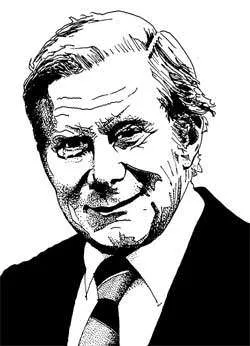
The Reverend Mr. Opitz is a member of the staff of the Foundation for Economic Education.
There has been a dramatic revolution in scientific thought in this century. The physics and chemistry of today’s world bear little resemblance to the schoolboy sciences of a generation ago. The revolution in historical study has been hardly less dramatic. Historical writing used to be largely composed of folk legends, narratives of kings and their wars, tales designed to inflate nationalistic pride, and the like.
But now history is conceived as the shadow cast by the evolving spirit of man (Gerald Heard), as the life history of cultures and civilizations (Spengler and Toynbee), or as the effort to understand the development of the present out of the past as an organic process, as with Christopher Dawson.
Heard’s major contributions have been in other fields than history, but Dawson as an historian invites comparison with Spengler and Toynbee. These two men have gained spectacular popular success, whereas Dawson has not. But Dawson is the most prolific of the three, and there are those who would argue that he is a more profound thinker than either Spengler or Toynbee. In any event, penetrating essays on each of these men, as well as other essays on the histories of Augustine, Gibbon, Marx, and H. G. Wells, are included in a new anthology of Dawson‘s writings from 1921 to 1954, entitled The Dynamics of World History (Edited by John J. Mulloy.
This book is highly recommended, alike to those who are interested in probing into mankind’s curious and vagrant history and to those whose main concern is to get out of the mess we are in but who realize that no remedy is much good unless it proceeds from a sound diagnosis.
Who Is Christopher Dawson?
Libertarians with long memories may be wondering where they have heard the name Dawson before. Perhaps it was in Ralph Adams Cram’s review of Nock’s Our Enemy, the State. After a glowing endorsement of Nock’s book, Cram said he would add only one thing: a recommendation that it be read along with Dawson‘s Religion and the Modern State<.
This book appeared in 1936. Among other things, it is an analysis of totalitarianism which sees that its mistaken ideas about economics and government are symptomatic of a deeper illness. The philosophically minded person reflecting on the contemporary scene must ask: Why these mistakes at this time? Totalitarianism, Dawson contends, is the inevitable backlash following the uprooted liberalism which gained ascendancy in the nineteenth century.
Persons in Community
Several factors in that century conspired to deprive men of the lively appreciation that they are parts of the whole cosmic process and utterly dependent on it. An awareness of this relationship is the seed from which religion grows, flowering finally into a system of convictions about the nature of the cosmos and the moral obligations imposed by this nature. But there was a wing of liberalism which reduced religion to the level of a private idiosyncracy, as private and as irrational as the taste for catsup on ice cream. There are idiosyncratic elements in the historic religions, to be sure, but there is more. There is, in every vital religion, a system of ultimate values and beliefs which gains the assent and personal commitment of a significant number of people in any given society. This is the bond that joins persons in community; without it society cannot be a going concern.
The features which differentiate one society from another are structures and patterns precipitated by generations of commitment to a common set of values and beliefs; “behind every civilization there is a vision.” Human frailties being what they are, no society will live up to its pretentions, but the striving of a significant number of people to do so permits “a growing capital of social tradition.” This tradition is capable of molding, as well as being molded by, its component parts. This is obvious enough to anyone who is not color blind and tone deaf in respect to history.
Some nineteenth century rationalists appear to have been so afflicted. Nothing registered with them except abstract individuals capable only of nursing private satisfactions and pursuing private advantage. If this be the reality, the course of conduct is readily deduced: Follow self-interest, impede it slightly with moralisms extracted from the lately discarded religion, let everyone be on guard, and then a free for all.
The psychology here is faulty, stemming, as it did, from an inadequate cosmology. In due course it was to spell itself out into a collectivist ideology. For the concrete person as he appears in any historical society — as distinguished from the abstract individual of rationalist fancy — has the capacity for larger loyalties than he can contain in the effort to maximize private satisfactions. In the absence of a proper object of his loyalties — which it is the function of high spiritual faith to supply — he is susceptible to mob masters who dragoon him into bending the knee to the mortal god state.
Legitimate Materialism
Thus the totalitarian drift, as Dawson helps reconstruct it, is the agonized effort of the modern world to fill the void created when the traditional faith failed to keep itself contemporary. “A society that loses its religion loses at the same time its principle of inner cohesion,” after which it attempts in vain to brace itself with outer compulsion.
Dawson is a religious man and writes from within the Roman communion, but he gives full weight to the importance of material factors. “Underlying the historical process and the higher activities of civilized life,” he writes, “there are the primary relations of a society to its natural environment and its functional adaptation to economic ends . . . In a thousand ways human life is conditioned and determined by material factors, and there is a legitimate materialism which consists in the definition and analysis of these relations.” Some students of man go no higher than this level. “But,” according to Dawson, “a culture is not merely a community of work and a community of place; it is also, and above all, a community of thought, and it is seen and best known in its higher spiritual activities, to which alone the name of culture was first applied. If is impossible to understand or explain society by its material factors alone without considering the religious, intellectual and artistic influences which determine the form of its inner cultural life.”
A culture is something cultivated; “it is a work of art, a triumph of human inventiveness and endurance, and it is the fruit of an age-long cultural tradition… Social progress and the very existence of society itself are the results of the creative force of human personality.” There is thus a reciprocal relationship between individual persons and their respective societies.
Platform for Planning
But the isolated “individual” of some thinkers is a mere symbol, extracted for ease of manipulation from the concrete persons whom we actually confront. In our experience there are only actual people who are always citizens of a given nation, communicants of a certain religion, followers of a chosen occupation, full of prejudices, heirs of one of the strands of tradition, and so on. We never experience an “individual,” conceived of simply as a manifestation of essential humanity stripped of the above “accidental” variations. “A great culture,” Dawson writes, “sets its seal on a man, on all that he is, and all that he does, from his speech and gesture to his vision of reality and his ideals of conduct.” It is neglect of this truth — i.e., that a culture is an integrated whole and not simply a collocation of separate parts — which prepares the stage for the planner armed with political power.
Spiritual Freedom Threatened
Given the picture of a disintegrated society of self-seeking units “we are too apt to believe that everything would go well with the world if only we could enforce common standards by universal economic planning and some form of political world organization.”
To avoid that danger, we need a vital contact with Christendom in its broad sense — our western heritage of religion, science, scholarship, and literature. It is precisely at this point that Dawson proves so admirable a guide.