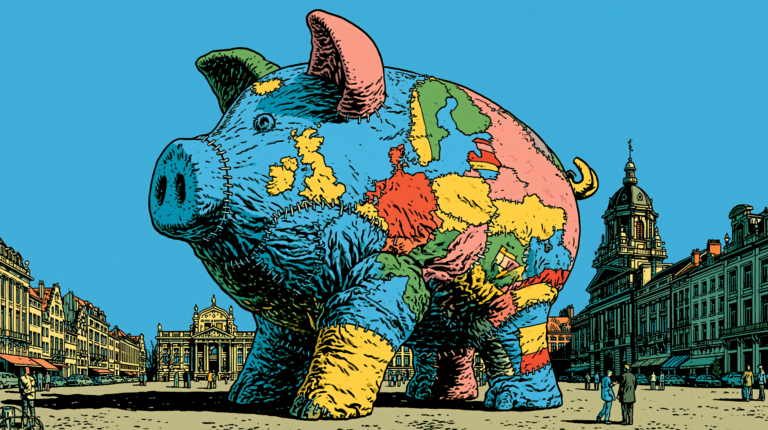

The EU’s next seven-year budget will be the most contentious to date.
Every seven years, the EU approves a new budget, known as a Multiannual Financial Framework (MFF). The next MFF will cover the period 2028–34, and has been described by European Commission president Ursula von der Leyen as “the most ambitious ever proposed.” It has to be approved unanimously by the end of 2027, but with general elections due in almost a third of the bloc’s 27 countries next year (France, Italy, Poland, Spain, Greece, Estonia, Finland, and Slovakia), the pressure is on to have negotiations wrapped up by Christmas. After a two-day summit in Brussels on June 18 and 19, however, only one point of agreement had been reached: to bring new funding ideas to the next brainstorming session in October.
This task will mainly fall to Ireland, which takes over the six-month presidency of the Council of the European Union from Cyprus at the end of this month (usually a meaningless administrative position). Dublin’s challenge? To put some substance behind the hot new phrase in Brussels: “new own resources.” These are proposed new funding streams to help finance an MFF of €2 trillion ($2.27 trillion)—equivalent to 1.26% of the bloc’s combined gross national income—without further raiding capitals’ coffers. The ideas on the table so far include sharing cash generated by the sale of CO2 emissions permits, a cluster of green taxes, and a windfall levy on the bloc’s biggest companies. Whatever they are, these new resources have to bring in around €66 billion ($74.94 billion).
It will take more than Irish ingenuity to resolve other major difficulties, which threaten to make this MFF—described by German Chancellor Friedrich Merz as “unacceptable and unbalanced”—the most contentious in the EU’s history. As usual with economic disputes, the bloc is split into two main camps—the so-called “Frugal Five” in one, formed following the Brexit vote of 2016, and sixteen other countries, known as the “Friends of Cohesion,” in another. But the divisions aren’t as neat as that, nor is the debate focused exclusively on the size of the budget. Another crucial question is whether the MFF needs structural overhaul if the EU is to deal with a geopolitical situation that has changed significantly since 2021.
The “Frugal Five,” four of which are led by center-right governments, are amongst the EU’s nine net contributors—that is, countries that pay more into the MFF than they receive. The group is made up of Germany, which in the last EU budget contributed €25.5 billion ($28.95 billion) more than it got back, the Netherlands (€7 billion more than received), Austria (€1.5 billion, $1.7 billion), Finland (€1.1 billion, $1.25 billion), and Sweden (€2.8 billion, $3.18 billion). It supports the substantial hikes in competitiveness and defense spending proposed for the next MFF, which will take the total allocations in those areas to €400 billion and €130 billion ($454.18 billion and $147.61 billion), respectively. The group also opposes common debt financing and the deferment of Next Generation EU (NGEU) repayments. Introduced in 2021 to help countries recover from the Covid pandemic, the NGEU scheme was financed by bonds issued on international markets; these begin to mature in 2028, so €170 billion ($193 billion) has been set aside in the next MFF to fund repayments.
The Frugals also favor the biggest proposed structural change to the next EU budget. This affects the Common Agricultural Policy (CAP) and “cohesion” funding for the bloc’s poorest regions and members, which jointly accounted for almost two thirds of the previous MFF. The EU Commission proposes that these two funds be merged into one, which would streamline funding plans from over 500 to just 27—one for each member state. This is effectively a nationalization proposal, designed to give EU capitals more flexibility in the deployment of agricultural and cohesion funds. It is in line with the bloc’s massive deregulation drive, which aims to cut administrative costs by almost €40 billion by 2029 ($45.42 billion). As von der Leyen said last year: “[A] lot of redundancy and overlapping is basically wasting potential that we cannot unlock.”
Some countries that one might have expected to be members of this camp remain outside it. Italy has criticized what it calls an “anachronistic” rebate system which sees Denmark (another net contributor, although it quit the original “Frugal Four” last year), Austria, Germany, the Netherlands, and Sweden receive discounts to their outsized contributions. Italian premier Giorgia Meloni claims that unless the scheme is scrapped, she will start requesting rebates for Italy, too (in 2021, Rome paid €3.3 billion, or $3.75 billion, more into the MFF than it received). France is also hard to pin down: although it was the bloc’s second largest net contributor after Germany in 2021, paying in €12.4 billion more than it received ($14 billion), it too remains apart from the Frugals. French president Emmanuel Macron’s stance that it is “idiotic” to start repaying NGEU loans in 2028 pits him firmly against the group—as does his call for permanent mutual debt schemes.
Against the “Frugal Five” are the “Friends of Cohesion”—sixteen countries from Central, Eastern, and Southern Europe. Politically, it’s a mixed group: ten of its national governments are center-right, three center-left, two centrist or cross-party coalitions, while Romania has no functioning government at all. All except Italy are net beneficiaries of the MFF, meaning that they receive more—€10 billion more ($11.35 billion), in Poland’s case—than they pay in. They want more mutual debt, a deferral of NGEU repayments, and less spent on defense and competitiveness, on the grounds that all these will draw money away from the CAP and cohesion schemes. France, while not a formal member, also opposes CAP cuts, because it is the biggest recipient of agricultural funding in the EU (some might find it surprising that Germany, despite being the third largest CAP recipient, is the unofficial leader of the Frugal Five).
This group is dismayed by the EU’s proposal to combine the CAP and cohesion funds. It points to the fact that the EU is ringfencing just €300 billion ($340 billion) for agriculture, down from €386 billion ($438 billion) in the last MFF—a cut of 30% that is unmatched in the new budget (although a safety net specifically aimed at farmers has been doubled to €6 billion, $6.81 billion). The €220 billion ($250 billion) of cohesion funds set aside specifically for poor regions, they say, is also insufficient. The interconnectedness of EU financing, however, ensures that there are ways to compensate for reduced handouts. If less is available in direct grants, perhaps the entrepreneurship and competitiveness encouraged by streamlined funding will play a bigger role in boosting disadvantaged regions.
That said, the group’s objection that it is unfair to slash or reorganize just these funds is not without foundation. Brussels still plans to spend €100 billion ($113.5 billion) on administration over the next seven years, and create 2,500 more jobs at the EU Commission, which already has a staff of 35,000. So much for deregulation.
What strikes one most about these negotiations is how conservative the Friends of Cohesion are, and how change-minded the so-called conservative nations are. The point on which they all agree is that the world is a very different place now compared to seven years ago. But more money, or the same amount of money going to the same places, is not the answer. Ways of thinking need to change, to enable experimentation with the financial structures that underpin the MFF. It is those that determine effective spending. Hopefully, when EU leaders next convene in October, there is more consensus on that point, too.