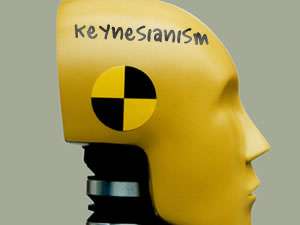

When I was in graduate school, some professors insisted that Austrian economics “failed the market test” of academic economics. Now one must consider that the “market test” is acceptance, so what they really were saying is that Austrian economics was not accepted because it was not accepted, which is not economic thought but rather circular logic. Nevertheless, many in the economics profession believe theories are true because other economists believe them.
Another thing I constantly heard in grad school was: “We are not interested in your inputs. We care about your outputs.” In other words, they were not going to judge my work on the basis of my own efforts, but rather what I produced. The first paper I read in grad school was Milton Friedman’s 1953 classic, “The Methodology of Positive Economics,” which said that the accuracy of a theory did not depend upon the reliability or reality of its assumptions, but rather on the theory’s ability “to predict events.” To put it another way, the outputs of analysis are much more important than its inputs.
I cannot say I disagree completely with that. Bad theory will produce bad outcomes, yet when one puts together the so-called market test with outcomes-based theory, something does not make sense. Why? There is no worse theory out there than Keynesian theory, yet it is taught in the economics textbooks as though it were an unvarnished truth.
The fundamental tenet of Keynesianism is that there cannot be a simultaneous rise in inflation and unemployment, the Phillips Curve being the Holy Grail. However, when the U.S. and British economies suffered severe stagflation during the late 1970s, people began to wonder what was happening.
I specifically remember seeing ABC’s economic correspondent, Dan Cordtz, around 1979 say that the theory no longer was working, as inflation and unemployment were increasing at the same time. It was then that the supply-side theory–cutting taxes and encouraging capital formation and production–appeared, and while I have had some real disagreements with the supply-siders, nonetheless they made some good points.
The Keynesians, led by President Jimmy Carter’s advisers and leftists such as John Kenneth Galbraith, declared such notions as cutting taxes and encouraging capital formation to be nonsense. The cartoonist Bill Mauldin, after Ronald Reagan adopted the supply-side model for his campaign, had a picture of Reagan throwing gasoline (labeled “tax cut”) onto the raging fires of inflation. The New Republic declared after Reagan’s election that his policies would lead soon to wage and price controls. Instead, the Consumer Price Index settled into its lowest increases in more than a decade and the economy grew nicely after the 1982 recession.
One would think that this episode would discredit the Keynesian paradigm, but it seems that the beast has more lives than a magic cat. Today the economics textbooks are dominated by Keynesian theories and Paul Krugman, who openly espouses the Keynesian paradigm, is the latest winner of the Nobel Prize in economics despite the fact that every Keynesian “solution” that the government has applied to the economy has not stopped the economic freefall.
Surely we are speaking of the failure of the Keynesian paradigm to produce satisfactory “outputs,” yet even such failures have not derailed this ideological train. Are we supposed to assume that even with its lack of ability to predict anything, that Keynesianism still “passes the market test”?
If one compares the Austrian analysis with that of Keynesianism, one sees that Austrian economics wins hands down. Not only have the Austrians been precise in their assessment of how the financial bubbles have brought down the economy, but also they have accurately demonstrated–through their theories–that the current government plan of borrow-and-print-money-and-spend-wildly is not going to revive the U.S. economy.
If there is a real “market test” of economic theory, it is the test of accuracy. That academic economists are not willing to junk their Keynesian theories for something that really works is not “proof” that Keynes was right. Instead, it demonstrates that many economists prefer to keep their heads in the sand.