
Noah Smith recently pushed back on a familiar piece of online discourse: that the American middle class is gone, squeezed out of existence. The tweet he was replying to offered an even more novel theory, that the middle class “was a 50-year fluke designed to prevent a communist revolution during the Cold War.”
Because that is how the world works, apparently: a small minority conjures social classes into existence, then dissolves them according to its political convenience.
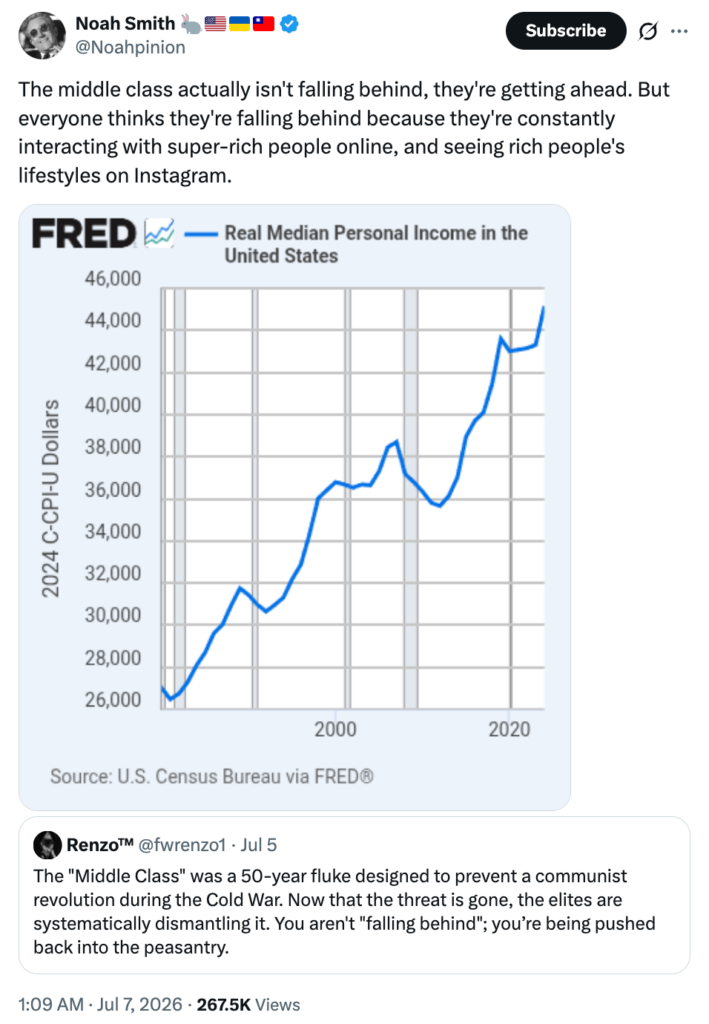
Let me be clear that I do not believe all is fine with the American middle class. I’ve written in this space against the misguided reflex of answering affordability complaints with income graphs. Yes, your income can go up, and you can still feel squeezed by the bottlenecks choking housing, education, childcare, and the American dream in general. That is why FEE is executing the Million Dollar Question campaign. Caring too little about the affordability crisis is precisely what opened the door for the rise of the DSA in American cities.
But here is the deeper question: Why is socialism the default response whenever the market system faces a challenge, even when that challenge can be solved by more market progress rather than less?
One answer I’ve scribbled about here before is what we may call the Rubin Paradox, after the late economist Paul Rubin: the species whose entire success rests on positive-sum cooperation is cognitively equipped only for zero-sum competition. Economic positive-sum thinking is not instinctual. Zero-sum thinking is absorbed the way we absorb speech; economic thinking has to be learned the way we learn to read. So when our Australopithecus brain faces new information, new challenges, new scenarios, it defaults to anti-economics.
But there is another answer, one that sounds antithetical to the Rubin Paradox and turns out to be complementary to it. It comes from Joseph Schumpeter.
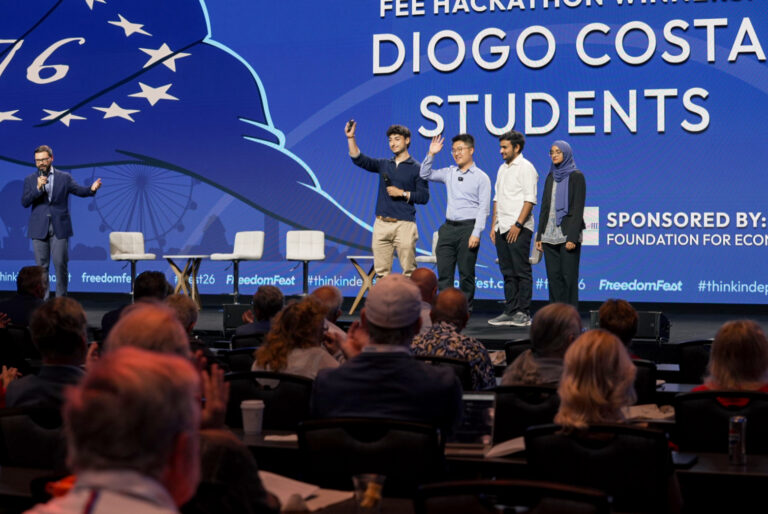
Last week, FEE brought 38 of the brightest and most ambitious students in the country to Las Vegas and presented them with a challenge: Can you use AI tools to create new applications that advance human prosperity and freedom? It was our second hackathon ever, a competition between coding teams in partnership with FreedomFest. The students had about 48 hours to ideate, design, and prototype a solution live in front of a panel of judges.
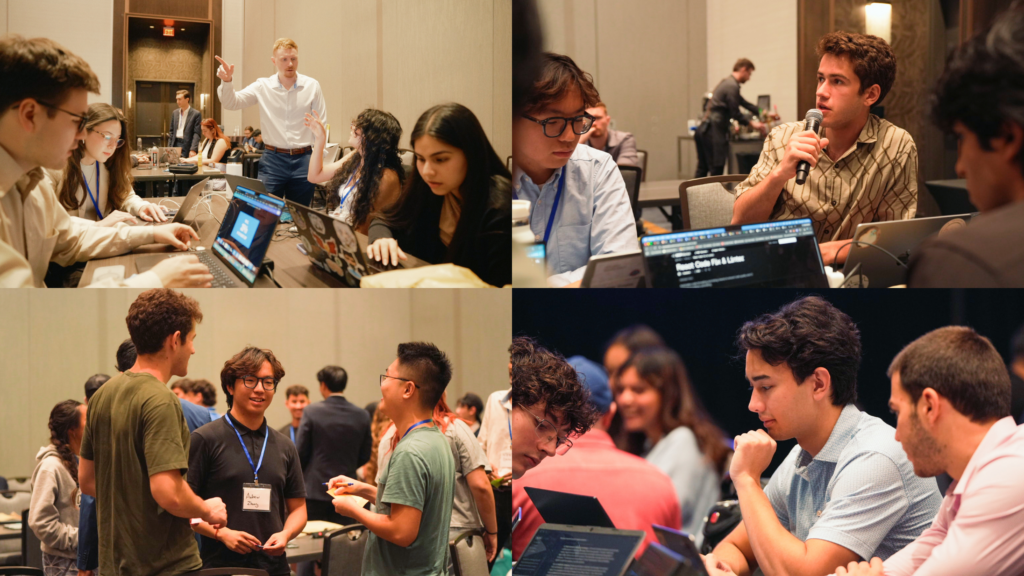
For years, FEE has developed the rising generation in sound economic thinking by training students in writing, videomaking, and content production. Now we are also teaching students how to build. In those 48 hours, they absorb FEE’s economic thinking while tinkering on projects of their own.
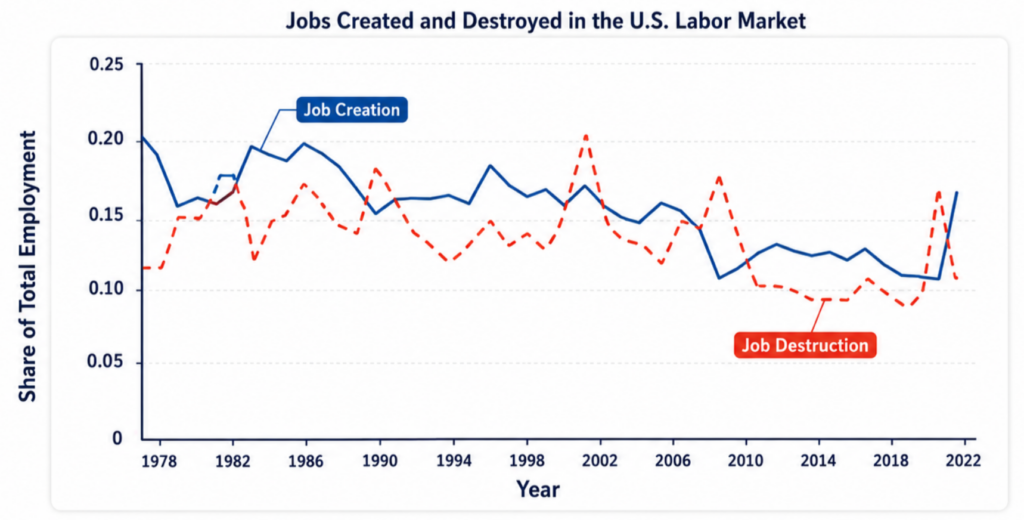
One of the sessions was led by Prof. John Dalton, on creative destruction. John went straight at the common misconceptions of anti-economic thinking. The fear of running out of jobs, he showed, is a symptom of the “lump of labor” fallacy. The human record shows there has never been a fixed amount of work waiting to be divided among the workforce. Job destruction has been commonplace throughout the modern history of economic growth, and job creation has followed the same trend. That is how progress happens: by destroying jobs that are no longer the most valuable use of a person’s time and moving labor into new and more valuable activities. That is creative destruction in the labor market. That is Schumpeter.
Now, Schumpeter is often misunderstood, because at the end of his long chain of creative destruction, his theory seems to predict that capitalism itself becomes the final victim. Socialism wins in the end and replaces the market system with command and control. Schumpeter’s picture of capitalism eating its own tail sounds like destiny, one more road arriving at the same socialist end of history that the Marxists promised.
Or does it? John Dalton reminded us that Schumpeter was not being fatalistic. He was sounding an alarm disguised as a prophecy. Schumpeter says so himself in the preface to the second edition to Capitalism, Socialism, and Democracy, where he rejects the charge of defeatism head on: “The report that a given ship is sinking is not defeatist.” What can be defeatist, he explains, is only how the crew takes the news. It can drown its sorrows, or it can man the pumps. Capitalism, Socialism, and Democracy was written for a crew he hoped would choose the pumps.
I agree with John, and I would add that Schumpeter’s criticism is as cultural as it is economic. This is where Schumpeter and Rubin diverge. Rubin looks back to our evolutionary past to explain the rejection of economic thinking. Schumpeter looks forward, into capitalism’s own future. Rubin’s paradox is inherited. Schumpeter’s paradox is manufactured along the way. As creative destruction advances, Schumpeter argued, a few things happen in that trajectory:
First, capitalism breeds its own critics. A growing economy demands ever more intellectual work, and therefore an ever-larger intellectual class. But intellectuals grow on criticism, so criticism of the market grows with the size of that class. And markets have no weapons to silence capitalism’s critics, because the very freedom of expression that enables the criticism is what allows creative destruction to prosper in the first place.
Second, capitalism becomes illegible. The market system is, for Schumpeter, an engine of rationalism and abstraction, and a capitalist economy grows more abstract over time. We move from the factory owner standing in front of a physical army of workers building material things to complex bureaucratic corporations producing abstract goods through abstract legal and administrative structures. At that level of complexity, value creation becomes blurry even to the workers inside the system. The defense of markets by its own producers weakens as the system grows more opaque.
Third, the two forces compound. The disruption of creative destruction combines with a general failure to understand the system, and both are amplified by an intellectual class with no interest in explaining the system or improving it, but every interest in bringing it down and replacing it with one where that same class sits at the top of the social pyramid.
Markets pay for the culture, and the culture returns the favor with an indictment. Hollywood is a creature of capital markets, and the reliable villain of its stories is the corporation. The result is the great and paradoxical weakness Schumpeter identified: as the market system becomes more economically powerful, it becomes culturally weaker.
The Schumpeterian picture, in other words, is the perfect storm for the Rubin Paradox. It finds in our anti-economic instincts fertile ground for breeding discontent against the market. The DSA surge in American cities is the storm in miniature: real bottlenecks in housing and childcare, caused by layers of regulation and restricted supply, and an intellectual class standing by with a zero-sum story that worsens the problem.
But notice what Schumpeter was doing by writing that book. He was educating us in the market process, and by doing so, reducing the power of anti-market intellectuals. Schumpeter was himself an intellectual. His life and work are proof that the intellectual class is not destined to be anti-capitalist. And his life is also the lesson in how to fight back: by teaching economic thinking to the world. What a free society needs is a permanent subset of the intellectual class permanently pushing against the anti-economic current of the broader class.
This is, in a sense, the oldest job description at FEE. Making the economic unseen visible is our founding tradition, running from Bastiat’s seen and unseen, through Hazlitt’s one lesson, to Leonard Read’s imaginative journey inside a pencil. A successful society running a complex economic system must feed and irrigate its educators in sound economic thinking.
And I mean educators in the broadest sense of the word, because we will need entrepreneurs to do this. As more individuals in a complex economy are alienated from the legibility of the system, we need builders to show them that the system is complex but not incomprehensible. Here, the new AI tools may be running Schumpeter’s abstraction dynamic in reverse. Schumpeter watched production drift from the visible factory owner to the anonymous corporate bureaucracy. But when one student can ideate, design, and ship a working application in 48 hours, production becomes individual and visible again. The builder starts to look less like a cog in an opaque machine and more like the legible proprietor of old, someone who can point at a thing and say, “I made this, and here is how.”
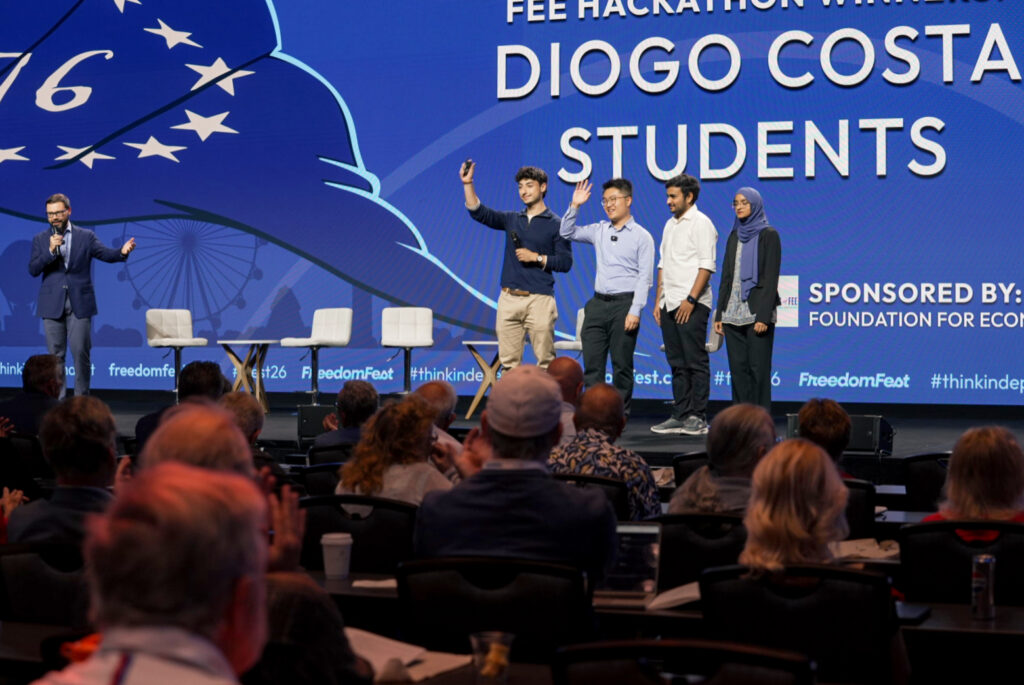
This is why FEE is teaching economic thinking not only to future writers, creators, and communicators, but to builders. We need that healthy intersection of people in the world of enterprise who can serve as the subset of intellectuals explaining prosperity and the process of creative destruction itself to new generations. Those who understand their own role in value creation must act as public intellectuals, and must support the individuals, projects, and organizations that promote the understanding of entrepreneurship. That is what our hackathon is creating: builders who grasp the economic principles behind human prosperity, agency, and flourishing, and who make the system legible through the things they make.
That is how we educate ourselves out of the Rubin Paradox. And it is how we educate ourselves out of Schumpeter’s paradox, too. We want a market system that is at once more economically powerful and culturally strong.