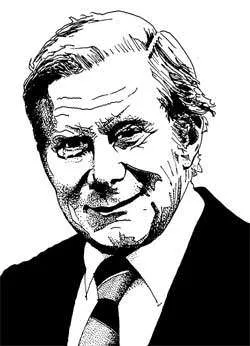
The Reverend Mr. Opitz is a member of the staff of the Foundation for Economic Education. This article is from a vesper sermon which he delivered at BeloitCollege in Wisconsin, March 6, 1960.
In the final of Eugene O’Neill’s play, The Great God Brown, the curtain opens to disclose a corpse on a couch. A policeman is standing by about to write something in a notebook with a stubby pencil.
“What’s his name?” asks the cop.
“His name is Man,” comes the reply.
“How do yuh spell it?” says the policeman.
Good question! How do you spell out what it means to be a man, or a woman, living in these days? This is not a question to be taken lightly, for the terms in which you think of yourself will determine in large measure the kind of person you will be, and the kinds of rewards life will offer you.
Do you think of yourself as a child of God? Do you think of yourself as a creature of the State? These are verbal symbols, and they have the power to shape your destiny in one direction or the other—depending on how you use them. You have to decide, and the decision is not an easy one.
Our grandfathers, in this respect, had an easier time of it than we. They may have been in error, but they were not in doubt. They were confident that they knew the secrets of the cosmos and the meaning of life; their churches gave them the answers. The old answers were good answers in their day, but nothing is more passé than answers to questions people are no longer asking. Is this actually the case in religion? Today’s verbal symbols are different, but perhaps the same old hungers are still with us.
Herman Melville shipped out as a cabin boy while still in his teens. With him he took an old guidebook to English towns which had belonged to his father. The ship docked in Liverpool and, book in hand, Melville set out to explore the city. Alas, the city for which the guidebook had been written had changed beyond recognition; the old landmarks had vanished. He lost his way.
This is precisely the kind of situation where religion, some kind of religion, will step in to offer its services. It is the business of religion to help man get his bearings in this strange universe; to remind him that, although he is a creature and not the Creator, nevertheless he is not the plaything of capricious forces; that, in some measure, and with God’s help, he can shape his own destiny.
But a doubt may intrude. Religious doubt did arise, as a matter of fact, and has been with us as a mood for a century or more. The doubter does not deny that traditional religion has been helpful to man in the past nor that it might be helpful to him today and tomorrow. All he says is that, as we now understand the universe, the kind of help religion once rendered is no longer available.
The premise behind this line of thought—prominent in the nineteenth century, but much less sure of itself today—is that science has explained the universe in purely naturalistic terms, dispensing with the hypothesis of God and thus with the need for religion. The modern mind, tutored by a smattering of science, is largely immersed in the view which conceives the world as a closed, interlocking system, self-contained, and operating according to unvarying rules which we can discover by experimentation.
Primitive Taboos
It seemed to many people that the new knowledge and power dispensed with the need for religion. And religion itself was partly to blame. At any given time primitive religion and religious superstition exist alongside of advanced and spiritual religion. These primitive elements came into acute conflict with modern knowledge. Real religion suffered by association. Primitive religion opposed the new knowledge merely because it was new; people accepted the new knowledge and came to regard all religion as irrelevant. The word “agnostic” was coined in 1869 to describe the prevailing attitude—the result of an unwarranted extrapolation from legitimate scientific inquiry. We had the tools to operate on the natural world, but no means of contacting a hypothetical supernatural world.
And anyway, the new dispensation continued, no purpose would be served by making this effort; we are doing all right for ourselves without outside help. God is not just unknowable; he is also unnecessary!
Such a dubious conclusion might not be serious if religion were a thing confined to the churches. But it is not. Religion is coextensive with human life. Christianity, almost from the beginning, aspired—not to remain a sect—but to become a society. And, to a considerable measure, Christianity did become a society—Christendom. Over a period of many centuries the inner spiritual life of individuals was “in play” with the structures of their social life. This balance has now been seriously disturbed—where it has not been destroyed outright.
Christendom was some seventeen centuries old by the time the American experiment was launched. The men who shaped the American system were the inheritors of a great religious tradition—a triple strand woven of Hebrew, Greek, and Roman elements—and the American dream of a society of free men was largely a projection of that religion. This is how the original American equation got its built-in religious dimension.
A society is held together because its members share a common understanding of certain basic principles. There must be a consensus as to the object of ultimate concern—we call it God. There must be general agreement as to the relation between God and man, and as to the nature of man and his proper end. There must be a common understanding as to what constitutes justice, honor, and virtue.
Society Cradled in Religion
The source from which a society derives its convictions about these matters is its religion. In this sense, every society is cradled in some religion, Christian or otherwise. The culture of
In other words, our institutions and our way of life are intimately related to the basic dogmas of Christianity. From this faith we derive our notions of the meaning of life, the moral order, the dignity of persons, and the rights and responsibilities of individuals. Ours is, therefore, a religious society, but a society whose religious base is now badly eroded. We may feel the resulting dislocations on the economic and political levels, but they stem from a deep-rooted malady on the spiritual level.
As the religious man understands the universe, this natural world which we can see and touch is not the only order of reality. The natural world is grounded in a spiritual reality, which we cannot sense but whose reality may be corroborated by intuition, reason, or revelation. When man loses contact with this divine order, he will transfer his allegiance to mundane objects. The object of religious faith and idealism has alwaysbeen a transcendent God; and the ultimate goal for man, as conceived by the religious vision, is the Kingdom of God. God is outside time, in eternity. The Kingdom of God, likewise, is not to be confused with some ideal human society which men might construct by the year 2000 or 10,000; the Kingdom of God is beyond history.
Brave New Worlds
But suppose man in his pride, out of touch with the sacred order, decides that a perfect society—a heaven on earth—is within his reach. For a time, at least, all the energy and idealism which he had put into his religion he puts behind the drive to construct a collectivist utopia, the brave new world. This is what has happened during the past century. “In an age prepared for by nearly 2,000 years of Christianity,” writes Bertram Wolfe, “but in which the faith of millions has grown dim and the altar seemed to them vacant of its image, Marxism arose to offer a fresh vision…. History was to be given a new meaning, a new goal, and a new end in Time…. At last man would become as God, master of his own destiny, maker of his own future, conscious architect of his world.”
The effort to fashion a homemade heaven on earth was a faith which gave meaning to the lives of many dedicated men. There is H. G. Wells, for instance, who wrote, at the turn of the century, “Socialism is to me a very great thing indeed, the form and substance of my ideal life, and all the religion I possess.” This dream of a socialist commonwealth has materialized, but in so doing it evolved into totalitarian tyranny.
Science, also became a religion for many who believed that if man would apply scientific methods to society, he could create a utopia of wealth, power, speed, and comfort. This dream, too, has been largely realized, with fateful consequences. Science has given us power, but not purpose; it has put into our hands the means for our mutual destruction, but it hasn’t given our lives meaning.
A Loss of Direction
These hopes and others to which men have pinned their faith have gone stale, and one senses an emptiness and loss of direction in men’s lives, making for a twofold crisis. First, there is a personal crisis, whose resolution demands that we find the beliefs and convictions which will make our own lives meaningful. To this is coupled the social crisis of the free society. The free society is engaged in a two-front war in defense of its value: on the one hand, against totalitarian threats fromoutside its borders, and on the other, against collectivizing political encroachments from within.
In a word, the religious vision dims, and in consequence the social picture it once projected gets out of focus. If the original American equation had a built-in religious dimension, that equation will cease to balance as the religious factors are leached out of it. Individual liberty, equal justice before the law, the right to private property, respect for minorities, are all what might be called “second stage” ideas. Ideas on the primary level are religious convictions about man’s inviolable soul, the sanctity of private conscience, and the belief that man’s final allegiance is to God, not the State. Therefore, if we want to preserve our “second stage” ideas, we must rehabilitate their “first stage” religious foundation. If we attempt to bypass this fundamental step, we exhibit the folly of the woman who declared that she didn’t fear the bread shortage because at her house they used toast! Unless you have bread in the first place, you won’t get toast in the second!
Rehabilitating Our Religious Heritage: A Job for Churchmen
How do we go about rehabilitating our religious heritage? This would appear to be a job for churches and churchmen, so let us take a look at the religious scene. On the professional religious front, the picture is baffling. Here are three theological samplings of late vintage.
Last year in The Christian Century (April 15, 1959) a professor at Hartford Seminary extolled another theologian who says, “The entire world is empty of God; and the entire world is redeemed by God in Jesus Christ.” This man “sees the problem of the contemporary church as that of witnessing to the living Christ in a world in which God is dead. Atheism is suddenly seen to be closer to Christianity than religion.”
A professor at
We understand the point these men are trying to make, but their manner of making it smacks of exhibitionism. You might suspect that, with professors such as these, students in our seminaries would be confused. They are. A professor at
Include in this confusing picture the infatuation of highly placed churchmen with political power; their failure to grasp the meaning of the free society, and their effort to put the Church into political programs hostile to it; their ambiguity toward communism. I deliberately used neutral terms here: “ambiguity toward communism”; but in the light of the recent controversy surrounding the Air Force Manual one is obligated to be more specific. Among other charges it is alleged by the Manual that there are Communists among the clergy. This allegation is categorically denied by a spokesman for the National Council of Churches. Each side in this controversy fired its shots through a smokescreen, and the general alarm was exploited by the unstable elements who feed on this kind of thing. In such an atmosphere it is impossible to get at the matter at issue. But we can get the current fracas into better focus if we go back a few years and draw upon the knowledge and honesty of Reinhold Niebuhr.
In the August 19, 1953, issue of The Christian Century Niebuhr wrote an article entitled “Communism and the Clergy.” The piece was occasioned by a statement of Bishop Oxnam which made a sweeping denial of communist influence in the churches.
“Such a statement causes difficulties,” writes Niebuhr, “because there are in fact communist sympathizers and fellow travelers in the Church. I wonder whether Bishop Oxnam ought not to have admitted this more freely…”
Niebuhr goes on to assert that “it must be affirmed that there have never been many explicit Stalinists in the churches…. Nevertheless, there are a few and we ought to admit it.” How does the seemingly incongruous union between Stalinism and Christianity occur, we ask, and Niebuhr answers, “The pathetic clerical Stalinism could not have developed except against the background of a very considerable Marxist dogmatism in the ‘liberal’ wing of Protestant Churches.” But even though it published Niebuhr’s admission and explanation, The Christian Century jumps into the present controversy with a denunciation of the Manual’s allegation, referring to the communist charge as “this false and defamatory attack on clergymen and churches.” (3/2/60) Thus the person who tries to make a balanced judgment is beset on the one side by those who see Communists everywhere; and on the other, by those who deny that there are Communists anywhere!
Ecclesiasticism Takes Over
Organize religion beyond a certain point and ecclesiasticism takes over; the Church becomes a power structure alongside the State, the claims of authority crowd out personal religious experience, a priesthood scorns the prophet and the innovator, religious liberty is overridden, the individual conscience suffocates, and the Church is corrupted. Not from such a source, but only from a Church true to its Founder, can “this nation under God… have a new birth of freedom.”
The crisis of our time is social, and the crisis is personal, but there is no way of dealing with the social crisis directly because it is a reflex of the personal crisis. This is where we come in.
Every artist is to some extent revealed in his painting, poem, or symphony. Man, too, comes from the hands of his Maker with the Creator’s signature still on him, but barely legible. The work of restoration is up to the individual. “Thou hast made us for thyself,” said Augustine, “and our hearts are restless until they find rest in thee.”
The first question we must ask of our religion is: “Is it true? Can it make its case before the bar of reason as to the nature of the universe and man’s place in it?” The answer is that it can; the affirmative has it over the negative. But this is not enough, although it’s a good beginning. At this first stage the inquiry is relatively impersonal. But from here on each one of us comes into the equation in an intensely personal way. It’s like finding ourselves alone at the controls of a plane with no choice but to go forward or go down. The first stage would be enough if religion were simply a set of propositions to be held at arm’s length, argued about, and merely accepted as reasonable. Religion is this, but it is also more than this; it is not merely believing certain truths; it is living them. In religion it is not simply a battle for men’s minds; it is a contest for men’s souls. Beyond mere faith, religion demands faithfulness and commitment. The Gospel doesn’t say, “This believe, and live”; it says, “This do, and live.”
There was a Greek philosopher, Heraclitus, who lived five centuries before Christ. Change is the law of life, he wrote, everything is in flux—including man. We are creatures in transit. We can’t drift along as we are, just being our jolly little selves; we must grow, and if we don’t, we decay. Heraclitus put this in a colorful way when he said: “We are here as in an egg.” Now an egg cannot go on and on just being a good egg; itmust either hatch or go bad. This is the nature of an egg, and in this respect the demand of our own nature is not essentially different.
The Choice Is Ours
The full embodiment of the Gospel vision is beyond the capacity of any generation of men, but at least a portion of that vision has worked its way into the law, customs, and conventions of Christendom. This vision once inspired our free institutions; and this original inspiration can be rekindled.
Our Declaration of Independence sets forth the conviction that political liberty is part of the covenant between a man and his Maker. In so doing it steps off, not so much in a new direction as into a new dimension. At the heart of our system is the conviction that sovereignty resides in the Creator; that it is he who endows men with the full stature of their humanity.
The eighteenth-century churches, true to the demands of our faith, proclaimed “liberty throughout the land.” The men of such churches created the American dream, and the men of such churches can today, if they will, recreate it. This choice is ours, but it must be freely willed.