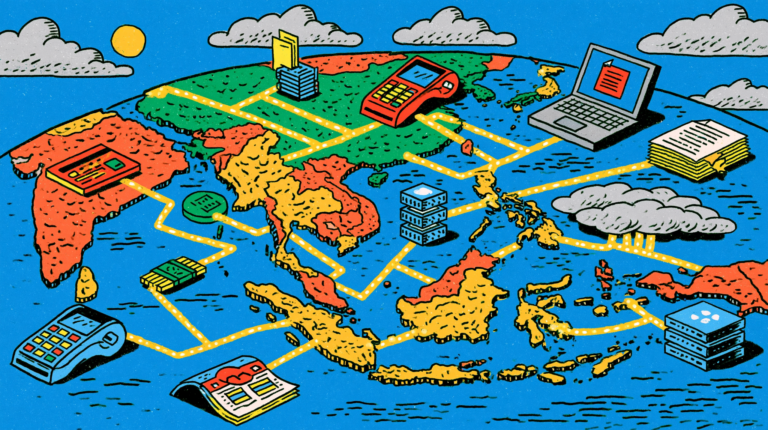

A new ASEAN agreement could reshape the region’s digital economy.
The ASEAN countries are hoping to double the collective value of their digital economies from $1 trillion to $2 trillion by 2030, through the Digital Economy Framework Agreement (DEFA) signed on November 14 in Pasay City. With all 11 economic ministers in attendance, during the 28th ASEAN Economic Community Council, the DEFA is expected to enter into force in early 2027, as the “first comprehensive standalone regional digital economy agreement between ASEAN member states (AMSs),” as the Singapore Ministry of Energy, Trade, and Industry (METI) put it.
Already one of the most integrated regions in the world in terms of digital trade commitments—with Singapore as the global top performer, and seven other AMSs, including Vietnam, in the top 20—the region could experience significant economic gains. The OECD estimates “that a shallow DEFA could increase regional trade by around 13% (total trade by 2.8%), a deep DEFA by 16% (total trade by 3.3%) and an extensive DEFA by 20% (total trade by 4.2%).”
The substance of the deal is significant: following its signing, Gan Kim Yong, Deputy Prime Minister of Singapore, announced that DEFA “establishes common rules covering digital trade, cross-border data flows, electronic payments, cybersecurity and artificial intelligence.” Within this broader framework, Gan hoped that “priority projects under the pact could include digital payment systems, digital identities for businesses and electronic trade documentation, which would make cross-border transactions faster, easier and less costly.” It is, in other words, a major milestone in the region’s attempts to create a single digital market.
Beyond the headline announcements, DEFA is a comprehensive, nine-chapter document, expected to cover source code protection, financial technology, and digital investment, alongside digital ID and talent mobility (a policy field over which Britain has had its own tussles recently), and a significant moratorium on customs duties on e-commerce, due to be reviewed five years after DEFA comes into effect.
While negotiations began in September 2023, the deal was formally signed on November 14, and will officially come into force exactly 180 days after the signing, replacing the 2019 ASEAN e-commerce agreement. Those 180 days bring us to May 13, 2027, marking nearly four years since talks began, but that date is only a deadline; indeed, though the agreement is legally binding, there is no expectation for individual nations to follow the same timeline beyond the deadline.
So in effect, that 180 days is a notice period as well as being one of transition, allowing the different signatories to align their currently quite divergent economies, especially those with significant gaps in infrastructure, regulation, and business readiness.
Regardless of whether the economic benefits will be realized, there are two important consequences that will come from DEFA’s signing. The first is that it signals to the global community that ASEAN is now a single voice in global digital trade governance, with Satvinder Singh, deputy secretary-general for the bloc, calling DEFA “both a regional integration mechanism and a geostrategic tool.” The policy flashpoint here is the continuation of the WTO’s moratorium on e-commerce customs duties, which expired on March 30, 2026, despite the US pushing for a long-term extension, meaning AMSs can now confidently and collectively appeal to digital businesses. Likewise, it gives AMSs the power to become rule-setters in the global economy, whereas member states are subject to rules written in Washington, Beijing, or Brussels. The DEFA signals to global investors that the bloc is moving in a more business-friendly direction.
The second, and related, consequence is the regulatory certainty for businesses; as is always the case with customs unions, the alignment between markets will ensure businesses know where they can operate and how, replacing a patchwork of national rules with a single binding set of rules. Removing conflicting national rules will cut compliance costs, especially for micro, small, and medium enterprises (MSMEs), and lay out clearer rules on moving data, money, and goods between AMSs.
This is not without risk, however: the US–ASEAN Business Council has noted that an open, phased timeline, while flexible in allowing each nation to move at its own speed, in an absence of clear milestones there arises the risk of partial integration, and members may need new laws or regulators to comply. For example, misalignment on data flows is a serious stumbling block, especially as member countries can make exceptions tied to concerns such as privacy laws, business confidentiality, and national security. For example, Vietnam requires local storage, while Indonesia blocks transfers to countries without equivalent protections—with no published list—and Malaysia requires transfer assessments but has issued no templates for conducting them. Different levels of, and attitudes toward, openness on data could alone drastically stall progress.
The regulatory benefits of market alignment at the international level may therefore be offset by an increased domestic regulatory burden; indeed, the OECD has warned that “barriers to digitally enabled trade span multiple policy areas” and “regulatory fragmentation is rising within the region and globally, raising compliance burdens and increasing the cost of operating internationally to the particular detriment of smaller firms which are key” throughout AMSs (emphasis added).
So, will the touted doubling of the ASEAN digital economy materialize? Perhaps, provided the alignment is as tight as possible and the OECD’s “extensive DEFA” scenario is achieved, removing as many barriers for MSMEs as possible, and giving global investors certainty over their future in the region.
But alongside the regulatory questions, the important thing to focus on is where that projection actually comes from, which is an internal ASEAN Secretariat estimate, so the estimated outcome ought to be taken with a pinch of salt, as its role was less an economic projection and more a political carrot to encourage the passage of the DEFA deal. Singapore’s METI specifically has drawn on Google, Temasek, and Bain & Company’s numbers to reach a projection of $1 trillion by 2035—evidently half of the headline figure, and a very different timeline. It has not been explained where those projections came from, which means that pinch of salt probably needs to be a little bit bigger.