
The EFTA deal could keep Vietnam’s Tiger Economy on track.
For most economies, especially those in the West, a growth of 9.95% would be celebrated—but in Vietnam, it has caused legislators to go into a panic. Despite achieving the fastest economic growth since 2022, it has fallen short of a target set by Vietnam’s National Assembly in April 2026, of an average annual growth of at least 10% over the next five years.
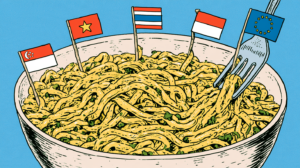
It is for this reason that Vietnam is banking on the new free trade agreement with the European Free Trade Area (EFTA) to provide the final boost.
For anyone who is unfamiliar, EFTA is not the same as the EU, but a distinct group of four nations—Switzerland, Norway, Iceland, and Liechtenstein. The market itself is small, with roughly 15 million people across the four nations, but the per capita wealth is very high: collectively, the EFTA bloc has a GDP of about $1.33 trillion, or about $108,000 per person in 2024.
Not to confuse things too much, but there is some overlap between EFTA and the EU, in that all EFTA nations except Switzerland have access to the EU Single Market through the European Economic Area agreement of 1994.
This distinction is important in context. While Vietnam and the EU have an existing trade agreement, in place since 2020 and intended to eliminate 99% of all tariffs, the new agreement between Vietnam and the EFTA specifically (EFTA-FTA) has been presented by both sides as a way to diversify markets while an ongoing trade war disrupts global trade. Indeed, the value of the deal is expected to boost economies at both ends of the deal significantly: already, Switzerland is Vietnam’s largest trading partner within the EFTA, with bilateral trade reaching approximately $3.5 billion in 2025.
Agreed on October 18, 2026, in Hanoi, the deal is expected to come into force, according to the Ambassador for Norway Stein Iversen, “three months after Vietnam and at least one of the four EFTA members complete ratification.”
The value of the deal is obvious for the EFTA nations: Vietnam can act as a ready gateway into Asia. Vietnam itself has a population of around 100 million, and—more importantly—the Vietnamese economy is linked to the ASEAN single free trade area (roughly 680 million people). In theory, a Swiss watchmaker could now relocate production to Vietnam, and ship the completed products back to Switzerland, potentially reducing prices for Swiss customers while bringing jobs for Vietnamese workers. Moreover, that Swiss watchmaker could now shop tariff-free to nations like Japan or Australia (provided the origin rules are met).
For Vietnam, however, the deal is part of a wider strategy dictated by the Communist Government towards the economy and domestic policy. Outlined earlier this year as the Vietnamese “Tiger Economy” strategy, the goal is for the economy to grow by 10% every year until 2030 in order to bring it into line with the wider Southeast Asian region. And while 9.95% is an impressive level of growth, when a target is politically motivated rather than economically determined, the risk comes from what—or who—is to blame for the target being missed. With a shortfall this small, it is easy for the government to blame the economy, rather than prompt a re-examination of the target itself.
But the EFTA-FTA is highly attractive to Vietnam for what it might do to the import/export balance sheet. Throughout 2026 Q3, exports rose by 24.5%, itself worth celebrating; but balanced against an increase of imports by 36.7%, this has led to a record trade deficit of $19.42 billion.
However, by gaining access to a market of an estimated 15 million consumers in the EFTA nations, Vietnam has the potential to reach a significant and wealthy market that desires exactly the products Vietnam leads in.
The foremost amongst these is the machinery and electrical equipment that Vietnam produces, of which the EU imported roughly €33.8 billion (about $38 billion at time of writing) in 2025—but importantly, more than half of all imports in this category came from Vietnam. EFTA might be small in comparison to the EU’s, but reducing barriers to entry for this market which already buys machinery from Vietnam will be a major boost to the Vietnamese economy.
Alongside electrical goods, Vietnam produces many items that are highly valued in the wealthy EFTA economy: textiles and high-end fashion items produced in the Southeast Asian country are particularly appealing, as are every day staples like coffee (which, with cashews and pepper, was worth €4.5 billion, or $5.04 billion, in 2025), seafood, and handcrafted items like wooden furniture.
Moreover, the motivation of diversifying the economy in the face of tariffs and import duties is a major one for Vietnam, which acts in many ways as a middle-economy for firms in the United States and China. Vietnam’s surplus with the United States reached $122.6 billion, while the deficit with China hit $121.5 billion. With figures so symmetrical between nations in the midst of a trade war, it makes Vietnam look more like a conduit than an economy—but a diversification of markets away from the two sides of a trade war can reduce the dependency risk of being tied so firmly into the supply chain.
The actual contents of the EFTA-FTA deal do not vary massively from the current status quo—Switzerland already scrapped tariffs on all industrial goods in 2024—but for electronics, clothing, and shoes, the deal is there to make trade rules more predictable and concretize zero tariffs as the standard.
The main gains for Vietnam are in food exports. As European nations—both within the EU and in ancillary markets like EFTA, Britain, and neighboring nations—protect their agricultural markets stringently, the new deal promises Vietnam farm concessions in line with the EFTA’s recent FTAs with other countries.