
Beijing’s railway and military influence is changing Southeast Asia.
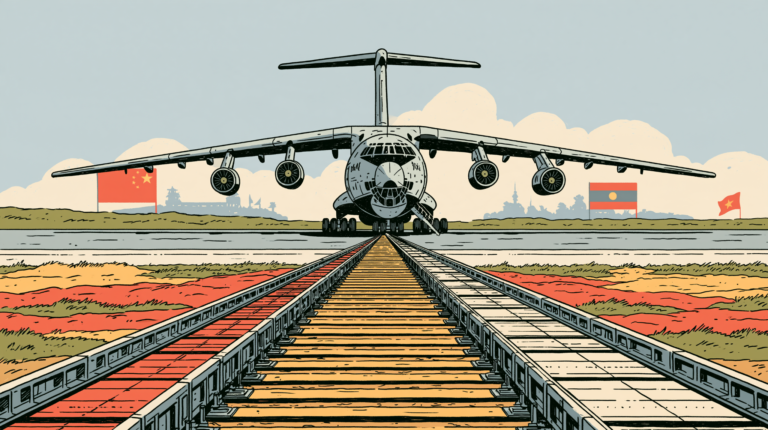
China is increasingly drawing Laos into its orbit through two main strategies: a railway freight line and a joint military air facility. Not going unnoticed among neighboring nations—especially Laos’s close ally Vietnam—the move feeds directly into China’s regional strategy of making mainland Southeast Asia a secure southern flank through close economic ties.
In some ways, this is a continuation of a long tradition in the way China views the region. In the imperial era, China treated many of its neighbors as, essentially, vassals. Its peripheral nations were part of a hierarchy with China at the center, with the Chinese court demanding tribute in return for access to Chinese markets and trade. Legitimacy was a consequence of recognition, and Laos sat very close to the bottom of the list.
Whether this carries through into contemporary Chinese policy is up for debate: officially, Beijing’s foreign policy is that all countries are equal, a consequence not of the official state communist ideology but of the country’s experience of being carved up by foreign powers.
However, this does not always play out in practice. In Hanoi in 2010, then-Foreign Minister Yang Jiechi told his ASEAN counterparts that “China is a big country, and other countries are small countries.” Alongside the Belt and Road Initiative’s launch in 2013, China’s foreign policies have shifted in a concrete direction: using infrastructure investment to deepen relations between other countries and bring them closer to its center of gravity.
It’s exactly this approach that China is pursuing in Laos and Thailand. As Kuik and Rosli put it, “of all the Southeast Asian countries, the Lao People’s Democratic Republic (PDR) has been one of the most enthusiastic in engaging with and embracing China’s Belt and Road Initiative (BRI),” and the flagship project in this effort is the Laos–China railway project. With construction inaugurated in December 2021, the railway will connect Laos’s capital of Vientiane with the border town of Boten, which sits on one side of the Laos–China border, with Mohan.
Initially estimated to cost $6 billion, financed through $3.54 billion of debt and $2.36 billion of equity, Beijing has put up as much as 70% of the cost, with the rail line connecting Vientiane via Boten to the Chinese town of Kunming. In the first half of 2026 alone, the value of trade passing through the line is estimated to be “17.17 billion yuan (about $2.53 billion), 33.8% higher than a year earlier.” Evidently a worthwhile investment for the Chinese, it’s not so much for the Laotians, whose 30% share was even financed with Chinese money.
Beyond the substantial investment (and ownership) on China’s side, the rail line has had the major impact of tying Laos ever closer to the Chinese economy as well as deepening Laos’s existing debt. The Lao government’s 30% share of the investment was partially secured through a loan (roughly $460 million, as the Laotian government could only afford $250 million of its own funding) from the China Exim Bank, in which the Laotian shares in the railway, the track itself, and even the rights to operate it are collateral, alongside “revenues from a bauxite mine and three potash mines.”
Likewise, the railway itself was built to Chinese standards, and plugged directly into the existing Chinese rail infrastructure. There is nothing inherently wrong with this—in fact, standardized rail lines between nations facilitate trade, and this has borne out for Laos: for example, freight costs from Kunming to Thailand via Laos have decreased by 30–50%. Even so, Laos remains exposed to Chinese leverage over pricing and governance, due to the financing arrangement laid out above, as well as China’s dominance in the operational control of the rail line itself.
Beyond economics, however, China is deepening its influence in Laos through more hard-power methods. The China–Laos Joint Support and Training Center, and the China–Laos Friendship Aviation Academy, sited at the Ban Keun airport, began operating on September 29, with the official statement declaring that “the two institutions, jointly maintained and operated by both sides, aim to help Laos strengthen the training of its air force pilots.” Although, as The Nation [Thailand] has reported, concerns have been raised by diplomats, who are “following construction at Ban Keun” and “are looking for signs of air defences, ammunition and fuel storage, and surveillance facilities.”
Alexander Neill, of Hawaii’s Pacific Forum, warned that “Such installations could indicate military functions beyond training. Ban Keun could eventually accommodate larger aircraft, including planes used for signals intelligence and electronic surveillance that could extend China’s reach into Southeast Asia.”
Sebastian Strangio at the Diplomat went one step further, claiming that “the Ban Keun facility has the potential to alter the strategic map of mainland Southeast Asia, pulling Laos and Cambodia further out of the Vietnamese sphere of influence.”
No wonder, then, that Vietnam has responded frostily to the development. On November 5, Foreign Ministry spokesperson Pham Thu Hang said, “Vietnam always hopes Laos will develop in a peaceful, independent and self-reliant manner,” and that “such cooperation must at the same time be a positive contribution to peace, security, stability and prosperity in the region and the world.” It’s the inclusion of “self-reliance” that barbs the statement.
Now, China is looking to use Laos as a route into Thailand, and subsequently to the eastern seaboard. The primary method for doing so is the planned expansion of the Thai–China high speed railway line, which was initially approved by the Thai cabinet in 2017 and expected to begin operating in 2027. While it is now not due to begin operation until 2030, Thai Transport Minister Phiphat Ratchakitprakarn has already laid out the government’s intention to tender for Phase 2 of the railway in 2027.
Will the Thai–China line have the same effect on relations between the two nations as the Laos–China deal has? The answer is, decidedly less so: Thailand has long been a participant in the Belt and Road Initiative, but primarily on its own terms, as its economy is more resilient than Laos’s and can pay for the investment itself.
That does not mean that China is without leverage, though. The technology is coming exclusively from China—in 2020, the State Railway of Thailand signed a contract with China Railway International Company Limited worth just over 50 billion baht (equivalent to about $1.5 billion at the time). It has not gone without notice, either, as more than 90% of the Thai respondents to the ISEAS survey of regional opinion expressed concern over China’s “growing regional economic influence.”
It’s not a secret that China is using its economic muscle to bind foreign economies tightly to it. With the Belt and Road Initiative spanning the globe, and China increasing its military presence abroad (as in Laos, and so too in Cambodia and Djibouti), developments like these must be watched closely. Is the claim that they could “redraw the region’s strategic map” overblown? Time will tell.