
India’s manufacturing boom is fueling demand for Chinese resources.
This month, there will be over 400 Chinese officials in New Delhi—more than double the previous delegation in 2019—to discuss the future of Sino–Indian relations. For China, those relations have never been more favorable; India’s position on the world stage has declined, though not in ways caused by China, making the prospect of resumed and increased trade between the two nations increasingly likely.
A key development came in March 2026, when the Indian Union Cabinet amended Press Note 3, a rule in place since 2020 that required government clearance for investment from any country sharing a land border with India (the largest of course being China, which shares a 3,500-kilometer border with India). The removal of this barrier proved its effectiveness by the end of August: investors had brought ₹4,896 crore ($512 million) across 29 projects. This is a proof of concept that cannot be easily ignored.
But the greater significance is in where investment did not come from: China. After relaxing a rule that primarily affected China, investment instead came from Mauritius, Korea, Japan, Singapore, and the United States.
From the two factors—the small inflow, and the source nations—a reasonable conclusion can be drawn: global funds carrying incidental Chinese shareholders had been caught by mistake, and they were now unblocked.
The conclusion that should be drawn is that formal (“hard”) blockages to trade are only ever one part of a greater picture and should be understood alongside the informal (“soft”) blockages. India’s trade problem with China is habitually described as a deficit to be narrowed by negotiation—the lifting of tariffs, increasing market access, joint ventures, and so on. It is better understood as an asymmetry that negotiation cannot alter: India’s constant attempts to address this gap seem to have made it wider.
Bilateral goods trade reached $151.1 billion in the fiscal year ending March 2026, and, of that, imports to India from China were $131.63 billion, the highest India recorded from any country; meanwhile, exports to China were only $19.47 billion. The new fiscal year is following the same trend: June’s deficit alone was $15.3 billion.
What India buys from China falls into roughly four broad categories—electronics, machinery, organic chemicals and plastics—as well as the pharmaceutical agents upon which India’s generic drug industry depends. What India sells in return is very much the raw end of things: ores and slag, mineral fuels, and marine products. Exports have been growing—up 37% in the previous year—but that growth seems less impressive when the actual numbers are considered: from $14 billion to $19 billion.
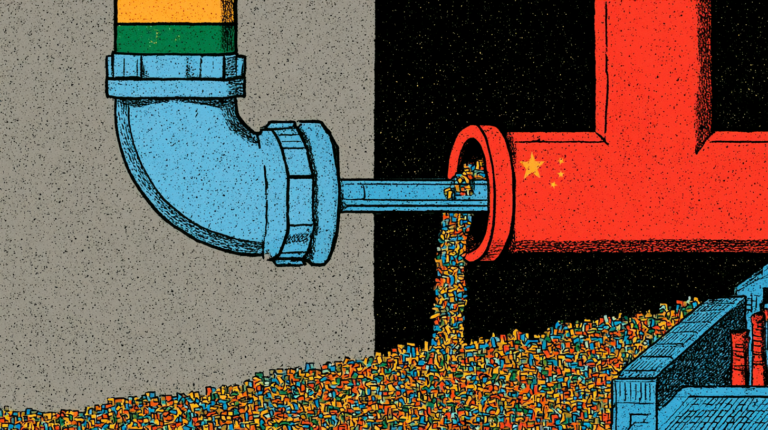
The Sino–Indian trade profile is not, therefore, one between two comparable advanced economies, but between a supplier and a manufacturer, and because the Indian economy supplies the very items that China exports to India, it becomes a self-reinforcing cycle. As Indian industry grows, and the country becomes wealthier, it will buy more of the products China produces using the very raw materials it has bought from India.
This yawning deficit is, in large part, a product of two of India’s own policies that have pulled in opposing directions.
The first is security-focused: Press Note 3, mentioned above, was first introduced at the very beginning of the COVID-19 pandemic, and was originally aimed at preventing opportunistic pandemic-era acquisitions. As a consequence, hundreds of Chinese investment applications were banned, and business visas for Chinese engineers were subject to layer upon layer of vetting, at the ministerial level. The cost of doing business simply skyrocketed. In a strict sense, it achieved its goal: Chinese direct investment collapsed to a mere $67.34 million between 2021 and 2024.
The second was an industrial policy designed to build a modern industrial base for India at speed. The first industries to benefit from this were the assembly-based industries: phones, appliances, solar panels, and so on. Naturally, these industries are resource-intensive and require more components as they grow; as a result, the trade deficit with China, the main supplier for these components, ballooned from $44 billion in 2021 to nearly $85 billion in 2024 and even further to $112 billion in 2025.
Delhi has been laser-focused on course correction since late 2025. Former cabinet secretary Rajiv Gauba proposed dismantling the visa-vetting system, and shortly after in December the government launched a digital sponsorship platform, simplifying the process and no longer requiring ministerial recommendations. On the FDI side, Press Note 2, which was approved in March and has been in effect since May 2026, automatically processed noncontrolling stakes of up to 10%, while introducing a 60-day approval window for priority manufacturing sectors (including electronics, capital goods, and solar cells).
These are real liberalization efforts, noted approvingly by the Carnegie Endowment, which wrote, “The practical argument for reform was genuine. The system was deterring not just Chinese capital but also legitimate global investment.”
The problem persists, however: the barriers to Chinese investment have been lowered, but Chinese investment has not automatically flowed through.
The forthcoming BRICS summit, held in Delhi from September 12–13, will be a real opportunity for India to address this. Xi Jinping himself will be coming, his first visit to India since 2019, with the aforementioned 400 expected delegates. The size of the delegation speaks to the seriousness of the summit and the potential for both sides (in fact, all BRICS nations) to take advantage of the global trend among manufacturers to pursue a “China Plus One” policy of diversification in response to a fragile global economy.
As it stands, trade will grow between the two nations, because both economies are growing and complement one another. Unfortunately for India, the trade deficit will grow, too, unless some serious rebalancing is made.