
The Asian powerhouse looks to strengthen Latin American trade links.
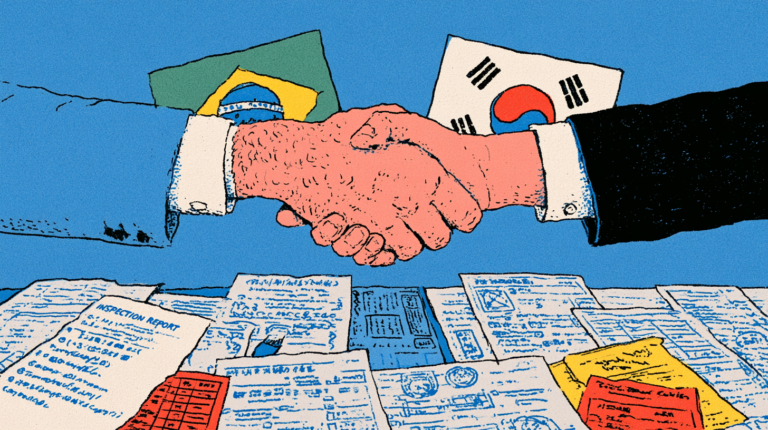
In the coming weeks, a delegation of South Korean food safety officials will take an extensive tour of Brazilian meat processing plants, checking everything from chilling temperatures and drainage to the paper trail that charts the meat’s journey. The mission of officials was agreed at a presidential summit in July 2026 and is, in every sense that matters, the trade negotiation in action.
Long stalled, the Korea–Mercosur trade talks have been revived as each nation adapts to the shifting sands of the international order; but the gap between political theater and technical progress is unusually wide between the two sides. Each might publicly commit to increased trade, but institutionalized differences over practices, such as animal welfare, are the minutiae that can sink trade deals.
On July 27, South Korean President Lee Jae Myung and Brazilian President Lula da Silva agreed to accelerate trade talks and establish a bilateral working group, particularly after Lee described reaching an agreement as urgent. Yet Brasília’s own trade records show the seventh round of talks—held in 2021—as the most recent. Between the rhetoric and the reality, there yawn five years of silence on an apparently urgent issue.
It is a fundamental truth of trade negotiations that presidents and negotiators operate on different timescales: the political will might be there, but the technical alignment usually is not. Since talks between Korea and the Mercosur bloc opened in May 2018, the negotiating agenda has covered a litany of issues: goods, services, e-commerce, investment, rules of origin, sanitary and phytosanitary measures, technical barriers, intellectual property, and government procurement. The list goes on, as you can probably imagine.
The economic case almost makes itself. In 2025, Brazil exported roughly $5.5 billion worth of goods to Korea and imported roughly $5.3 billion—a bilateral trade relationship worth about $10.8 billion—and that’s before the other Mercosur nations are taken into account. The trade between Korea and Brazil is instructive, however, because it is so complementary: Brazil sends petroleum, iron ore, cellulose, soy and meat to Korea, and receives in return semiconductors, electronics, machinery, and vehicles.
Korea is a wealthy food importer with a powerful manufacturing base that wants to sell into new markets; Mercosur as a bloc, and Brazil as a country, have the food and want the investment. Brazil’s agricultural exports alone reached about $2.4 billion in 2025, and the country has already won access to export eggs and egg products to Korea, entirely outside of any free-trade agreement.
Present complementarity is one thing, but future prosperity is another. The case is there for a strengthening of existing trade flows, but does this mean that the two countries will definitely benefit, and equally so, from any trade deal? In 1703, England and Portugal signed the Methuen Treaty precisely because Portuguese wine and English cloth were so naturally complementary, and over two centuries later, economists in each country were arguing over which had benefited more from the deal. Brazilian industrialists are acutely aware of this history.
This is why the National Confederation of Industries (Confederação Nacional da Indústria, CNI) stated its preference for “the suspension of negotiations on the Mercosur–South Korea agreement or, alternatively, defend a partial agreement that reflects the interests of the private sector in market access and rules, and protects sectors against unfair competition.” For Brazilian industrialists, it is a rational reading of the strengths of the Korean economy and the weaknesses of Brazil’s: industry. Korea is strongest precisely where Mercosur’s common external tariff has been the highest: automobiles and components, steel, chemicals, electrical and electronic equipment. The hardest bargaining between the two countries will therefore concern the speed and scope of liberalization, not merely the abstract desirability of a deal. The desirability is there, but as ever, rhetoric and reality need to match up.
So what has concretely changed since talks opened in 2018 and stalled in 2021? The answer is the same resource that has become vital to the emerging economies of the future: minerals, and specifically rare-earth minerals. When Korean Trade Minister Yeo Han-Koo convened the four Mercosur ambassadors in March, he highlighted the vast reserves of untapped lithium and nickel that sat beneath the Mercosur nations, and the summit in July produced a cooperation memorandum between the Brazilian and Korean mineral agencies on exactly this issue: “sustainable development of the mining sector.” On a parallel track, Korea and Argentina have agreed on a similar understanding, as both Seoul and Buenos Aires have emphasized critical minerals and energy in the same register.
It might seem merely like adding one ingredient to the mix, but as it stands, minerals have become so vital that they have significantly rebalanced and reframed the trade discussions. Selling soybeans is selling into a market; but selling battery minerals is buying into a production system that cannot be easily reconfigured. Both governments understand what is at stake here: Brazil becoming a vital supplier, but one vulnerable to international trade disruptions; Korea securing valuable minerals, but becoming dependent in the process.
Alongside this balancing act is Mercosur’s own expansion of trade negotiations. The trade bloc is increasingly active in pursuing trade agreements, and an equally significant one was launched at the end of June 2026: economic partnership negotiations with Japan. For Korea, this introduces another pressure: time. Seoul and Tokyo’s interests overlap almost exactly, with vehicles, machinery, advanced manufacturing, and rare-earth minerals on the table. For Brasília, this is leverage, as now there are two customers seeking access to the same goods.
Brazil ran a 45-day public consultation on the future of Korea–Mercosur trade, launching on May 15 and closing at the beginning of July, itself a fascinating move to seek a democratic mandate for a specific trade deal. It has catalyzed the discussions: ministers are meeting, working groups exist to refine language, and delegations are being sent to inspect meat processing plants, among other things.
For all of this promise, there is a conspicuous absence: the lack of any announced eighth round of negotiations. Lula has spoken of, and expressed his preference for, finishing in 2026, but—as mentioned above—this is a political objective that the economic reality might not validate. To send a signal that each nation is serious about a trade deal, a Round 8 date should be announced, or at least a schedule for completion. Until then, the summits are best understood as an agreement to keep agreeing.