
How regulation is undermining free trade with Canada.
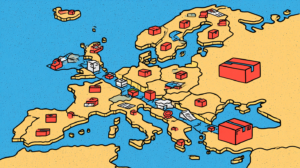
As discussions unfold over the EU’s proposed “associate membership” for Canada, Prime Minister Mark Carney has repeatedly stressed his desire for an economic and geopolitical partnership that preserves national sovereignty. This alliance serves the mutual interests of both the European Union and Canada by reducing strategic dependence on major third-party trading partners, particularly the United States and China.
The paradox is that the core economic instrument designed to unite Canada and the EU, the Comprehensive Economic and Trade Agreement (CETA), remains without full ratification by 10 EU national parliaments, nearly a decade after entering into provisional application.
Rather than dismissing the concerns of these 10 member states as blind protectionism, one must understand that Brussels’s excessive regulations created the conditions for this impasse.
When the European Commission imposes costly environmental mandates, stringent restrictions, and heavy bureaucratic burdens on its own farmers, it artificially inflates the cost of European food production.
Facing this forced loss of competitiveness created by these regulations, national parliaments react in political self-defense: they block trade agreements to protect domestic sectors that simply cannot compete with foreign partners operating under more functional regulatory frameworks. Protectionism at the border emerges as the inevitable consequence of over-intervention at home.
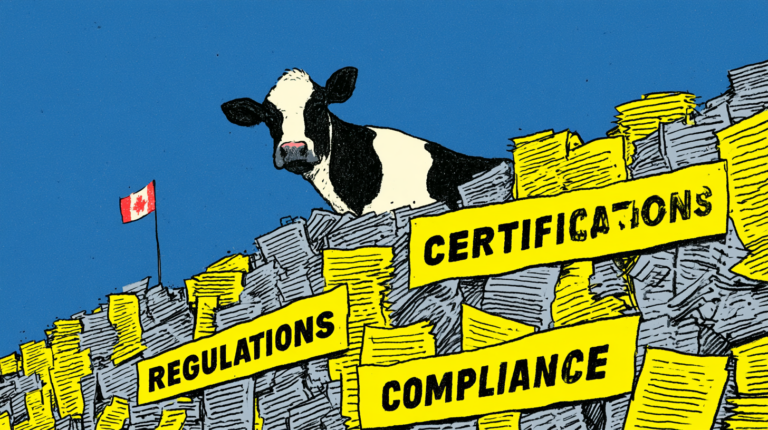
Canada itself has not derived significant benefits from CETA’s provisional application in the agricultural sector, as compliance with European sanitary requirements proved commercially unviable. To access the duty-free tariff quota, Canadian cattle ranchers would need to establish entirely segregated and certified hormone-free production chains. With massive domestic and US markets accepting standard production methods, the cost of navigating Brussels’s bureaucracy far outweighed potential profit margins. Consequently, year after year, Canada utilizes less than 3% of its allotted beef quota.
Europe panics over an “invasion” of products that Ottawa has no financial incentive to ship, while Canada discovers that European market access comes wrapped in regulatory barriers that render its benefits moot.
On one hand, product rules aim to protect consumers by enforcing uniform health and safety standards. If a product fails to meet sanitary requirements, it cannot enter the European market. On the other hand, protectionist rules are designed to shield local producers from foreign competitors. In this case, those competitors already meet sanitary standards but can produce more cheaply than local farmers, who are crippled by Brussels’s regulatory overreach.
Under CETA, product-based sanitary regulations pushed the certification costs for hormone-free beef so high that exporting became unprofitable. The compliance burden itself acted as an entry barrier, rendering political vetoes by ten European nations largely redundant. In the livestock sector, CETA in its current form has become a zero-sum game that neither side wins or has an incentive to pursue.
If agriculture has become an economic dead end, the push by Mark Carney and Ursula von der Leyen for a deeper alliance is justified because CETA’s true value has shifted from agriculture to geopolitics. The European Union does not need Canadian beef; it needs Canada’s lithium, nickel, uranium, and green hydrogen to break its reliance on China and Russia. Ottawa, for its part, seeks to diversify exports to buffer itself against political unpredictability in Washington. Unlike the agro-food sector, raw material trade faces no such friction.
In agriculture, Europe has domestic production and fears competition; in critical minerals, Europe faces absolute scarcity and has no domestic extractive industry to protect. There are no mining lobbies demanding tariffs on Canadian ore, nor are there complex sanitary standards blocking exchange. Compared with the agricultural maze, raw material trade finds a regulatory path that is infinitely smoother and strategically imperative.
Yet the illusion of a free market fails on the Canadian side as well, finding its mirror image in Ottawa’s domestic policies.
The primary Canadian bottleneck is its own rigid supply management system, a protectionist framework that sets prices and levies steep tariffs to insulate dairy, poultry, and egg producers. Although Canada granted minor cheese quota concessions under CETA, the core of its agricultural protectionism remains intact.
Coupled with this economic barrier is a domestic rift over animal welfare: while Quebec defends foie gras production and exports, the practice of gavage faces mounting pushback in urban centers like Toronto, reflecting the ethical and regulatory debates that divide global markets.
Faced with the prospect of sacrificing future energy and mineral security to appease present-day agricultural panic, the European Union exposes the fundamental flaw of its model. The resistance of national parliaments is the inevitable response to the regulatory monster that the European Commission itself built.
After suffocating its own farmers with bureaucracy, environmental costs, and excessive demands, Brussels cannot act surprised when those farmers demand protection from foreign trade. When a bloc imposes unsustainable burdens at home, it is ultimately forced to build walls at the border.
If Europe wants to be a relevant geopolitical player and a trusted trade partner, it must dismantle its internal regulatory labyrinth and restore the market’s freedom to produce, compete, and thrive.