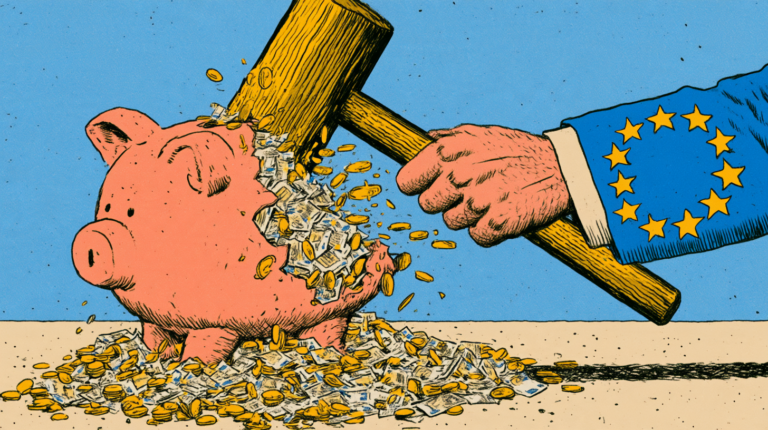

How Brussels is turning household savings into an instrument of public policy.
On October 9, EU finance ministers reached a political agreement to move supervision of Europe’s largest cross-border trading venues and market infrastructure from national regulators to the European Securities and Markets Authority (ESMA) in Paris. EU leaders want the package agreed by the end of the year.
“Europe has the savings. Now it’s time to put them to work,” said Ireland’s finance minister, Simon Harris, whose country holds the rotating Council presidency until the end of 2026. He meant the roughly €10 trillion that, according to the Council, European households keep in low-yield bank deposits.
Brussels insists no one will be forced to move a single euro. Meanwhile, it is building an entire system to move that euro where it wants it to go. The plan raises a question about the legitimacy of a state that treats family savings as a resource it can exploit.
The Savings and Investments Union works through incentives. In September 2025, the Commission issued a non-binding recommendation asking member states to create savings and investment accounts with favorable tax treatment. According to the Commission, the goal is to help citizens earn more from their savings while funding EU companies and “strategic priorities.”
Two months later, the Commission returned to the subject, recommending that governments automatically enroll workers in supplementary pension schemes. Workers can opt out, but most people stick with the default, as the Commission itself acknowledges. The stated aim is for pensions to provide long-term capital to the European economy.
Legally, none of these recommendations are binding. In practice, however, there is pressure to apply them, because the Commission will monitor implementation through the European Semester, the EU’s annual cycle of budgetary surveillance. Member states saw the risk: in February, finance ministers replaced a text asking them to “take steps to implement” the recommendations with a softer pledge to “explore options.”
In March 2025, the Commission unveiled the strategy alongside its white paper on defense, and it was described as indispensable to Ursula von der Leyen’s “ReArm Europe” initiative. Part of families’ savings would end up financing the military, an end many savers would never choose.
But even if the goal were consensual, the decision would still not belong to the state.
A saver is safer spreading her money across the world than tying it to the same economy that pays her salary and her pension. A policy designed to keep European savings in Europe pushes the other way.
Once savings are expected to serve “strategic priorities,” someone has to define them, and that someone will be a politician or an official. Each Commission will have its own list. Capital will flow to the sectors with the best lobbyists, and savers will absorb the losses when those bets fail.
If governments want to spend more on defense, the honest route is to put that need to voters and write it into a budget. Steering private savings toward the same ends moves the cost off the public books and the risk onto households.
Centralizing supervision in Paris eliminates competition among national regulators, the mechanism that lets a well-regulated country attract business, and hands power to an authority run by six appointed members.
Brussels treats deposits as a market failure. Many are emergency funds, money set aside for a home, or the savings of older people who, quite reasonably, prefer safety to returns.
And some of the obstacles to investing are of the EU’s own making. Since 2018, European retail investors have been barred from buying US-listed ETFs, because those funds do not produce the key information document (KID) that EU rules require. A member of the European Parliament warned that this cut savers off from funds with lower fees. Having shut the door on cheaper products, Brussels can hardly be surprised that Europeans prefer the bank.
The simplest solution would be to cut taxes on investment income for everyone, with no strings attached, remove the rules that keep cheap products out of reach, and let national governments compete. The Commission’s own staff working document catalogues accounts that already exist, as in Denmark, built without any blueprint from Brussels.
Savings are what people set aside from work already done, for needs only they can weigh. A government that wants a share of that money has an honest instrument for it: a tax, debated in the open and voted on.
If Europe wants its citizens to invest, it must give them back the freedom to choose where, and accept that the answer will not always be the one Brussels prefers.