
Protecting steelmakers means higher costs for manufacturers.
Steel tariffs protect producers at the expense of the businesses that depend on them.
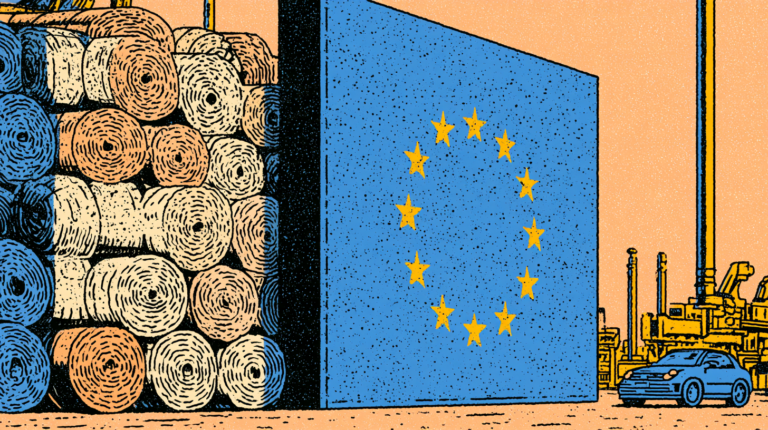
As of July 1, the European Union has capped duty-free steel imports at about 18.3 million tonnes (20.2 US tons) a year, 47% below 2024 quota levels. Regulation (EU) 2026/1384 also doubles the duty on imports that exceed those limits, from 25% to 50%.
Brussels justifies these measures by pointing to global overcapacity and the need for strategic autonomy. Yet, by making imported steel more expensive, it risks hurting thousands of European companies that rely on this raw material to compete in domestic and international markets.
One of the main drivers of overcapacity is state support for production, particularly in China. Subsidies, tax breaks, and cheap loans allow some steelmakers to keep producing even when domestic demand falls short. Because the home market cannot absorb all the steel produced, manufacturers look for buyers abroad, pushing down international prices. The OECD estimates that global excess capacity will reach 721 million tonnes (794 US tons) by 2027. Chinese steel exports more than doubled between 2020 and 2024, reaching 118 million tonnes (130 million US tons). Meanwhile, the EU steel industry was operating at just 67% of capacity.
Steel is an intermediate good, a raw material used to make highly necessary, everyday products such as automobiles, auto parts, household appliances, and industrial equipment. Restricting imports reduces available supply and limits buyers’ options. When steel becomes more expensive, the companies that use it must raise prices, accept thinner margins, or cut other costs, including investment and jobs.
In January, 10 industry associations, including ACEA, APPLiA, CECIMO, and Orgalim, estimated that the new restrictions could generate between €5 billion ($5.6 billion) and €9 billion ($10.1 billion) in additional tariff costs per year, assuming that imports stay at 2024 levels. The Commission expects a 3.25% rise in average steel prices, while buyers warn of increases of up to 30% in some categories.
The effects may reach well beyond the European steel market. A manufacturer that pays more for its raw material faces higher costs than competitors that can buy cheaper steel in other markets. If it raises prices, it risks losing orders; if it absorbs the costs, it has fewer resources to invest and grow. Protecting steel mills can therefore weaken other industries that employ more people and produce higher value-added goods.
Since its enactment on October 1, the “melt and pour” rule has required importers to prove where their steel was originally melted and cast, even if it was later processed in another country. This requirement raises administrative costs and can make imported steel harder to obtain, especially for small businesses that rely on distributors and have no direct control over the required documentation.
The restrictions also affect close trading partners. EU free-trade partners account for about 80% of steel imports and benefit from half of the annual quota, but their access remains limited. Switzerland (a supplier of specialized steel to European industrial supply chains) and the United Kingdom have both objected to the measure. A policy aimed at Chinese overcapacity ends up also restricting supply from economies closely integrated with Europe.
The American experience offers a useful perspective. In 2018, President Donald Trump imposed a 25% tariff on most steel imports under Section 232, raising them to 50% in June 2025. The Peterson Institute for International Economics estimated that steel users would bear additional costs of about $650,000 for every job created in the steel industry. Federal Reserve economists Aaron Flaaen and Justin Pierce found that the American industries most exposed to the 2018–19 tariffs saw relative declines in employment, driven in part by higher input costs and retaliatory tariffs from trading partners. The 2025 increase points the same way. A year after the tariff rose to 50%, total steel imports fell about 13% (finished steel down 17%), while domestic raw steel output rose roughly 3% and shipments 5%. The benchmark price of hot-rolled coil climbed 31%, and Labor Department data showed producer prices for steel mill products up 13.3% over the year. Manufacturing employment, meanwhile, stayed flat.
The European system uses quotas before applying the 50% tariff, but it faces the same dilemma. Protection reduces the competitive pressure to improve productivity, and tariffs leave untouched the subsidy policies that fueled global overcapacity. Brussels also plans to consider extending the restrictions to products such as pipes and wire rods and, later, to goods made of steel or containing significant amounts of it.
The result of these measures will be lower investment, fewer jobs, and higher prices. Protectionism simply shifts the costs of foreign competition onto other businesses and onto consumers.