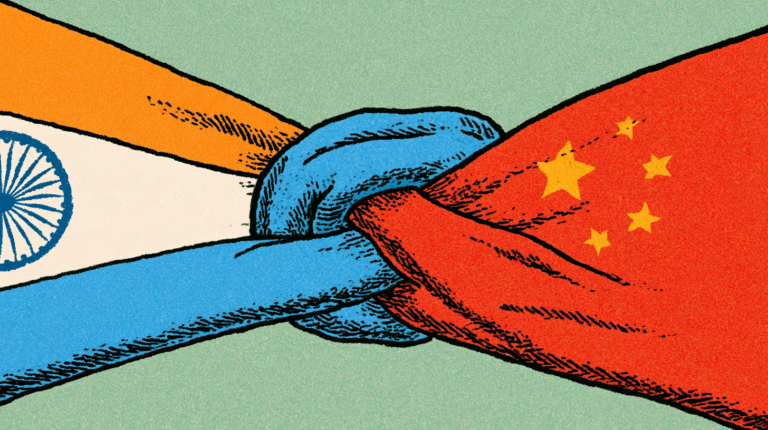

The costs of dependence are growing.
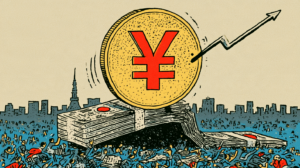
In the summer of 2025, electronic manufacturing giant Foxconn recalled roughly 300 Chinese engineers and technicians from its facilities in Tamil Nadu, the southernmost state of India’s mainland, and a further 300 just weeks later, leaving only the plants and machines behind while withdrawing the capacity to run them. It is symbolic of what India’s trade relationship with China actually looks like, and why the current trade deficit of $112.16 billion (up from $99.12 billion a year earlier, on a bilateral trade of $151.1 billion) is not easily closable, even after Xi Jinping and 400 functionaries visited Delhi for the latest BRICS summit. China has now overtaken the United States as India’s largest goods-trading partner.
There are three principal obstacles standing in the way of rebalancing this trade deficit, yet only one of them is in India’s hands to resolve.
The first major obstacle is the one over which India has the least control: Beijing’s willingness, or lack thereof, to calibrate. Over 90% of India’s rare-earth magnets and metals come from China, and China’s own customs data showed a 58% fall in magnet exports to India from January 2025. While the actual amount is trivial compared to the billions of dollars of trade, it’s the leverage that matters. If one country can slow another’s vehicle and electronics production through administrative delays, the trade relationship is not exactly a balanced one.
Since roughly June 2026, Chinese authorities have tightened approvals for Indian business travelers, and only a limited share of applications are clearing the hurdles: industry accounts put approval rates as low as 20–40%, with the electronics and automotive industries being the most affected. That had not changed by the eve of the summit, when Indian executives were still reported to be facing “significant difficulties” in obtaining Chinese visas. Both Modi and Xi stressed the need for greater mobility between the two countries when they met, yet no concrete easing of these restrictions has actually materialized.
This is a structural vulnerability that means India is dependent on Chinese equipment, components, and technical staff but simply cannot get them into its factories without cooperation from Chinese officials. Twelve days before National Security Advisor Ajit Doval (the longest-serving advisor, having been in office since 2014) flew to Beijing for boundary talks in August 2026, China extended anti-dumping duties on Indian optical fiber for a further five years. Such vulnerability goes clearly beyond heavy industry.
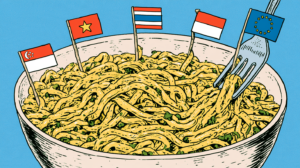
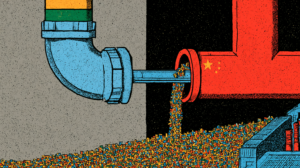
The second major obstacle comes from the United States. On August 13, the White House Office of Trade and Manufacturing Policy published a report naming over 40 economies as part of a “shadow transshipment network”—placing India in tier one. Transshipment is a loophole in President Trump’s protectionist policies that allows China to circumvent the policies both Trump administrations have pursued to reshore or nearshore production, and it’s one that the United States is attempting to close. India is not the only major economy to be included in tier one, as it is joined by Canada, Japan, Mexico, Korea, Taiwan, and even the European Union, with Mexico, India, and Vietnam identified as the leading conduits for China-origin goods—an estimated $67 billion in 2025.
This is not a result of any deliberate Indian policy of evasion, and the US has not alleged any—but it does not need to. Washington has signaled retrospective duties for undeclared or “misdeclared” origin and rules of origin written into the interim framework agreed in February that cut Indian tariffs from 50% to 18%.
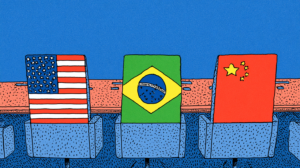
This is a serious limitation on India’s growth, given that the US market currently takes over $100 billion of India’s exports, and that access is now conditional on limiting the Chinese content of Indian goods. This is precisely the moment India has concluded that it needs more Chinese content in order to grow its manufacturing base. India finds itself between a rock and a hard place: every component sourced to make an Indian factory viable is a component that makes an Indian export suspect. The ground may shift even further, following Xi’s visit to the White House on September 24, with a US–China trade truce up for extension.
This is where the third obstacle comes in, and it’s one that India owns; however, it’s not an easy one to overcome. India can grow the industries it is already strong in and a major exporter of, especially pharmaceuticals, or it can double down on the industries that make it an attractive partner for China, such as raw materials including ores, fuels, and chemicals. India’s exports to China grew almost 37% in 2025–26, which seems transformative until the actual numbers are considered: that’s only growth from roughly $14 billion to $19 billion.
It was for this reason that Subrahmanyam Jaishankar, Indian minister for external affairs, asked Wang Yi, China’s foreign minister, for three things in July 2026: fair market access, movement on the trade balance, and the reliability and predictability of supply chains. The last one Beijing can grant quickly and cheaply, because it costs nothing to promise and can be withdrawn easily. Market access can be granted, and selectively so, whether that’s in pharmaceuticals or agricultural lines. But balance cannot be granted—it can only be reached by India growing exports, and not ones dependent on Chinese imports—and that is likely to take years.
When Modi and Xi met in Delhi on September 12, their meeting echoed the demands almost word for word, agreeing to address “structural trade imbalance and supply chain issues” and to facilitate meaningful and predictable market access—with no concrete commitment attached to either.
Going into Xi Jinping’s visit, India’s goals were easily identifiable: dormant bilateral trade mechanisms restarted, undertakings on rare-earth and fertilizer supply, further joint venture clearances, expanded border trade, and some movement on reciprocal visa allowances to restore the status quo ante from around the beginning of 2025. Coming out, the leaders’ 40-minute meeting was described by officials as extremely positive, but on the economic track there was little to show beyond the resumption of direct flights between Delhi and Guangzhou. Rare-earths, fertilizer, joint ventures, and visas produced no concrete announcements. As Bloomberg observed, the warmth merely papered over fundamental differences.
India can continue with selective de-risking, opening where inputs are needed and holding where the vulnerability is strategic. But Beijing has already shown how quickly India’s dependency can convert into political pressure. In August 2025, it eased curbs on magnets, fertilizers, and tunnel-boring equipment after commitments from Wang Yi, only to add 5 more elements to its rare-earth control list a mere two months later; by December of the same year, the list had grown to 12. Each new integration between the economies deepens that risk only further. It would be wrong, then, to say that India’s goal is negotiating down a deficit, but rather negotiating what that deficit will look like and how it will shape the nation’s economic future.