
Why Europeans are turning to private health care.
American progressives continue to advocate for a Medicare for All system, pointing to the Old Continent as a utopian model of universal access to health care. However, in Europe, systems in which the state functions as both direct provider and single-payer monopolist continue to fail.
Contrary to the narrative pushed by certain political circles, Europeans are increasingly adopting private health insurance. The structural flaws in countries that double down on centralized, state-run models show notable consistencies: swelling waiting lists, health care professionals fleeing a public sector constrained by rigid salary scales, and a systemic inability to allocate resources where they are needed most.
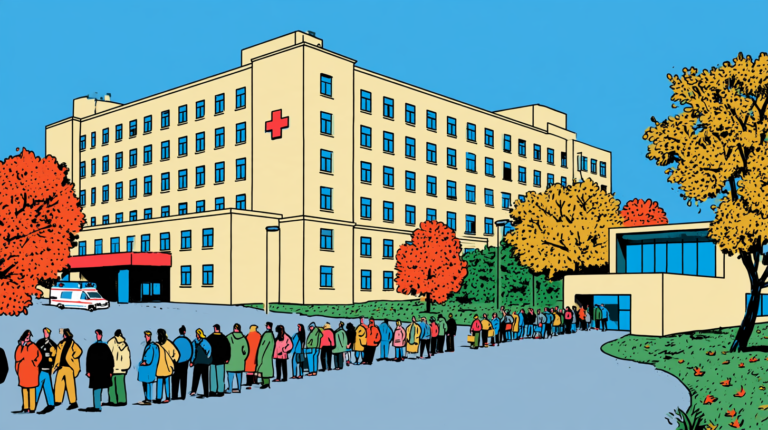
In the United Kingdom, whose famous National Health Service (NHS) served as the inspiration for public systems across Europe, roughly 71% of adults now say they would consider using private health care. Meanwhile, more than half of adults aged 35 to 44 expect to do so within the next year, a direct result of record-breaking waiting lists. In England, there are about 7 million people waiting for hospital treatment. The statutory promise of treatment within 18 weeks has failed consistently since 2016, and more than a third of emergency room patients wait more than four hours, a delay linked to estimates of over 1,300 excess deaths per month.
In Sweden, a country steeped in social-democratic tradition, over 826,000 citizens, roughly 8% of the population, hold private health insurance to bypass the sluggishness of a taxpayer-funded system.
In Portugal, a country with below-average European incomes where the tax burden on families is among the highest in the EU relative to earnings, the recurring closure of emergency rooms and maternity wards has driven more than 35% of the population to obtain private insurance. Despite financial difficulties, many families pay out of pocket simply to secure basic care.
This health care model, the Beveridge model, operates as a state monopoly. In doing so, central planning demonstrates that removing price mechanisms does not eliminate scarcity; it merely rations care through waiting lists and administrative bureaucracy.
There is another health care system in Europe, the Bismarck model, adopted by nations such as the Netherlands and Germany. Although based on mandatory social insurance, Bismarck systems achieve superior access by fostering competition between public and private providers, granting patients greater freedom of choice while preserving universal coverage. In the Netherlands, basic insurance is purchased from competing private insurers. In Germany, patients can freely choose their sickness fund and physician. According to recent data, only 0.3% of Dutch patients and 0.6% of German patients go without care due to waiting lists.
In Bismarckian systems, long-term sustainability depends on private complementarity to prevent capacity bottlenecks. However, in countries that cling to the rigidity of the Beveridge model, the practical result is double taxation: Europeans end up paying for health care twice, first through heavy taxes to fund a public service that fails to treat them in time, and second out of their own pockets through private insurance.
In practice, the state monopoly’s own utopian promise is what drives citizens into the free market. The growth of Europe’s private health care sector is not an ideological assault on the social safety net, but rather an inevitable consequence of its structural limitations.
As ideologues and lawmakers in Washington continue to present single-payer state financing as a progressive solution, Europe’s real-world evidence offers an economic lesson: scarcity does not disappear by banning the market; it merely changes shape. When the state assumes a financing monopoly, resource allocation ceases to respond to actual patient demand and is instead managed by budgetary and administrative criteria, with negative results not only for health but also for overall economic productivity.
The expansion of the private sector in Europe is the result of a practical necessity. Turning to private care after already paying high taxes is the way millions of families attempt to protect their health when the public system subjects them to months of waiting.
The United States of America should reinforce what Europe is only now beginning to rediscover: competition and freedom of choice remain the best guarantees of access, efficiency, and quality.