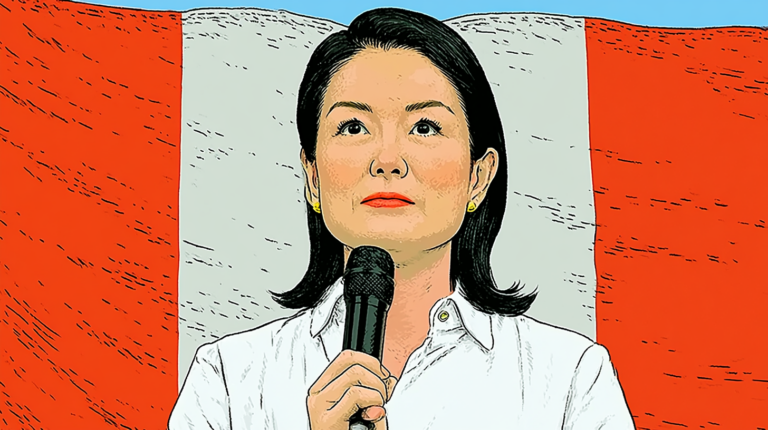

A razor-thin majority brings Keiko Fujimori to power.
With just over 99% of ballots counted, Keiko Fujimori holds a lead of roughly 40,000 votes over Roberto Sánchez—less than half a percentage point, and the third consecutive Peruvian presidential contest decided by a margin that narrow. Sánchez led through the early days of counting, carried by rural and highland turnout; but the overseas votes, which broke for Fujimori above 63%, pulled the result the other way as the tally crossed 95%.
The outcome is no longer seriously in doubt. What remains in doubt is whether a victory this narrow constitutes a mandate to govern, or merely a turn to occupy the office in impotence.
Fujimori has never held executive power. What she inherits, however, is a name: her father, Alberto Fujimori, governed Peru from 1990 to 2000, stabilizing a hyperinflationary economy and crushing the Shining Path insurgency, albeit with darkly authoritarian techniques for which he was later convicted. Long known as Peru’s answer to Venezuela’s Hugo Chávez, Fujimori has cast a long shadow over Peruvian politics ever since.
Keiko served as his First Lady through the latter half of the 1990s, then built her own career: a congresswoman from 2006 to 2011, and the leader of Fuerza Popular (“Popular Force”) since. She spent 13 months in pretrial detention on corruption charges tied to Odebrecht financing; a court voided the case in January 2025. She has run for president four times, losing the previous three runoffs by margins under a single percentage point before, now, winning her fourth.
Her governing history is, as a result, tied deeply to her father’s. She has spent two decades defending it rather than living it, which is itself a kind of qualification in a country where economic memory often prevails over institutional memory. The model her father installed—trade liberalization, fiscal orthodoxy, an open door to foreign capital—has outlasted eight changes of president in ten years. The claims of Fujimorismo—the governing-economic doctrine named for Fujimori that has dominated ever since his time—is that it alone can be trusted to keep that model standing.
Keiko Fujimori’s flagship commitments are, consequently, the two pillars of Fujimorismo itself: a hard line on crime, and an unapologetic defense of the market economy.
The security platform proposes deploying the military against organized crime and prison disorder, taking inspiration both from Peru’s own recent past, and Nayib Bukele’s divisive tactics in El Salvador. Alongside this, the platform promises expanding video surveillance, and modernizing this apparatus through the use of artificial intelligence to detect corruption in public contracting. She insists that her father’s system’s abuses will not be repeated.
The economic platform is a much-needed deregulatory shock: cutting investment-approval timelines by 40%, reducing the fiscal deficit from 2.2% to 1% of GDP, and shrinking the state. As for exactly how that shrinking will be achieved besides the aforementioned measures, Keiko is not clear.
Nevertheless, both pillars of the plan were sold on a single word, repeated at her closing rally and in her final debate: order, against the chaos she says the left represents.
That framing carried the affluent, urban, and overseas vote decisively. It did less among the rural and indigenous communities who associate the Fujimori name with her father’s abuses of the 1990s and with her own attempt, after losing in 2021, to annul hundreds of thousands of their ballots without evidence. Fuerza Popular’s congressional bloc is large enough this term to insulate her from the impeachment threat that has destabilized her predecessors—a structural stability that, it must be hoped, offsets the razor-thin margin of this victory.
The contest was loud well before the ballots were cast. Thousands marched across the capital of Lima, as well as Arequipa and Huancayo in the campaign’s final weeks under the banner of “Keiko Out, Fujimori Never Again,” led in part by relatives of her father’s victims.
The protests continued into the count itself. As Fujimori’s lead widened past 98% reporting, civic groups including the youth-led Generación Z Perú called for fresh demonstrations in defense of the “vote of our brothers and sisters in rural areas,” while commentators on social media accused electoral authorities of distorting the count in the right’s favor; an echo, almost note for note, of the fraud allegations Fujimori herself made without evidence in 2021, now redirected towards her by the other side.
Public discourse has split along the same fault line that decided the vote. Urban and overseas Peruvians have largely framed the result as a vote for stability over disorder; rural and indigenous communities, where Sánchez dominated by margins in some areas as wide as 85%, have framed it as a re-imposition of an elite their parents fought against in the 1990s.
The Lima city government’s threat to sanction marches in the historic center has done little to cool the temperature: both camps describe the other’s mobilization in the language of threat rather than disagreement—fraud, danger, regression—leaving little common vocabulary for the country to share once the certification is final. It is a perilous place for a nation when the Loser’s Consent necessary for democracy to function collapses entirely, undermined by the rhetoric that places the political opponents beyond the bounds of the body politic.
On international trade, Fujimori’s continuity instinct holds. Her deregulatory platform preserves existing agreements, favors deepened ties with Washington, and pressured the outgoing transitional government to honor a contested multi-billion dollar F-16 purchase from the United States. Yet Atlantic Council analysts now expect a more pragmatic posture than her pro-Washington reputation suggested during the campaign: she has avoided explicitly siding against China, recognizing that Beijing remains one of Peru’s principal trading and investment partners through the Chancay megaport and its mining concessions. A zero-sum choice between Washington and Beijing, forced upon her by a global context entirely beyond her ability to influence, would undercut the very stability her platform promises to deliver.
Regionally, Peru’s position as a Pacific Alliance member and the most credible Pacific gateway between South America and Asia is unaffected by the result: the infrastructure, unlike the presidency, does not change hands every electoral cycle. Peru remains the world’s second-largest copper producer and a major exporter of gold, silver, zinc, and molybdenum, with rising mineral prices offering Fujimori a more favorable fiscal backdrop than her recent predecessors enjoyed. Whether that windfall reaches the rural communities who voted overwhelmingly against her is the open question her presidency will be measured against.
Fujimori takes office having narrowly won the argument over which model Peru should keep, without having won the country that model is meant to serve. Her congressional bloc may protect her from the impeachment mechanism that ended four of her predecessors’ terms early; but nothing protects her from the deeper accusation now leveled by Sánchez’s supporters and echoed in the streets—that her ascent looks less like victory than recapture. The question Fujimori’s presidency now poses is not whether Peru’s market model can survive another term—that is all but certain. It is whether a government elected on a margin of 40,000 votes can convince the country it was not simply imposed upon it.