

A review of ‘New Space Capitalism’ by Rainer Zitelmann.
In his new book, New Space Capitalism: The Entrepreneurial Path to the Stars, Rainer Zitelmann presents the idea that private enterprise is the best way for space exploration to go forward, pointing out the ways in which public funding, since the days of the Moon landing, has been too uneven (and insufficient) to make the advances possible.
When reaching space initially was a political contest, the spirit was there, but since the end of the Cold War, it has been less of a priority.
Political commitment to space as an goal has fluctuated to the point that, as Zitelmann illustrates, for some years American astronauts were having to hitch a ride with the Russians to get to the International Space Station (the NASA engineers of the Cold War Mercury Program would have been appalled). The disasters of the space shuttles Challenger and Columbia reduced public enthusiasm for the whole thing, and it was harder to whip up excitement (and funding) for further missions.
But today, billionaires have become more involved, and the prospect of space tourism has also put more money into the field. And this is, in its way, nothing new. In looking back to the earliest days of space as a pursuit, the building blocks, such as the building of big telescopes, were funded by the wealthy—and that it was by no means a natural fate that space exploration would become a government-funded activity.
It’s easy for us to forget the philanthropists like James Lick, who left money to establish the observatory on Mount Hamilton in California. His bequest was $700,000—in 1874. A sum which, according to Zitelmann, “measured as an equivalent to US GDP, would be approximately $1.8 billion.”
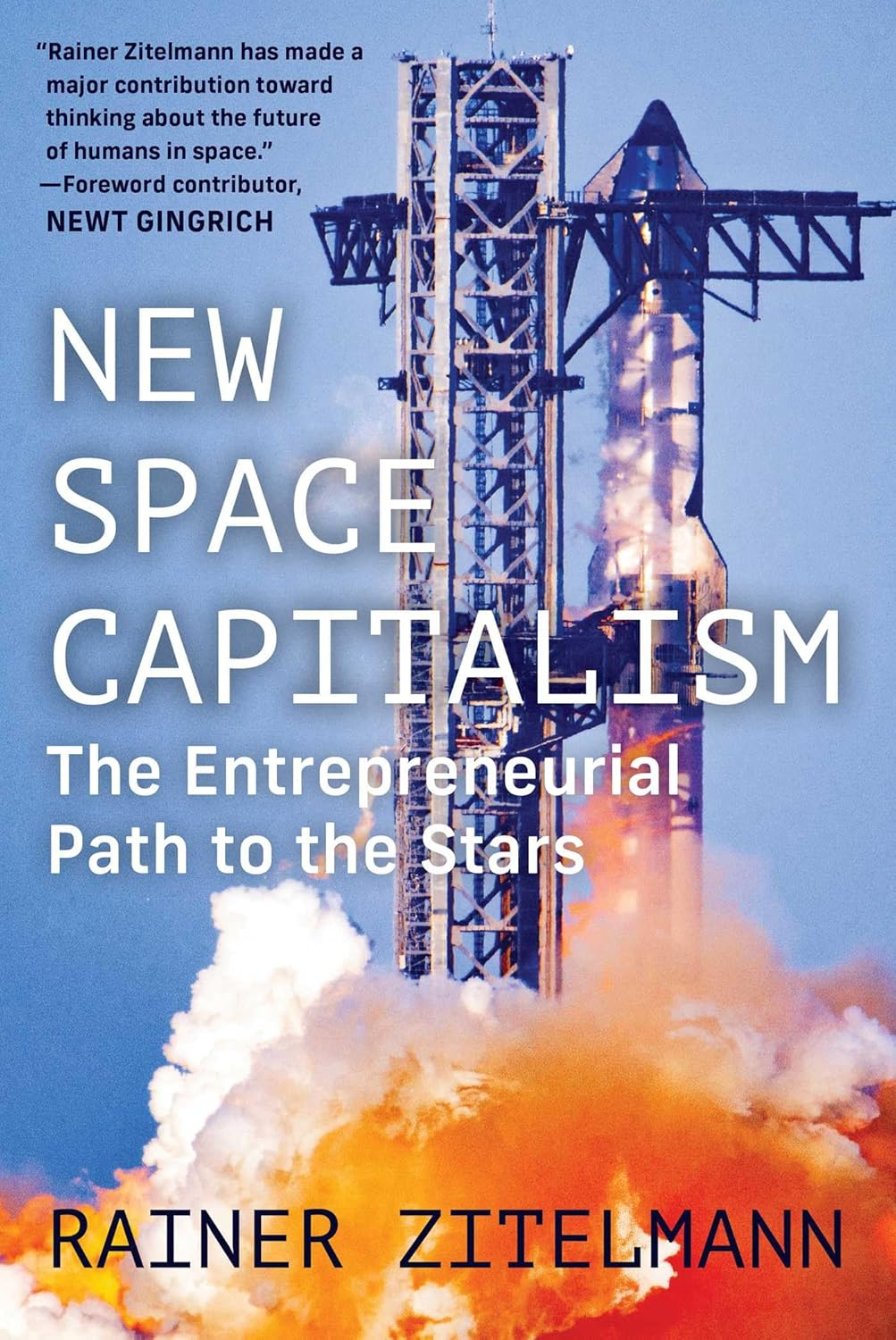
In a sense things have come full circle, as private individuals and companies are pushing the boundaries of space exploration and turning it into a range of commercial operations. One of the biggest growth areas is indeed for those who can afford it to go into space themselves. And this could be a huge market.
As Zitelmann puts it:
There are over 900 billionaires in the United States today. Their investable wealth dwarfs anything NASA ever dreamed of. Given the right tax and regulatory environment, a number of them will follow Jared Isaacman in traveling into space and investing in space.
Interestingly, he’s a little more lukewarm about Martian exploration and travel, at least to the extent that Mars could be a popular tourist destination. Despite Elon Musk’s Martian enthusiasm, it presents greater challenges to both tourist endeavors and those looking to exploit potential resources on the planet. In Zitelmann’s words:
…I consider large-scale tourism on Mars unlikely, since not only does it take six to nine months to reach the planet, there’s also only one launch window every twenty-six months. A tourist would need to commit several years of their life to such a journey, and that’s something only a few wealthy retirees would realistically be able to do. Tourists are more likely to travel to the Moon, which would be worth a three-week trip.
Three weeks is definitely more plausible, and with expanding options, trips to the Moon could easily become the next Everest in terms of its popularity with billionaires as a trophy destination. And it is this kind of commercial use where Zitelmann sees the real growth opportunities.
Nor are these developments only benefiting rich space tourists. Elon Musk’s satellite Internet service, Starlink, has already proven its worth to consumers around the world, not least the fact it can provide service in adverse situations:
Starlink has also demonstrated its value in disaster response, offering reliable communications for rescue teams during critical incidents such as the 2019/20 Australian wildfires and Hurricane Melissa in Jamaica and the Bahamas in October 2025—where terrestrial networks failed.
The kind of technological developments that come from private space tourism and research may yet bring new benefits to the rest of us. However, international law around the exploitation of resources in space may be precisely what holds us back. Zitelmann explains how the Outer Space Treaty may be a limitation:
There is much to suggest that Mars would remain in a similar state to Antarctica… The Antarctic Treaty, which was signed in 1959 and entered into force in 1961, imposes stringent restrictions on the extraction of raw materials and both the acquisition and ownership of land in the region surrounding the South Pole. Article IV of the Antarctic Treaty suspends all existing territorial claims and prohibits new claims or the expansion of existing rights for as long as the treaty is in force. Consequently, no sovereignty claims are recognized, and no state can claim Antarctica as its territory or exercise sovereign rights there.
What happens if and when we get the technology to go further remains to be seen. But private enterprise is likely to be what takes us there.