
A few weeks ago, Paul Krugman argued that Europe is not really falling behind the United States. Yes, measured US productivity growth has been stronger, but GDP per capita at current prices has not diverged that much between Europe and America because Europeans also benefit from increased American productivity by buying cheaper technology. The great Atlantic divergence is more of a statistical misunderstanding rooted in America’s tech sector, one that dissipates if we trust our eyes instead. Walk around France, then walk around an American state with similar measured income per person, like Alabama. Does it really look like France is poorer?
As Luis Garicano and his son Pieter wrote, part of the dispute is technical. Krugman compares incomes at current prices, which makes Europe’s relative position look more stable since 2000. But current prices hide productivity gains in any sector where prices fall. If America produces twice as much software while the price of software halves, current-price accounting registers no growth at all. Measured at constant prices, which is how economists track real growth over time, America has pulled away decisively, and most of all in the last six years.
The problem with Krugman’s “walking around test,” the Garicanos suggest, is that European downtowns look richer because Europe’s wealth is displayed in its historic urban cores, the very neighborhoods, by the way, that price out young Europeans. In comparison, America’s wealth lives in suburbs and exurbs, which are also the places tourists never go. So instead of the walking around test, the Garicanos say, try the driving around test.
Now, thanks to the World Cup, that test is being run in real time.
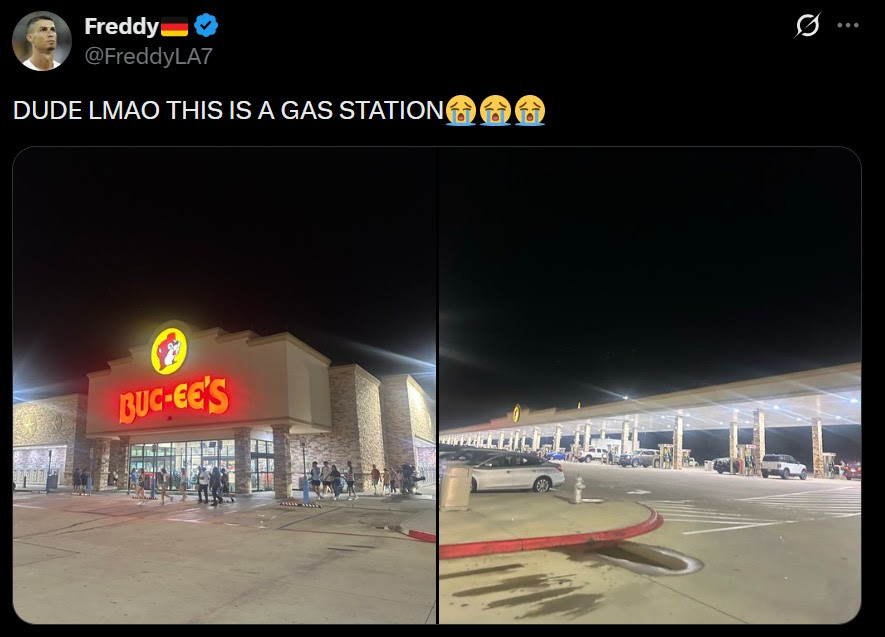
Thousands of Europeans are doing exactly what the Garicanos prescribed. They are renting cars and driving between host cities, through Tennessee and Georgia, the Carolinas and Texas, through the parts of America that Krugman invoked and Europeans hardly get to see. They’re going to Walmarts. They’re discovering Bass Pro Shops and Buc-ee’s.
It’s a joy to see all these mini Boris Yeltsin in Texas moments, as tourists walk into ordinary grocery stores and are startled by the scale and variety, by the prices, free refills, and portion sizes, and by the parking lots, air conditioning, highways, huge homes, giant stadiums, and the sheer abundance of American consumer life.
Their reactions have been one of the most wholesome side effects of this World Cup. A German fan named Freddy landed in Atlanta, started posting his road trip through the South, and has already become a star of this World Cup outside the field. It’s like watching the enthusiasm of a 19th-century traveler discovering a new civilization. He was perplexed by a Buc-ee’s being a gas station so large it looks like an airport terminal. He was overwhelmed by the Coca-Cola Freestyle machine with too many choices. He visited a college football stadium in Alabama and described it as “the most ‘The European mind can’t comprehend this’ moment of my life.” He visited Fairhope, Alabama, and wrote “I could live here.”
Even Lamine Yamal, Spain’s superstar, was spotted grocery shopping at a Walmart in Georgia. One visitor wrote that Walmarts are like museums for Europeans. I get him. The prices, the volumes, the sheer variety on an ordinary American shelf are a museum of abundance, except everything in it is for sale, and most of it is cheap.
Europeans are seeing American homes, too. I know the feeling of driving through the periphery of a random Southern city and passing thousands of new four- and five-bedroom homes of a size and quality that is simply uncommon in Europe today. The most overlooked American towns offer a standard of living that seems absolutely luxurious to a visitor from Brussels or Bratislava.
The fans are discovering American hospitality along the way. The government might give tourists a hard time at the airport, but most Americans treat visitors with warmth and respect. @ParkWoodDeli posted a video of them giving a real New Jersey deli experience to a couple from London. It’s that kind of humorous and unpolished hospitality that few places can replicate authentically. As someone wrote in the comments, “Best PR this country has had in years.”
One Algerian architect wrote that the residents of Lawrence, Kansas, “have all rallied to cheer for the Algerian national team that arrived in their town. The matter didn’t stop at buying scarves and attending training sessions; it went as far as memorizing the Algerian national anthem.” “This isn’t the America we know!” he concluded.

But this is the America Americans know. Yes, I’m the first one to concede that America is too car-dependent, and many of these prosperous places are not beautiful because they were built for cars rather than people. A lot of it is aesthetically disappointing. Europe has plenty that Americans should envy. Historical beauty accumulated through the centuries, walkability, inherited urbanism, better trains, lower violent crime in many countries. The list goes on. But the claim under examination is not whether Alabama is charming. It is whether Alabama is poor. A drive through reveals that American middle and upper-middle classes live with a level of space, consumption, convenience, and purchasing power that is difficult to replicate in much of Europe.
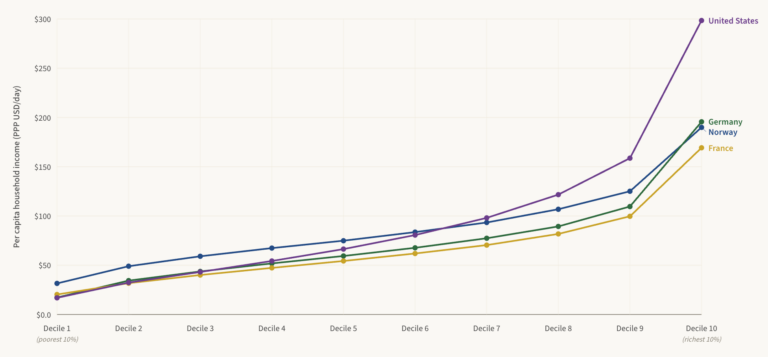
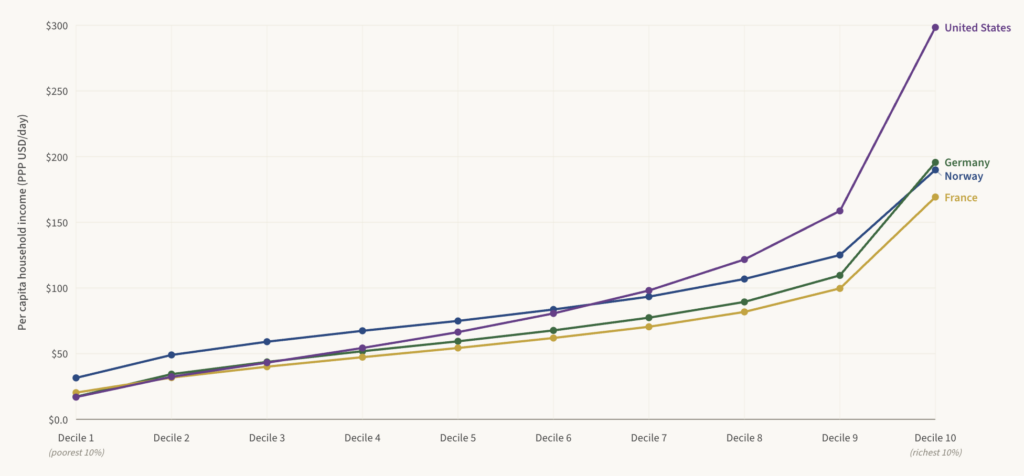
This becomes especially clear when comparing people in similar professional classes. The Europeans buying tickets to the World Cup and flying across the Atlantic are not a random sample. The competition selects for the upper part of Europe’s income distribution. It is at the top that the gap between America and Europe becomes more pronounced. Compare a software engineer, a lawyer, or a doctor in Dallas with the same professional in Munich. The difference in purchasing power is glaring. As the Garicanos write, an entry-level Deloitte consultant earns around $33,000 in Madrid and $63,000 in Charlotte. Adjusted for purchasing power parity, the top decile in the United States has a per-capita household income of $298 a day, which is about 53% higher than Germany, 57% higher than Norway, and 76% higher than France. The visitors marveling at America’s strip malls are affluent people discovering that their American counterparts live in a different material world.
Abundance is what free economies do. Where Americans are free to produce, life is astonishingly cheap. Where they are not, even American paychecks strain. The things tourists marvel at, the groceries, electronics, clothing, and free refills, are the goods where markets are freest. The things that squeeze the American middle class, such as housing, healthcare, childcare, and higher education, are the ones where supply is blocked by zoning, permitting, licensing, and mandates. As I argued in my last essay, the affordability crisis is a war on supply.
The driving around test reveals this, too. The Sunbelt cities the fans are driving through, Nashville, Austin, Charlotte, Atlanta, are booming and still livable because they let builders build. The coastal cities that gated themselves against new housing are the ones where the American dream now carries a seven-figure price tag. America’s middle class lives amid the blessings of capitalism, and it should enjoy more of them. One lesson from the great American driving test of this World Cup is for Americans not only to become more conscious of the affluence that startles Germans and Nordics, but to unlock it for their own middle class, the teachers, nurses, and young families who face European levels of scarcity in America’s most walkable and productive cities. That is the challenge behind the affordability crisis, and the one FEE’s generous donors have put one million dollars on this summer at MillionDollarQuestion.org.
The driving around test is finally being administered at continental scale. So far, the Garicanos are winning. If Americans take the lesson from every stocked supermarket aisle and extend it to multifamily units in the cities that are building the future, they may soon win the walking around test as well.