
The Economist’s latest cover story looks behind the Gen Z socialism meme and finds a real global movement. During the New York mayoral race, Zohran Mamdani campaigned on freezing the rent and opening municipal grocery stores. British Labour figures are toying with grocery price caps while Polanski’s Greens want rent controls, free buses, and a new wealth tax. Washington state is bringing in a 9.9% tax on earnings over $1 million. Socialist Jean-Luc Mélenchon is mounting another run at the French presidency on the strength of young voters. Germany’s Die Linke has promised to scrap every fee from day care through university. Brazilian Congress is about to reduce the maximum work week from 44 to 40 hours with two mandatory rest days. In Canada, the new leader of the New Democrats, Avi Lewis, wants public grocery stores nationwide and a halt to data-center construction (and some MAGA Republicans have warmed to pausing data centers). Even when these candidates don’t win, increasingly their ideas do.
If mid-1900s socialism had a union flavor, and the socialism of the turn of the century was about climate and anti-globalization, this one has an anti-price theory flavor. It wants rent freezes, grocery price caps, free buses, and wealth taxes. It is more blatantly self-interested. As The Economist describes it, the appeal is less to any collective ideal than to a list of personal wants: cut my rent, lower my bills, give me a free bus pass. It sounds egocentric, but it is winning.

It is also worth noticing how intuitive the bad solutions are, and how counterintuitive the good ones. We did not evolve for an economy of strangers and supply curves. We evolved in small bands where the pie was roughly fixed, where one person’s gain usually meant another’s loss. Gen Z socialism is not an exotic ideology. It is what people believe by default when no one makes the case for markets. It’s the zero-sum mind reasserting itself in a positive-sum civilization.
That kind of folk economic illiteracy is where the conversation starts. It is not where it ends. The solutions don’t make economic sense, but the grievances are real. Rent in big cities has become unaffordable, inflation ran high for years, good jobs seem harder to find, and the rise of AI promises to make finding one even harder. So you can tell Gen Z that GDP is at a record high, but they are thinking lunch costs far more than it used to. If you are 26 and every productive city is priced beyond reach, “The economy is growing” sounds less like a counterpoint and more like an insult.
Now, if economic literacy is where the conversation starts, let it start by comparing two cities. In 1980, Shenzhen was a town of about 30,000 people across the border from Hong Kong. That year, it became China’s first Special Economic Zone, and over the next four decades it grew to more than 17 million residents, in its fastest years taking in close to a million newcomers a year. Think of how dynamic that process had to be to absorb that influx: the housing that had to be built, along with the streets, the schools, the commerce. Not everyone moved there to build phones. People brought whatever they were good at—often cooking, driving, trading, and teaching—because Shenzhen was where those skills were suddenly worth the most.
Shenzhen’s closest American counterpart is San Francisco. The most advanced technology in the world is built there. And yet the city has hovered around three quarters of a million people for forty years. It peaked near 880,000 residents in 2018 and has lost population since. The nine-county Bay Area has grown by about two-thirds since 1970 and began to shrink in the early 2020s for the first time in half a century. When a place draws that kind of demand but does not add supply, prices do the work that building was supposed to do. Neighborhoods stop being places people move into to get started and become places people get pushed out of. It is the affordability crisis in miniature: the city with the most opportunity in the world gating people out by arresting its own development.
This is the point Ezra Klein made in a recent conversation with Ian Bremmer. We often hear that the American middle class has been hollowed out. That is not quite true. Look at real median household income over time, and you see that middle-class Americans got richer.
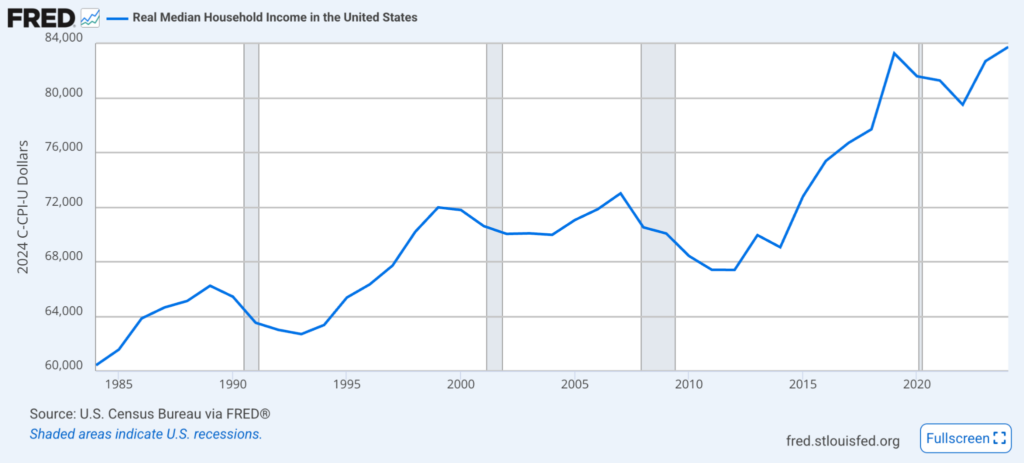
What got hollowed out was not the statistical middle class, but the actual places where the middle class used to be able to live. Klein’s phrase for it is that we have “broken the relationship between technology and places.” The communities with an industrial base, civic life, and real institutions emptied out, while people were not allowed to move to where opportunity had gone. The superstar cities—New York, San Francisco, Los Angeles, Boston—got richer and richer. In an earlier America, that would have started a new engine of mobility: you moved to the rich city, cut hair, or fought fires, and your kids grew up better off than you. That is roughly what is happening in China today, where the cities get richer and people pour into them.
In America we did the reverse, because those superstar and super progressive cities made it impossible to build. Klein describes “just driving around the other day in the part of Silicon Valley, Santa Clara area, where you have Meta and Nvidia. It is so crazy to me that you do not have places for people to live. It’s strip malls, and it’s single-family homes. We’ve not built huge towers next to them. You look at what Shenzhen looks like. And here, where we’ve invented A.I., it looks like an office park.”
There are many forces behind the affordability crisis, but housing is the most visible one; or rather, the absence of it. We have wrapped housing in zoning rules, height limits, minimum lot sizes, parking requirements, environmental review, and layers of discretionary approval that let almost anyone slow a project down. We build too little, too slowly, in exactly the places people most want to live. The price is what tells builders where to build, owners where to invest, families where the opportunity is. Freeze it and you have not lowered the cost of anything. You have switched off the signal while leaving the scarcity exactly where it was. The apartment that never gets built makes no noise and casts no vote, but it is the real casualty of a rent freeze, and it is invisible precisely because it never comes to exist. RAND found that the same apartment building costs more than twice as much to put up in California as in Texas. None of that is a law of nature. High rents, as The Economist concludes, are the result of markets that are “insufficiently free, not excessively so.” The crisis is not what capitalism looks like when it runs wild. It is what capitalism looks like when we stop letting it build.
The same logic is already playing out with groceries. To bring down what shoppers pay, the Federal Trade Commission has begun reviving the Robinson–Patman Act, a 1936 New Deal statute that polices the discounts large retailers get from suppliers. The effect, as economists have warned for decades, is to discourage the very volume discounts that let stores cut prices. We would be fighting the cost of groceries by making groceries cost more.
Look closely, and every plank of the program turns out to be the same move: a war on supply. Freeze rents, and less housing gets built. Cap grocery prices, and the shelves thin out. Pause the data centers, and computing power gets dearer and migrates abroad. You cannot make a thing more abundant by making less of it, and abundance is the only thing that has ever made anything cheap.
So we are caught between two failures. On one side, a generation is asking for fixes that will deepen the problem they are furious about. On the other, the people who should be defending markets too often answer by denying that the problem exists. Look at the growth charts, they say. Both responses fail the same young person. One tells them their pain is imaginary; the other tells them it is real and prescribes poison. Defenders of free markets should stop apologizing and start solving the problems driving the anger. We need to build the housing and clear the bottlenecks. We need to start having the right conversation.
That is why FEE has just launched The Million Dollar Question, a national campaign built around the question behind the rise of Gen Z socialism: What’s behind the affordability crisis?
Anyone can go to MillionDollarQuestion.org and take a short, ten-question quiz on the policies and bottlenecks that make life more expensive. Everyone who completes it is entered into a lottery, and twelve people will be chosen to come to Atlanta for a taped finale, The Affordability Showdown, hosted by comedian Andrew Heaton. One finalist will walk away with $1 million.
Yes, it is a quiz. Yes, it is a contest. Yes, it is a million-dollar prize! But the point is bigger than the money. The affordability crisis has become one of the central political questions of the next generation, and too many young Americans are being told that the answer is socialism. They deserve a better answer.
As The Economist piece concludes, “The first step is for free-market liberals to stop apologising… A punchier defence of capitalism would work better in the social-media age than hand-wringing by uncharismatic centrists like Sir Keir Starmer.” The Million Dollar Question is that first step.
So take the quiz. Share it with your friends. Send it to your kids, your students, your coworkers, and especially to the young people in your life who know something is broken but have not yet heard a serious explanation for what went wrong.
A generation is deciding whether the market system that built the modern world is worth upgrading or destroying. There is still time to win that argument. And it starts with one question: What’s behind the affordability crisis?