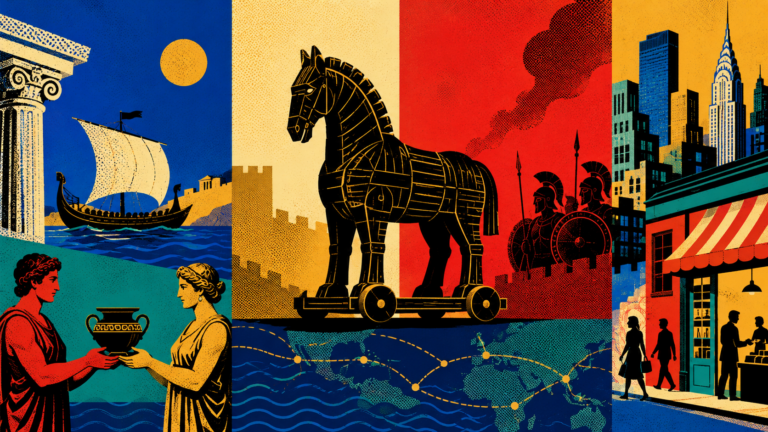

Everyone has offered a take on Christopher Nolan’s The Odyssey. I have one as well.
I have always regarded Nolan as a somewhat Straussian filmmaker. Some of the messages of his films are written for those in the know. But The Odyssey does not require that kind of esoteric reading. Its message is right there on the surface. In fact, it may be too obvious, which is perhaps the film’s greatest weakness.
When Nolan’s Odysseus tells Penelope that “our age of bronze is collapsing,” he displays a level of historical self-awareness that is not granted to people living inside history, least of all ancient history. They would not even have the vocabulary for it. Nobody in the Bronze Age knew they were living in the Bronze Age, or what such metallic ages would come to mean.
But perhaps, in an age of declining literacy, a filmmaker has to be that obvious. Or perhaps Nolan’s obviousness is itself a form of permission. By stating the theme so plainly, he invites the viewer to stop treating the story merely as an adventure and to read it as a meditation on the rise and fall of civilization.
Because in the same breath in which he announces the collapse, Odysseus says something more important: “We lived in a world of palaces and trade, language, blind to its beauty, until we broke it.” Civilization, in Nolan’s telling, depends on human cooperation. It is a great and intricate order built by people who can travel, exchange, speak, give gifts, receive strangers, and trust that an offer of peace is not concealing an act of war.
That is the meaning of xenia, what the film calls Zeus’s law. Xenia is sometimes translated simply as “hospitality,” but it was actually a moral technology for making human interaction possible beyond the boundaries of family and tribe. A stranger arriving at your door was to be welcomed, fed, and protected before being interrogated about his identity. Gifts created bonds between households and across generations. Under the protection of Zeus, the traveler, the merchant, and the foreigner could hope to move through a dangerous world without immediately being treated as prey.
Xenia was not modern liberalism. It did not establish universal rights or equality before the law. But it was an early recognition that civilization requires moral obligations toward the human dignity of people we do not know. Nolan’s Odysseus spends years in a kind of purgatory because he violated those obligations. His wanderings can be read as penance for violating the norms that made peaceful cooperation between peoples possible.
The first violation was the Trojan War itself. In Nolan’s adaptation, Helen is an excuse. Odysseus knows the war was never about Helen. Helen was the pretext. He tells Penelope, “This is Agamemnon’s pretext to break Troy’s control over the trade routes.” That is also why, trying to get home from Troy, Odysseus and his men keep searching for those routes. “Help us get home, to find the trade routes,” he asks Circe. The routes of trade are where you find peace, hospitality, and gifts. They create repeated encounters in which people have reasons to restrain their violence and preserve their reputations. Drift away from them, and you find violence, trickery, and men who have forgotten what civilization feels like.
And violence is not the only solvent of cooperation. Fraud dissolves it, too. The Trojan Horse is the ultimate symbol of fraud, a gift of peace that turned out to be a trick of war. Human cooperation depends on trust, and trust is fragile. A society can survive the loss of a particular transaction, but it cannot survive the loss of confidence in the categories that make transactions intelligible. A gift must be distinguishable from a trap, and commerce must be distinguishable from plunder. Blockade trade, corrupt the gift, slaughter the innocent, and the result is not merely the destruction of one city. It is the destruction of the cooperative order on which all cities depend. Agamemnon, Odysseus, and their men erased the law of Zeus in a single stroke.
Henry Hazlitt had a powerful insight about cooperation. In The Foundations of Morality, he argues that even companies locked in competition are cooperating at a higher level. Think of sports teams. The harder they fight to defeat each other on the field, the more they are upholding the written and unwritten rules of the game. Their rivalry takes place inside a larger cooperative arrangement. They are cooperating at a meta scale.
The same goes for firms. Hazlitt applied the insight to Ford and General Motors. Each company tried to win customers away from the other. But in doing so, each pressured the other to lower costs, improve quality, and develop better cars. Their competition was a form of indirect cooperation with consumers. And, through consumers, with one another.
Something similar may now be happening between OpenAI and Anthropic. Their rivalry could determine who leads the next generation of artificial intelligence. But the competitive pressure each places on the other also accelerates research, increases investment, attracts talent, improves products, and helps keep the United States at the frontier of the age of AI. Competition under the rule of law is one of cooperation’s most productive forms.
This is what the emerging critics of commercial society often fail to grasp. They see rivalry but not the cooperation around it. They see prices and profits, but not the millions of acts of coordination and service from which those prices and profits emerge.
You probably saw New York Mayor Zohran Mamdani’s plan for five government-controlled grocery stores. The stores are supposed to sell a basket of essential foods, including produce and meat, at prices 30% below those charged by private grocers.
The proposal has obvious political appeal. A store offering the same groceries for considerably less looks like a gift. Now, it is not that a government-controlled store will be 30% more efficient than a private one, or that there is 30% of profit lying around to give back to shoppers. Grocery margins are razor-thin, 1–2%, not much more. The discounts will be subsidized by the city, which is another way of saying that New Yorkers will pay for their groceries twice, once at the register and once through taxes.
And the sheer logistics of sorting the demand for the discounted items will pile up new costs of its own. If the price is held significantly below what buyers would otherwise pay, demand will exceed the available supply. The city will then need some mechanism to determine who receives the cheaper products, how much each person may buy, and how resale or repeated purchases will be prevented. Every such mechanism will create extra costs just to keep this socialist experiment from turning into the infamous bread line.
But the economics is not even the worst of it. What this arrangement breaks is the cooperation with the rest of New York’s commercial society. New York may be the greatest commercial society, not only in America but in the history of the world, and it runs its daily life on bodegas and corner shops. To Mamdani’s credit, his administration has also taken steps to reduce unnecessary permits, fees, and paperwork for bodegas and other small businesses. But subsidized municipal stores are a Trojan Horse rolled up to the gates of New York’s commercial class. They look like a gift. They work like a fraud. A private grocer must cover rent, taxes, inventory losses, labor costs, security, utilities, and the cost of capital. A city-owned competitor can shift those costs elsewhere in the public budget and then present the resulting price as evidence of superior efficiency. The Trojan Horse is the suggestion that the discount is free.
To be fair, it would be too harsh to pretend that municipal grocery stores are the primary threat to trust in American commercial society. Every time rent-seeking defeats entrepreneurship, the cooperative order takes a hit. It happens when incumbent businesses erect barriers to entry against potential competitors. It happens through protectionism, favoritism, licensing restrictions, targeted subsidies, regulatory capture, and special privileges. It happens in city halls, state capitals, and Washington, DC. A policy does not become compatible with commercial society merely because it benefits a private company rather than a public agency.
I have argued elsewhere that economic cooperation should be understood as part of our civic life, and taught as part of civics. Producing something of value for others is an exercise in civic virtue. Keeping promises, respecting contracts, serving customers, developing skills, assuming risk, and building institutions are all ways of participating in the common life of a society. Rent-seeking is the opposite. It involves using political power to obtain what one could not obtain by voluntary cooperation. It replaces persuasion with privilege and service with extraction.
This kind of civic economics is what FEE is trying to teach the next generation.
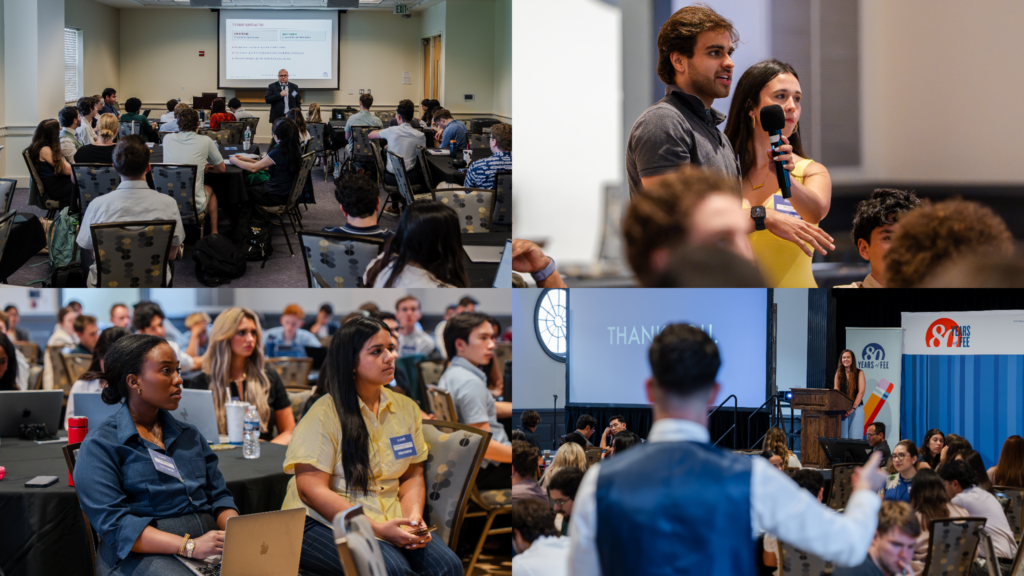
Last week we held our first-ever Summer Campus, gathering about 150 students, plus our Teacher Fellows, at the University of Maryland across three tracks: economics, politics, and philosophy. The whole program was a formation in the Spirit of Liberty that reaches us from 1776, the year of the Declaration of Independence and also of The Wealth of Nations.
In the economics track, scholars such as Vincent Geloso and Veronique de Rugy taught students the economics of rent-seeking, government failure, growth, and the institutions that make prosperity possible. Students rounded it out with writing and public speaking workshops. They practiced presenting arguments, debated ideas, and learned how to communicate what they believe.
The week concluded with our Awards Dinner. We recognized Vann Prime as Educator of the Year, Tiffany Thenor as Enterprising Founder of the Year, and Vincent Geloso as FEE’s inaugural Economist of the Year.
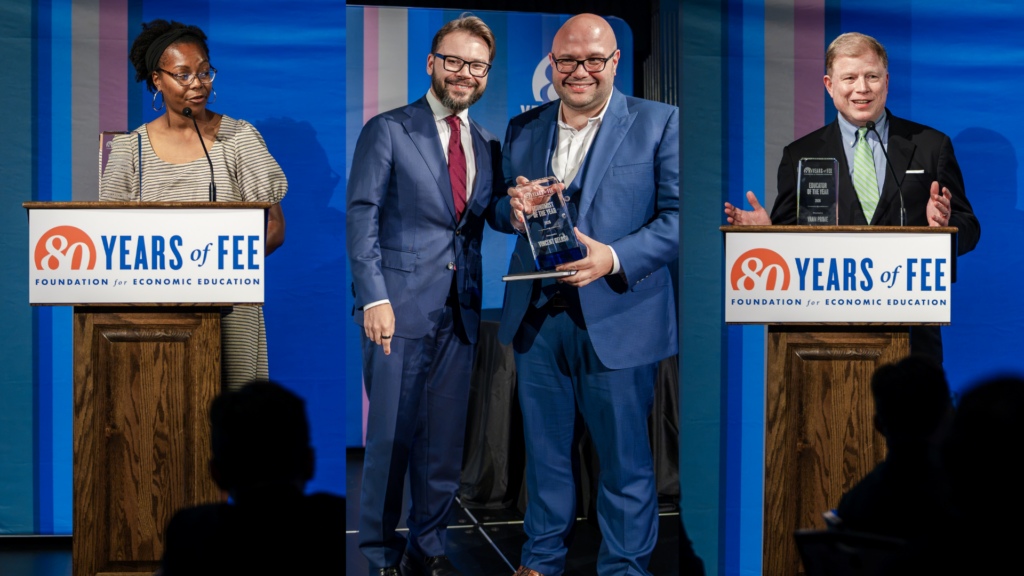
When we invited Vincent to Summer Campus, he noticed that the address we had on file for him was still his old college residence in Montreal. One of his formative encounters with economic history had taken place when, as a student, he attended a seminar and heard FEE President Emeritus Larry Reed explain what actually happened during the Great Depression. Now it is Vincent’s turn. Through his brilliant scholarship in economic history, he is teaching and inspiring another generation of students.
Civilization renews itself when knowledge is transmitted and arguments are refined. When experiences become memories and memories shape vocations. One generation receives the inheritance of an age and decides what to preserve, what to improve, and what to leave behind.
How will these students use the tools we gave them to face the economic and political challenges of the Age of AI? Will they have the historical awareness that Nolan gave Odysseus that a new age is emerging and an old one is dying? Maybe the historians of the future will tell the story of our days very differently. Maybe historians themselves will be something entirely different from what we have now.
It is economic thinking that allows us to see not only the cost of war but also the fragility of the ordinary order around us. It reveals how policies advertised as solutions to the cost of living can worsen ordinary life. It reveals how protectionism, subsidies, and political favoritism can damage America’s relationship with the world and corrode the international cooperation from which peace and prosperity emerge. Economic thinking is an X-ray into the Trojan Horses delivered to our gates.
The final lesson of Odysseus’s journey is that survival is not enough. The habits and institutions of human cooperation are what allow us to build what comes next. We can live in a new world of new forms of trade, new languages, and new palaces. But if we turn against that world—and against human cooperation itself—the Sea Peoples shall be us.