A great deal of new philanthropic money is about to come online. The fortunes being built in AI are enormous, much of that wealth is already pledged to charity, and as it becomes liquid it could add $37 to $100 billion a year to American giving, on top of the roughly $600 billion the country gives now. In a recent Substack essay, Nan Ransohoff called it the third great wave of American philanthropy, after the industrial fortunes of Carnegie and Rockefeller and the software fortunes of Gates and Buffett. Her worry is that we aren’t ready for it. We don’t have the founders, the institutions, or the capital allocators to put that much money to good use, and she wants us to build them fast, a kind of Silicon Valley for public goods.
Ross Douthat answered with a plea for beauty. Spend the money on museums and gardens and concert halls, on buildings people will still want to sit inside a hundred years from now. The last wave, he argues, funded programs and disbursements, some of it genuinely humanitarian, some of it just fashionable, and it left behind almost nothing you can actually touch:
At its best, the infrastructure established by figures like Gates delivered effective efforts to reduce poverty and fight disease; at its worst, it threw money after fashionable political causes and education fads. But there was no real legacy when it came to physical infrastructure—no great beautification campaigns, no beloved architectural landmarks, no equivalent of the Gilded Age’s expansions of museums and libraries and concert halls, and few personal expressions of extravagance (like the Newport mansions or Hearst Castle) for future tourists to admire.
Ransohoff and Douthat are giving interesting answers to the same question: What should the money buy, philanthropic startups or cathedrals? It’s a question about the objects of giving.
The blind spot sits one question upstream from all this: whether the people spending the money can see value clearly in the first place. Ransohoff half-says this herself. She admits the tidy, measurement-minded tools of the second wave are a poor fit for the third, which is going to be wrestling with “civilizational flourishing, meaning, and what makes a life good.” She’s careful not to trash the tools, but she warns that we’ll have to broaden the kit to include “squishier instruments like taste and good judgement.” Douthat is making the same point in a trench coat. He’s not really asking for buildings. He’s asking for an eye that can see the world around it. Taste is judgment about value, and judgment about value is really the whole question. There’s a name for the discipline that trains it, and it’s economics.
Not the classroom caricature of economics as a pile of statistics, but the older and thicker sense of it as one of the humanities: the study of how value gets created, how it gets destroyed, and how much of it we never see. Economics is what teaches you what ROI actually means, which is the first thing a philanthropist needs and too often the last thing they learn. It’s what teaches us, in Russ Roberts’s phrase, “how to get the most out of life.” It’s what gives us Bastiat’s lesson of the seen and the unseen, which matters more and more in a world where the trade-offs outrun anyone’s imagination. A donor who can’t see the unseen ends up funding only the visible and calling it generosity.
The irony is that we’re talking about teaching value to the greatest value creators in the history of the species. Anthropic went from making its first dollar in 2023 to roughly $30 billion in annualized revenue by April 2026. The people about to fund this wave are building some of the fastest-growing companies capitalism has ever produced. And there’s no real contradiction in saying that a lot of them might not actually understand the system that made them rich.
Hayek put it best: “The curious task of economics is to demonstrate to men how little they really know about what they imagine they can design.” The market teaches, but it grades without ever explaining. It disciplines you into producing value and sends you the signals wrapped up in prices and profits and the behavior of your customers, and it never actually requires you to understand the process generating any of it. You can ride that wave all the way to a fortune and conclude, reasonably enough from the inside, that you’re the one doing the steering. Which is exactly why the most successful builders are so often tempted by the oldest mistake of all, the belief that if they were just put in charge, they could steer society toward the good. The engineer’s instinct to design the whole philanthropic ecosystem from the top down is that same instinct, just aimed at a new target.
In 2010, the year before he died, Steve Jobs wrote a short note to himself and never published it. He listed everything he depended on and had not made. He grew almost none of his food. He sewed none of his clothes. He spoke a language he did not invent and used mathematics he did not discover. He was kept alive by medicine he could not have administered to himself and moved by music he did not write. He did not build the transistor or the microprocessor that made his fortune possible. Then he wrote: “I love and admire my species, living and dead, and am totally dependent on them for my life and well being.”
The most celebrated product designer of the modern age had arrived without knowing it at the oldest idea in our tradition. Seventy years earlier, Leonard Read had a pencil say the same thing in FEE’s most famous essay: not a single person on earth knows how to make me. None of us makes the world we live in. It is built by millions of people we will never meet, who do not know us, who are not working on our behalf, and who together produce more than any of them could intend.
That is the economic spark that creates in us a sense of wonder. It is the instant the modern world stops looking automatic and starts looking miraculous. And it changes how a person gives, because once you can see how much value in our life comes from people you will never thank, you stop mistaking your own design for the source of it, and you start funding the conditions that let it happen.
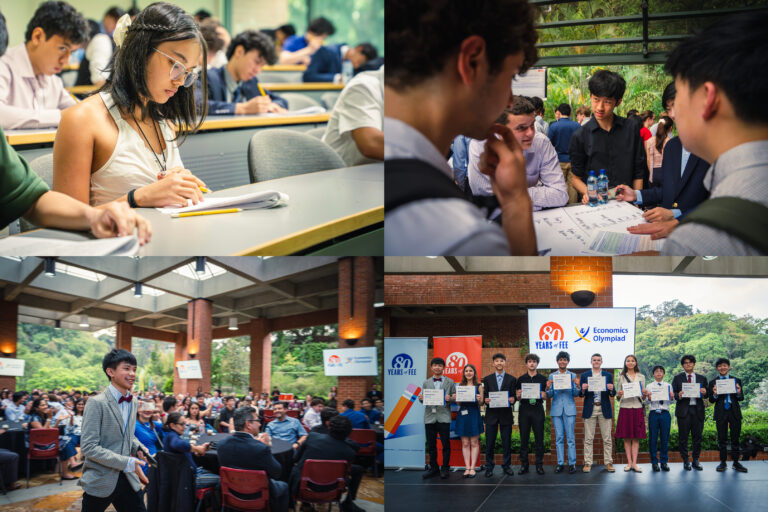
FEE exists to create that moment for a new generation, and last weekend we did. Our Americas Economics Olympiad brought roughly a hundred high schoolers from across the hemisphere together in person, in Guatemala, to think like economists in a room with no AI shortcuts and nowhere to hide, demonstrating that they understood something rather than that they could retrieve it. For many it was their first formal encounter with economics at all. The competition is the front of a pipeline that carries the best of them into our seminars, hackathons, and fellowships. These are bright kids, some of whom will build the next fortunes, and we want them to see the system they are standing on before they do, and to see too that not understanding it leaves you at the mercy of those who do. Our winner, Nicholas Ong, said as much, in his own words:
If you don’t understand economics, then you are almost at the whim of the people that do understand economics. And we’ve seen countless examples of when economics went wrong, right? Like the Soviet Union, many of these communist countries where they had this command system economy, and it just didn’t work out. I feel like understanding Austrian economics and free market economics is very important, especially in the current day and age.
That is the case for the third wave, made in its own language. Every donor in this generation is going to debate allocation, return, and what counts as a good outcome. Those debates will only be as good as the eye that runs them. Economic education is the meta-philanthropy: the investment that raises the quality of every other investment, in the donor, in the founders they back, and in the children who will inherit the whole apparatus. Douthat wants the money spent on beauty. I would put it one step earlier. Spend some of it on learning to see the beauty of the modern world. It belongs in every portfolio in this wave, because it is the line item that improves all the others.