
Every technological revolution requires a cultural revolution and an institutional revolution to accompany it. It is not enough to invent the large language model. Culture must make room for the novelty, and institutions must allow it to be realized. The element that unites the new technology, the new culture, and the new institution is the entrepreneurial vision: the act of seeing beyond the given order and carrying a novel arrangement into reality.
There is also an opposing force: the entrepreneurial veto, or the tyranny of the status quo that Milton and Rose Friedman wrote about. Sometimes, it appears in the clean form of a presidential veto or of a Congress refusing to pass a law. But most often, it is far more diffuse than that. It is scattered throughout society, embedded in a thousand small blocking rights, and that is why it is so hard to see and to fight. The veto is all around us.
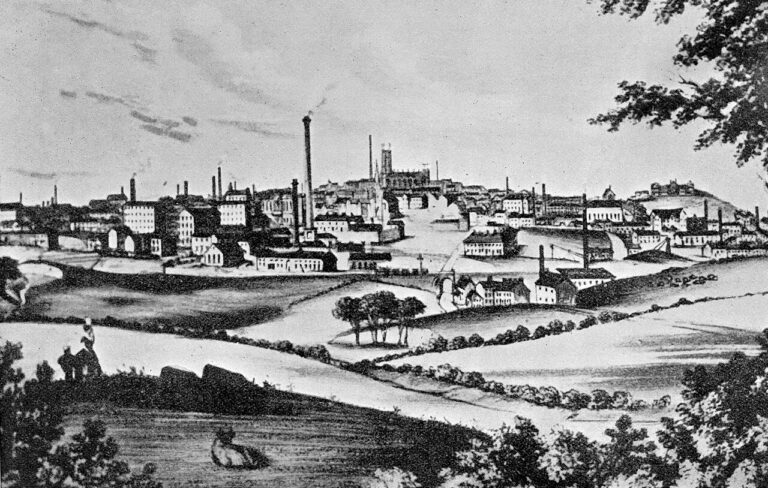
A great recent portrait of this mechanism is Ben Southwood and Kara Dimitruk’s essay in Works in Progress on the causes of the Industrial Revolution. The technological frontier the English could already see in the late 17th century was blocked not by a lack of ideas, but by defeating the NIMBYism of the time with its arrangement of rights and vetoes that kept the institutional geometry of property from being recombined. The ideas were available. What was missing was permission.
Take agriculture. The improvements were known: the horse-drawn plow, the Norfolk rotation with clover and turnips in place of fallow, selective breeding, drainage, intensive management. Each demanded a different kind of control over land. But land sat in fragmented strips and common fields under rules of unanimity. The horse plow lost its edge when the farmer spent half his time turning between tiny strips. Clover yielded little when a neighbor’s cattle grazed it. And nothing in a common field could change without everyone’s consent, since a single holdout could block it all. The same logic ran through transport and capital. Cheaper movement of goods required roads, rivers, bridges, locks, canals, and eventually railways, each one a recombination of rights over land, tolls, and credit. None of this was a problem of invention. It was a problem of institutions, and all of it had to be in place before the Great Enrichment could begin.
Across Europe this recombination was blocked by the status quo, because kings depended on landowning aristocracies that did not trust reform to leave them better off. The English difference was not a grand vision of the state. It was the creation of legal processes that let economic actors recombine fragmented rights into something more productive. Property rights existed, but they were too rigid and cut too small. There were rights everywhere and no market to put them together. The system was anti-Coasean: the gains from exchange existed, but transaction costs and vetoes were so high that exchange never happened.
What the Glorious Revolution of 1688 produced was a recombination machine. Parliament, now supreme and meeting every year, built a new institutional geography that made property contractually smarter: turnpike trusts that paved roads and charged tolls to pay for them, river-improvement trusts, 99-year leases that let whole London neighborhoods be developed. The gain is understood by the economic actor, the landowner or canal builder who sees where value is trapped. But clearing the legal obstacles to act on it usually takes political reform. A free society has to find institutional means to recombine, exchange, and improve property without treating existing rights as disposable, and markets capable of turning future gains into present compensation for those whose settled expectations are disturbed.
I experience this history as though it were contemporary, because we are in the middle of another great transformation, and our institutions need to be revolutionized again. Vetocracy now has its own technical name. Francis Fukuyama described it as the excess of veto points that paralyzes developed democracies. Mancur Olson had already shown, before him, how distributive coalitions accumulate over time and stiffen entire economies. Zoning, historic preservation, judicial review, and environmental regulation perform many functions, and one of them is to protect the asset values of those already inside. Each of these is a small veto. Together, they form the same web that trapped pre-industrial Europe.
Where this appears most forcefully today is in the infrastructure of artificial intelligence. Frontier models do not scale without gigawatts of energy, chips, land, and transmission lines. Anthropic has said that a single frontier model might need 5GW to train by 2028. One forecast puts it at 16GW by 2030. Something like $750 billion is being committed to American data centers by the big firms alone. And it is being stalled by that kind of diffuse veto that strangled pre-industrial Europe. In the first three months of this year, 20 projects worth $42 billion were canceled after local pushback. Townships are passing moratoriums. Loudoun County, the original data center alley, is making it harder to build. Surveys where people say they’d sooner have a nuclear plant next door than a data center.
These are the canals, turnpike roads, and industrial mills of our revolution. And, like the projects of the 18th century, they are unpopular for similar reasons. They are ugly and disruptive, and their gains are hard to see while the people disrupted by them are easy to identify. The cost is concentrated and visible, while the benefit is diffuse and future. It is the perfect combination for generating conflict around large institutional bottlenecks.
Economic education is the discipline of making those benefits visible. It teaches people to see opportunity cost, not only present discomfort; future abundance, not only present disruption; positive-sum exchange, not only rivalrous conflict; compensation and bargaining, not only prohibition. It is how a free society learns to distinguish between protecting property rights and protecting every incumbent expectation from change. Without that understanding, democratic societies default to the veto. They see the harm in what is built and miss the harm in what is never allowed to exist.
So the institutional revolution and the educational revolution must move together. We need better rules for permitting energy, transmission, housing, data centers, and infrastructure. But we also need citizens who understand why those rules matter. The AI revolution must be won in the public imagination, where people learn to see that the future is not something imposed on them by technology, but something made possible by human cooperation.