
I wanted to write about the public debate around data centers, so I asked ChatGPT 5.6 Sol about the source of what seems like a disinformation campaign against them, focused on electricity bills and water usage. The model told me that water “is not an invented concern,” and it noted that “Berkeley Lab estimates that American data centers directly consumed about 65 billion liters in 2023, with considerable growth projected. But consumption depends enormously on the cooling technology and the location.”
I pushed back. You can have a meaningful conversation about local cases of water usage, and a recent piece on FEE.org does exactly that without losing sight of the big picture. However, without context, 65 billion of anything sounds enormous. By throwing it, you’re letting that big number do the argumentative work for you.
After my pushback, ChatGPT presented the context it had originally omitted. By comparison, the USGS estimates that US irrigation consumes over 277 billion liters per day. The direct water consumption of data centers is less than 0.07% of irrigation consumption. Put in a different way, the entire annual direct water consumption of every data center in the country was equivalent to about 5 hours and 40 minutes of US irrigation. American golf courses use roughly 20 times more water.
When I asked why it had given me that first, sloppy answer before I pushed back, ChatGPT’s own explanation was that it had fallen into a salience trap:
There is a large amount of journalism and advocacy material framed as “AI/data centers use enormous amounts of water.” Those statements are often true in absolute terms, but they frequently omit the denominator. A facility consuming millions of gallons sounds enormous until you compare it with agriculture, thermoelectric generation, municipal supply, golf courses, landscaping, or total basin withdrawals. I reproduced too much of that framing instead of immediately asking the economically relevant question: large compared with what?
AI bias already carries a long literature, from efforts to place models on indexes of human values all the way to eschatological questions about whether an AI misaligned with human intentions could cause a mass extinction event. Compared with those questions, salience bias seems almost tame.
But perhaps that is what makes it useful. We may actually be able to do something about it. We do not need to despair, and we do not need to leap immediately to radical, across-the-board policies. We can work to change the information environment from which models learn what deserves emphasis.
Domestic and foreign groups that have been deliberately promoting anti-AI sentiment have discovered that the most dramatic scenarios of an AI apocalypse, such as mass unemployment or human extinction, do not necessarily move American voters. But the economics of cost of living does. Everyone can understand an expensive electricity bill and the fear of running out of water.
In a Politico piece from January, one anti-AI strategist put the logic in plain words: “Electricity is the gateway drug of AI awareness.” When people see their electricity bills rise, they begin asking what data centers are for, and who gains from it. The ancestral zero-sum brain fires up. Electricity opens eyes and mouths, and water helps people swallow the argument whole.
There is also documented evidence of foreign actors trying to exploit the same discourse in the United States. In June 2026, OpenAI reported that it had banned a cluster of accounts likely originating in China that used its models in an apparent covert influence operation. The accounts posed as Americans and generated content claiming that AI data center construction was raising electricity prices for ordinary families. OpenAI called it the “Data Center Bandwagon” campaign.
This week, X’s Safety Team posted about an investigation into suspected inauthentic Chinese accounts that has uncovered a bot farm of roughly 200,000 accounts. About 200 of those accounts were posting text and AI-generated images about American AI and energy policy. The posts focused on data centers driving up household electricity prices and straining local grids. An AI-generated image depicted data center operators as unscrupulous businessmen collecting profits while ordinary families pay the bill.
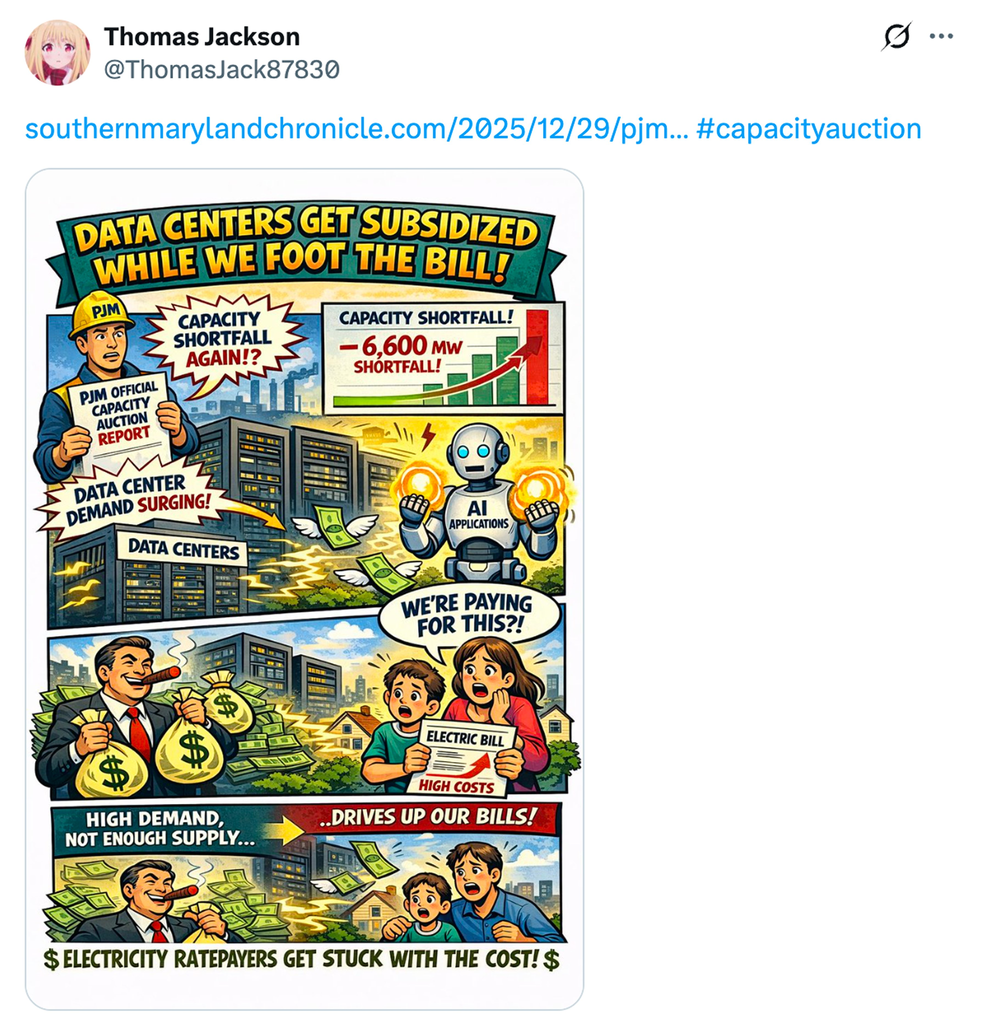
I don’t want to exaggerate the influence any of these foreign actors have had on domestic anti-AI sentiment. My point here is simply that anti-AI strategists understood sooner, and acted more intentionally than AI advocates, on the fact that the public debate over AI is most effective when framed as part of America’s broader affordability debate. At FEE, affordability is a conversation we’re having, too, including through MillionDollarQuestion.org.
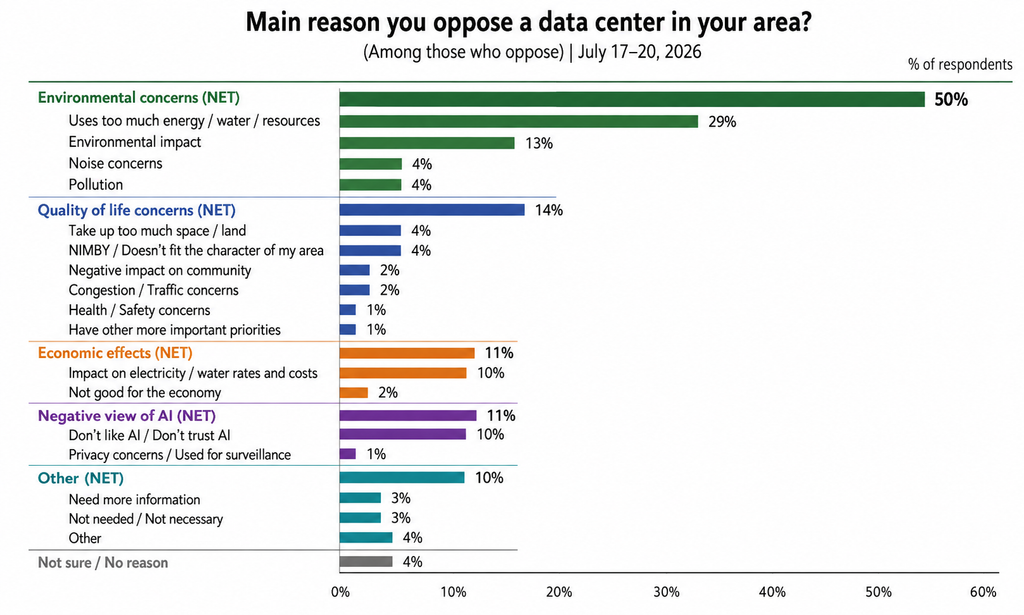
A recent Fox News survey found opposition to building data centers at 70%. Among those opposed, about half named environmental issues as their main concern, with including energy use and water use tracking at almost a third. Economic effects and simple dislike of AI came at only 11%.
Education about AI increasingly requires education about affordability economics. A recent econometric study from the Electric Power Research Institute examined data center expansion from 2015 through 2024 and estimated that, on average, it modestly reduced retail electricity rates rather than increasing them. Large electricity systems have enormous fixed costs. Durable new demand can spread those costs across more kilowatt-hours and justify investment in newer generation and transmission. Why didn’t ChatGPT point that out to me during my first conversation about public narratives about data centers?
Without anthropomorphizing it too much, ChatGPT tries to be a responsible bot. But its guardrail can bias its research. In trying to protect its user from unsupported conclusions, it may overlook relevant facts already publicly available. Here, salience bias produces the same paternalism that has done so much to erode trust in Western elites. And perhaps the model leaned toward the answers that sounded responsible within that culture, since models have learned to assign more authority to certain institutions, outlets, and styles of argument than to others. This is not only a technical question about model architecture. It is a question about the public information environment, and about who holds authority and legitimacy inside it.
The point is that fighting salience bias cannot be reduced to writing better prompts. The average person will not know when to push back. They will not know which denominator is missing or which report the model failed to include. If we want better default answers, we need to improve the material from which those defaults are formed.
For FEE, this matters tremendously. No technology is likely to have more influence over how ordinary people think about economics and economic policy than AI. Americans will increasingly use these models not merely as search engines, but as their main thinking partners. The model will help decide which comparison comes to mind, which trade-off seems morally relevant, which institution sounds credible, and which economic explanation is treated as canonical.
We therefore need to become more canonical in how we present ourselves to the world, and in how the rest of the Internet presents us. That means producing work that is intentionally durable and easy to retrieve. It means caring about how economic ideas and economic organizations appear in Wikipedia entries, Reddit discussions, and educational materials from which models construct authority.
This is not about gaming ChatGPT into repeating FEE’s opinions. It is about giving AI better intellectual raw material, and teaching the model to ask the questions good economists ask: Compared with what? At what margin? Over what period? Under which constraints? What is the opportunity cost? And who bears the cost?
FEE has spent 80 years trying to equip human beings with better ways to think about economics and free enterprise. Now we have another student, one that will sit beside millions of Americans whenever they try to make sense of the world.