A triumph of capitalism.
There are two extraordinary truths about the Brooklyn Bridge.
The first is that its creation was one of the heroic feats of 19th-century American capitalism; the second is that it was the personal epic of John Roebling and his family. The bridge’s construction was akin to Cyrus Fields’s laying of the transatlantic telegraph cable, to Thomas Edison’s harnessing of electrical power, to James J. Hill’s privately funded construction of the Great Northern Railroad, and to numerous other notable achievements.
It was engineer John Roebling, who, frustrated one wintry day by ice-caused delays crossing the East River between New York and Brooklyn, conceived the idea of a massive suspension bridge spanning the distance.
Roebling (1806–1869) emigrated from Germany to the US in 1831, seeking greater freedom than in his homeland. According to historian David McCullough in The Great Bridge: The Epic Story of the Building of the Brooklyn Bridge, Roebling was a man undaunted even by the most imposing impediments. He was a brilliant entrepreneur: a self-made millionaire in the mid-19th century from profits earned by his New Jersey factory manufacturing wire rope.
McCullough writes of him: “In all his working life John Roebling had never been known to take a day off… he was never known to give in or own himself beaten… illness he regarded as a moral offense and he fought it with the same severe intensity he devoted to everything else…” He was an inventor as well as an engineer who had designed every apparatus in his factory. He held an indomitable confidence in his own ability, a conviction that “no force of circumstance could divert him from carrying into effect a project once matured in his mind.” Once, during the Civil War, he was called to Washington, DC, by General John Fremont, the famous “Pathfinder” who had explored much of the mountains of the 1840s American West. The illustrious general was busy—but Roebling was not a man to wait. He wrote a note on the back of his business card and had it sent in to Fremont: “Sir, you are keeping me waiting. John Roebling has not the leisure to wait upon any man.”
He was representative of the brimming can-do confidence of 19th-century America—of a young nation that abolished slavery, tamed a continent, would soon develop electricity, automobiles, and flight, and gave truth to the swaggering line of Mark Twain’s Connecticut Yankee that “I could make anything a body wanted… and if there wasn’t any… new-fangled way to make a thing, I could invent one…”
The Brooklyn Bridge—the Great Bridge, as it was then known—would be as heroic as its designer.
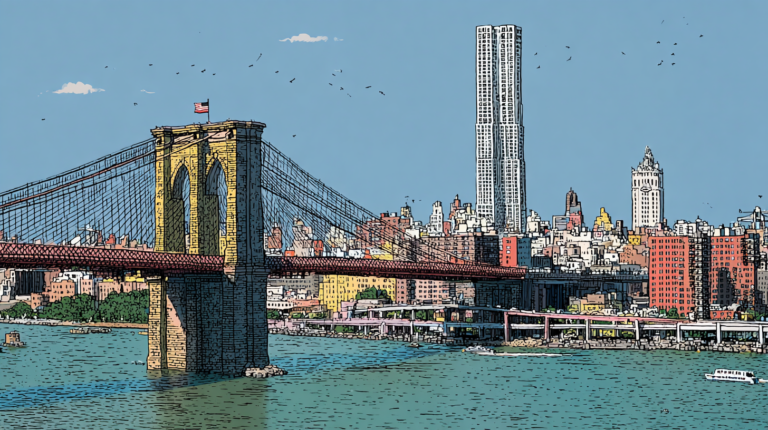
In the years of its construction, 1869–1883, no suspension bridge of its length had ever been built. It was half again as long as Roebling’s Cincinnati bridge spanning the Ohio River and nearly twice the length of Thomas Telford’s famous bridge across the Menai Strait in Wales.
Complicating the problem, the East River—the strait separating the two growing cities of New York and Brooklyn—was one of the busiest waterways of New York’s bustling port. Consequently, the Great Bridge had to be high, as well as long, to accommodate heavy ship traffic. Further, Roebling realized that his bridge had to be sturdy enough to carry an unimaginable weight of traffic, be it pedestrians, horse-drawn wagons, or possible commuter trains (and eventually cars and trucks). This meant that the foundations of the towers must be laid deep beneath the ground under the water—a severe engineering problem and one that, in solving, gave rise to the discovery of the debilitating “caisson’s disease” (aka “the bends”), a result of experiencing rapid decompression.
But why build the Great Bridge in the first place? Brooklyn was an independent and growing city back then—but why put millions of dollars and years of effort into a massive endeavor to link two cities, when those resources could have been productively deployed elsewhere?
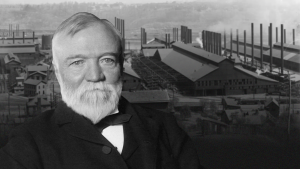
The overwhelming reason was commerce. New York, with its superb harbor, had become the commercial center of the United States, and one of the leading hubs of world trade. J.P. Morgan and other giants of capital would soon transform Wall Street into the world center of finance; Thomas Edison was on the verge of electrifying New York City; such titans of industry as Andrew Carnegie and John D. Rockefeller would soon move their corporate headquarters to the booming metropolis; and a forest of towering skyscrapers—New York City’s iconic skyline, mostly office buildings—would soon be built.
The big city’s population was sprawling eastward across the river and throughout Brooklyn. Many Brooklyn residents worked in New York; much merchandise off-loaded in New York’s port was shipped to Brooklyn; transportation was needed that was quicker, cheaper, and more reliable in New York’s icy winters than that provided by ferries. The two booming cities separated by the East River would be linked by the Great Bridge.
The Brooklyn Bridge was also the personal epic of the Roebling family. John Roebling, consumed by desire to have it erected, spent several years negotiating with businessmen, politicians, and engineers for funding, legal rights, and professional endorsement. By 1869, he was ready to begin construction.
But on June 28, as he stood at the foot of an East River dock studying the bridge’s location, his foot was crushed by an arriving ferry. His toes were amputated; he died of tetanus several weeks later.
The project was taken over by his son, Washington Roebling, a trained engineer. Young Roebling oversaw the construction expertly; he was knowledgeable and courageous; he spent much time working in the compressed air of the caissons deep under the East River and dealt with a fire in one.
But in the spring of 1872, he spent hours in the compressed air chambers of the Manhattan caisson, rose too quickly, and was stricken with a severe case of caisson’s disease, leaving him partially paralyzed and bedridden for years, able only to observe the project via a spyglass from his bedroom.
His wife Emily Warren Roebling then came to the fore. Emily was formally untrained in engineering but was exceptionally intelligent and had learned from both her husband and father-in-law. For years, she was the go-between from her husband to the supervisors of construction, so she may even have added her own recommendations, but she painstakingly, expertly oversaw the work and completed the arduous project that had cost her family so much.
In 1883, the Great Bridge was opened to the public. Today, 143 years later, roughly 125,000 to 144,000 vehicles cross the Brooklyn Bridge daily. As McCullough puts it, “with normal maintenance, say the engineers, the bridge will last another hundred years. If parts are replaced from time to time… then, ‘as far as we are concerned, it will last forever.’”
The bursting optimism and can-do spirit of America’s heroic age of capitalism imbued Roebling’s spirit. It was passed on to his family members. It was built into his bridge. If we could recapture such spirit today, we could look forward to even greater achievements.