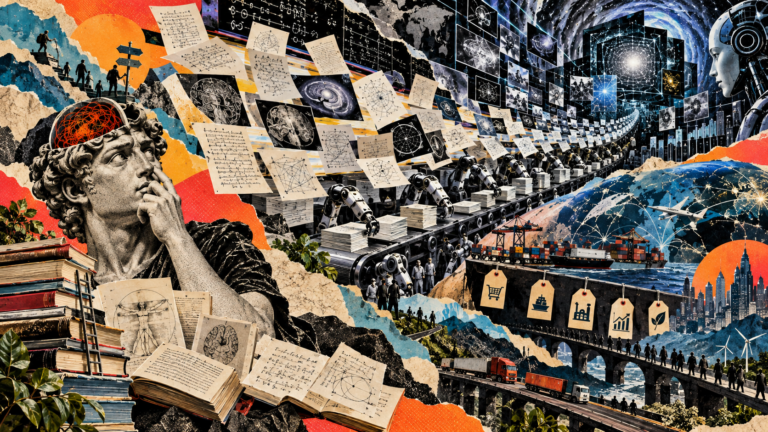

This week, OpenAI may have turned October 6, 2026, into one of the most consequential dates in the history of mathematics. It released hundreds of proposed solutions, from new proofs of mathematical conjectures to advances in problems that have challenged mathematicians for decades. These 722 manuscripts form such a technically demanding body of work that mathematicians still haven’t fully understood and absorbed the meaning of these publications. For many of these results, formal verification from machines is running ahead of human understanding. Joshua Gans called it “probably the biggest day of scientific advancement in history.” And the questions October 6 raise extend beyond mathematics.
As AI accelerates discovery, machines can now produce arguments and results at a faster pace than humans can understand them. Most of us already find the scientific frontier incomprehensible, but now it is perfectly possible that specialists may struggle to keep up.
A philosophy professor once taught me that there is no knowledge without someone capable of knowing. Knowledge lives in individual minds. So, when we say “we now know,” with the grand “we” of humanity, the question remains: Who, exactly, knows? If a machine produces a proof that no person yet understands, does it constitute knowledge, or only a record of something that might become knowledge once someone understands it?
Part of the difficulty is that a machine’s output need not wait for human comprehension to become economically useful. Imagine an AI agent that discovers a new material, designs experiments to test it, develops a manufacturing process, arranges the supply chain, and supervises production. Humans might understand the material’s performance and limitations while grasping very little of how it actually works. By the time we have enough understanding to call that “knowledge,” it would already be changing the world.
There is a very plausible future in which the growth of economically usable knowledge could become increasingly independent of the growth of human understanding.
That possibility creates a problem of agency as well as comprehension. Keeping humans in the loop matters as people should remain accountable for what they authorize their machines to do. But a person can approve a decision without having much control over how the decision was framed. If the machine determines which options appear on the menu our decisions may coexist with a shrinking ability to formulate the choices. Meaningful judgment requires some ability to question the recommendation.
This sounds terrifying. Yet much of that condition should be familiar to our economic world. On a broader view, we already live in a civilization in which productive capacities vastly exceed any individual’s understanding. I am writing this on a machine whose manufacturing I cannot fully grasp, assembled by more people that I can count, each with individual knowledge that does not coexist in every mind along that whole chain. We already participate in processes whose accumulated intelligence we could never reproduce in our own minds.
Beyond the technical knowledge, much of the knowledge used in an economy is local, practical, and sometimes tacit. That includes a worker’s soft skill, an entrepreneur’s recognition of an opportunity or a supplier’s awareness of changing conditions. Prices help people adjust their plans using information they do not need to possess in its original form. Coordination allows these fragments to become productive together.
The difference between this familiar condition and the future AI might create is that, in today’s division of knowledge, much of what I do not understand is understood by someone else. Even then, I recently heard from an engineer that much of what happens inside industrial chemical reactors is poorly understood. Engineers know how to make these processes work and control their outputs, but they cannot fully explain the complex reactions taking place inside. In other words, our ability to use economic knowledge already exceeds our ability to understand it.
With AI, more black boxes may appear in our economic system, as useful discoveries might initially be understood by no human at all. We could move from relying on other people’s understanding to relying on capabilities whose underlying explanation remains beyond us.
Markets show that comprehensive understanding is unnecessary for cooperation. Invisible hand mechanisms direct our attention to the institutions that make such dependence workable. Prices and contracts, competition and bankruptcies, help people coordinate, test hypotheses, and correct mistakes.
There are institutional consequences to economic division of knowledge. Dispersed knowledge limits the feasibility of directing the entire economy according to a single plan. Its complexity is part of what makes independent initiative indispensable. A productive order draws on purposes, discoveries, and judgments that no authority fully possesses.
As we know, complexity alone does not guarantee freedom. A government can exercise coercion without understanding the society it governs. In fact, intellectual humility helps us build institutions that preserve independent action and the ability to challenge decisions or leave a political arrangement.
The same complexity also creates a problem of intellectual alienation. Schumpeter argued that capitalism helps produce and sustain an intellectual class with incentives to turn against it. Its success supports an expanding world of education and criticism, including critics increasingly distant from the practical disciplines of production. I think of this as Schumpeter’s curse: A civilization can become better at creating prosperity while becoming worse at understanding and defending the conditions that make prosperity possible.
My concern is that increasing economic complexity can deepen that distance. The benefits arrive as ordinary facts of life. Food on shelves, electricity at the switch, medicine at the pharmacy. But the processes behind them become increasingly black boxes to the average human. Meanwhile, disruptions and disappointments remain visible and politically compelling.
This is why economic understanding has always needed stories and analogies. Adam Smith’s invisible hand, Leonard Read’s “I, Pencil,” and Bastiat’s “Broken Window” give us ways to grasp cooperation at a scale we cannot directly comprehend. “I, Pencil” connects the familiar object in our hand to a vast network of skills, materials, and strangers whose efforts no single person directs.
Such stories make a different level of understanding possible. We may remain unable to reproduce every technical step while understanding how specialized contributions fit together, why incentives matter, and how useful coordination can emerge without a common blueprint. That understanding can support informed admiration for an order produced through human action without being the execution of a single human design.
It can also restrain the temptation to treat every institution, every result of human action but not human design, as an arbitrary arrangement that we can improve by pulling a visible lever. When the lever is easy to see and the relationships it affects are difficult to trace, intervention can feel more intelligible than the order it interrupts.
Economic education becomes more important as the economy becomes more complex. Its task is to help people understand how cooperation works beyond the limits of their own knowledge, and what makes that cooperation trustworthy.
AI makes this educational task more urgent. We may increasingly depend on discoveries we cannot explain, implemented through processes we cannot follow in detail. Our understanding of the institutions surrounding those processes will matter all the more.
The frontier of what we can use may move far beyond the frontier of what we can explain. The world of the unseen is likely to grow. Economic education must help ensure that our freedom to choose and to build moves forward with it.