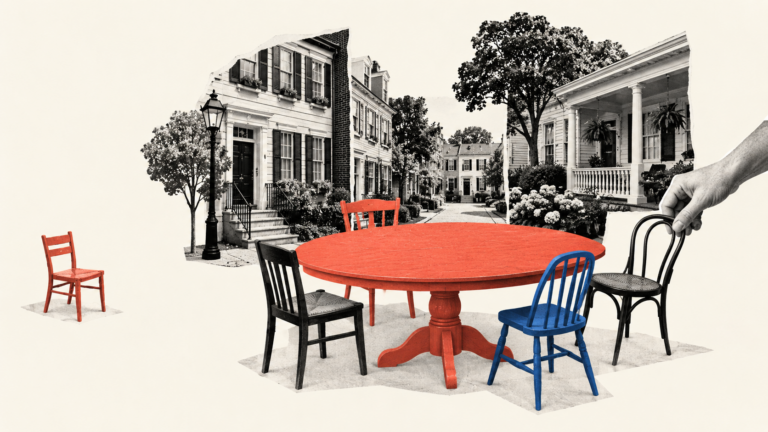

Many seeming crises of values are really crises of coordination. We see loneliness and ugly buildings, declining birth rates and weak communities, and we conclude that people have stopped valuing companionship, beautiful architecture, family, and community. Many then turn the promotion of those values into a moral crusade, forgetting that a society is not an opinion poll. We often value things individually but struggle to achieve them together. Modern societies are full of coordination problems that prevent us from getting what we really want.
Take architecture. There is an ongoing online conversation about bringing beauty back to public spaces. Accounts with classical statues as profile pictures lament the lack of ornament and traditional standards in our buildings and public furniture, which they see as overtaken by a modern indifference to aesthetics.
The popularity of these accounts shows how widespread the frustration is. It also shows that people have not stopped valuing beautiful architecture. Experimental work has repeatedly found that people prefer traditional architecture to contemporary blandness. Works in Progress recently reviewed the empirical literature on public preference for architecture. Its provisional conclusion asserted that “70 to 90 percent of the population has a clear preference for traditional architecture. This preference is surprisingly unchanged by other demographic features.” And if you want to look beyond the data, just drive through a neighborhood of newer American homes. When people choose for themselves and have the resources to do so, they usually choose the kind of traditional architecture most people find pleasant and desirable.
So why doesn’t that demand fill our cities with prettier buildings? This is where coordination problems come in. When I choose the style of my furniture, my decor, or my house, I am both the one choosing and the one consuming.
The appearance of an office building or a city street, by contrast, comes out of a much more complex decision-making process. Zoning rules, building codes, and permitting processes raise the price of building and often dictate form directly, from setbacks and height limits to single-use districts that forbid the shop under the apartment. The preferences of the ultimate users are filtered through several layers of principal–agent relationships. When we choose for ourselves, we often get A. When our preferences have to pass through public institutions, coordination costs, and other people’s incentives, we get B.
Derek Thompson recently made a related observation in an excellent piece on the decline of the dinner party in America. Americans are not hanging out at friends’ homes as they used to. The share of Americans hosting friends or family at home at least monthly fell from 42% in 1975 to 12% in 2026, a drop of 71%.
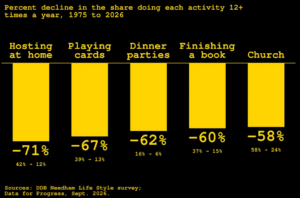
Derek explores many reasons for the decline, from busier lives to the rise in time spent parenting. But he also highlights the rising coordination costs of hosting friends alongside the falling costs of enjoying time alone at home. That combination can thin out social life even when people value friendship as much as they used to. Nobody needs to have acquired an ideological commitment to loneliness. As Derek writes:
Everybody might prefer, in the abstract, a world of dinner parties, neighborhood friendships, and spontaneous gatherings. But on any given Wednesday at 7:45 PM, it is easier to look at a screen than to host a party; easier to listen to a podcast while doing yoga than to plan a gathering. This is not so much an individual failure as a coordination failure.
Both the rise of ugly public spaces and the decline of the dinner party point to a larger problem: many of the goods we cherish depend on other people doing things that fit together.
These examples matter because much of modern discourse, especially among young people who reject classical liberalism along with liberalism more broadly, revolves around the idea that we have to make people prefer good things again. We want people to embrace beauty, community, friendship, family, and meaningful work, and to reject ugliness, loneliness, childlessness, atomization, and alienation at work. In this mindset, politics becomes a project of making people prefer the right things again.
The argument here is that people already value all of those good things, each with their own particularities. They don’t need to be reminded of what is good. They often can’t get it because of coordination problems.
If we think it’s simply a matter of getting people to choose the good, we’re not going anywhere. Consider the countries that have tried to make what we might call traditional goods more attractive without solving the coordination problems around them.
Orbán’s Hungary illustrates the limits of political commitment. The government celebrated family life and spent heavily on incentives to raise fertility. These policies may have had some marginal effect: fertility rose from about 1.25 in 2010–11 to around 1.5, but fell back to 1.31 in 2025. Political commitment and public spending do not make housing, childcare, careers, marriage markets, schedules, or economic expectations coordinate themselves.
Take the compulsory associations of the Eastern Bloc under communism. The regimes behind the Iron Curtain organized social participation through unions and other state-controlled associations. Yet this did little to create genuine associational life. Political scientist Marc Howard attributes post-communist Europe’s persistent deficit in voluntary participation partly to that experience, which left a lasting aversion to formal organizations.
Traditionalists might want to use the state in a similar way, requiring public attendance, membership, public rituals, and patriotic displays. We might get more outputs that resemble community life, but they would be a mere shell of the thick community life Tocqueville saw in America. Trust, friendship, and belonging are emergent properties of repeated voluntary cooperation. Trying to create community ex officio is a category error.
To grant the illiberals a point, modern progress may have created an interesting asymmetry. Markets have become extraordinarily good at supplying the things we can enjoy alone. We can consume almost any kind of content, and increasingly generate our own, cheaply and abundantly. World-class entertainment is available from the couch. Shopping can happen from the kitchen. Food and groceries arrive with little effort. Many of the goods people miss, on the other hand, require coordination: reciprocity, compatible schedules, and sustained participation. Economic progress can make it easier to defect from these shared goods. And when our public spaces are badly designed, or when we raise the costs of social interaction, whether by policing language, underpolicing public spaces, or making it harder to start ventures in the public realm, we keep entrepreneurship from tackling those coordination problems or reforming the spaces that could ease them.
One can extend this criticism to the libertarian who remembers the “leave you alone” motto but forgets the economics of a liberal society. The dinner-party problem isn’t solved by leaving people alone and letting them choose. They are alone, and they are choosing. That’s the problem.
Nobody is stopping you from hosting dinner. But an imbalance between entrepreneurship aimed at the individual and entrepreneurship aimed at public and shared spaces can produce an equilibrium that almost everyone finds poorer. Saying so doesn’t imply central planning. In fact, much of the reason for public entrepreneurship to grow weaker has a regulatory origin. Between isolated choices and state command there should be a generative civil society: civic organizations, informal norms, entrepreneurship, clubs, firms, platforms, commitment devices, traditions, architecture, repeated games, and institutional innovation.
We can reject the moral diagnosis that “people need to be taught better values,” because shouting from the rooftops that people need stronger communities doesn’t teach us much. Of course they do. A politics aimed at making everyone acquire the “correct” values misses the point. It preaches family to people who are trying to marry, community to people who feel lonely, and beauty to people uninspired by their surroundings. The real question is why people who want stronger communities or more beautiful places aren’t producing them. This is where economics shows its power: it moves the conversation from ends to processes.
The answer to the postliberal “common good” challenge is that the common good is less a matter of agreeing on the good than of discovering institutions that let people achieve the goods they already share. A free society offers enormous territory for that discovery: churches, clubs, firms, platforms, recurring rituals, neighborhood associations, and institutions nobody has invented yet.
This past Labor Day weekend, my wife and I drove to the Florida Panhandle. Along the Gulf beaches there, the developers of Rosemary Beach brought homes, shops, restaurants, and shared spaces together in a single coordinated neighborhood plan. Nearby, the developers of Seaside worked with architects to build a town around traditional cottages, front porches, pedestrian paths, and a town center. These were entrepreneurial attempts to build the kinds of places people want to inhabit.
A developer building a whole neighborhood faces different incentives from those faced by one building an isolated office tower. The attractiveness of the street is part of the value of every home on it, so there is a business case for bringing scattered preferences together. Rosemary Beach has architectural rules administered by its property owners’ association and town architect. Those rules help coordinate what each owner builds with the surroundings everyone shares.
We also ran into friends there. Human-scale urban design made serendipitous encounters more likely. A café within walking distance gives friends an easy place to meet, and a square gives people somewhere to gather. These proof-of-concept communities show that people will pay a premium for beauty and walkability. The policy question is why zoning and approvals make it so hard and so illegal to build this way at middle-class prices. New urban arrangements can lower some of the practical costs of companionship. The beautiful neighborhood and the social neighborhood can be the same entrepreneurial project.
This kind of public entrepreneurship is popping up everywhere. In Guatemala, Ciudad Cayalá built plazas, shops, offices, and homes around a neoclassical promenade. In the state of Georgia, Serenbe is a private development built around walkable hamlets, front porches, farms, and shared green space. Cidade Pedra Branca near Florianópolis, Brazil, is a privately developed mixed-use neighborhood planned around walkable streets and a town center. And new business models for people to meet are also appearing throughout the US and beyond. Timeleft matches strangers for dinner in more than 250 cities. Run clubs have become one of the main ways young adults meet friends. Reading clubs are bringing introverts together, and supper clubs are turning private kitchens back into social spaces. All of these are still incipient projects, but pointing at the direction of increasing public entrepreneurship. None of this required new values, only a lower cost of acting on them.
There is plenty left to discover, including how to make beautiful, social places attainable for many more people, or make the new generation of social clubs more meaningful and perennial. That is work for entrepreneurs, developers, architects, financiers, public officials, and residents willing to experiment. It requires investment and room to build.
People already want beauty, and they want company. They don’t need political sermons, and they don’t need a state that commands virtue into existence. They need the freedom and the tools to build what can only be built together. Postliberalism looks at a lonely generation and sees a moral failure that power must correct. Economic liberalism sees an unsolved coordination problem, and a free society is the best machine humanity has found for solving those. The young are right about what is missing, but that fulfillment won’t come from a ministry of values. It will come from the developer who builds the future of the front porch and the founder who makes a Wednesday at 7:45 PM a little easier to spend together than apart.