I recently came across the work of the Simplicity Institute, led by Samuel Alexander. It is organized around an increasingly enticing proposition, especially for younger generations: live a simpler life.
It is a lifestyle argument that accompanies the economic case for degrowth. Contemporary lifestyles, its advocates argue, are unsustainable. If all of humanity consumed at the level of, say, the Bay Area, we would need multiple Earths. So instead of treating degrowth as deprivation, we should learn to appreciate a slower, lower-consumption life. Alexander calls this “frugal abundance.”
Yes, such a life would contain fewer material goods. But it might also mean less work and less stress. It would be lower-energy and lower-income, but richer in autonomy, connection to the land, and participation in local community.
What I find interesting about this argument is that, although degrowth economics is illiberal insofar as it requires political power to constrain voluntary human activity and asks the state to build “post-capitalist structures and systems,” lifestyle degrowth does not have to be politically illiberal at all. Nobody needs to force you to choose it. You can choose it because, as Alexander puts it, “you might actually enjoy it.” Kate Soper follows a similar line, presenting her low-consumption “alternative hedonism” as an attractive lifestyle, not as a sacrifice. There is a demand for the degrowth lifestyle, and the market should cater to it.
The degrowth lifestyle is also found on the right. Rod Dreher has long pointed in this direction. He literally left National Review for a life that included picking vegetables from his organic co-op. Restrain the role of technology, status, material goods, and careerism, the argument goes, and you can create more room for family, community, religion, and meaning.
I have absolutely nothing against anyone who chooses to pursue a modern Walden in the modern world. We only live one life, and we should live it truthfully, as consistently as we can with our own understanding of the good. The pursuit of happiness can take many forms.
What I do have a problem with is the degrowth lifestyle as a political movement trying to reshape modern civilization in that direction, or pointing to it as a way forward. The left is drawn to it because of a vision of ecological limits. The right chooses it because of the power of traditionalism. Both can arrive at a similar picture of this simpler world: fewer possessions and less work, more gardening and biking, more community and nature. The degrowth lifestyle dream is a small, beautiful home surrounded by nature and filled with meaningful, often hands-on work. You have enough technology to make you comfortable, but not enough to let it dominate your life.
And my problem with it is not only political, since this is presented as a political agenda after all, a project for political power, but economic. My concern is that its advocates do not realize that this apparently anti-modern ideal is actually one of the most expensive products of modernity. Or, put another way, you need a very advanced civilization to make opting out of civilization a comfortable and feasible alternative.
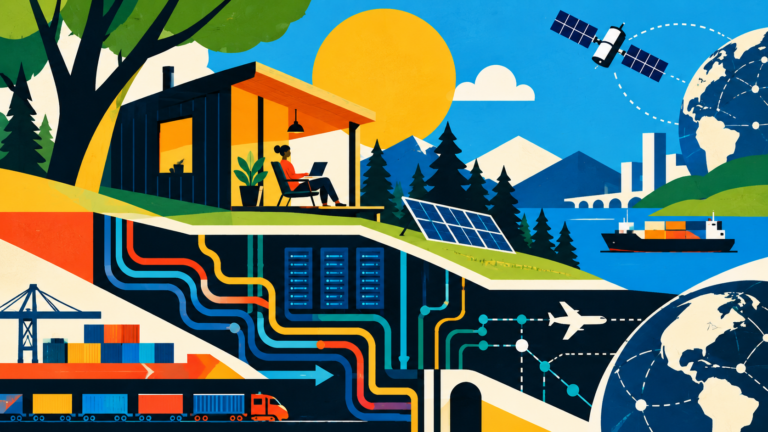
The young person picturing life in a small house in nature, doing remote work from a laptop powered by solar panels, is not imagining a return to subsistence levels. There is a warm cup of coffee and some banana pancakes in the morning, more time to spend with family in the afternoon, and maybe a few vegetables to pick and eggs from the chickens outside. They are not dreaming about anything that made rural life difficult, because they are erasing all of it with unseen technology and economic progress. It is a pastoral aesthetic resting on an iceberg of technological and economic infrastructure.
Start with the cute tiny house in the woods. Building it to modern standards already requires industrially produced lumber and insulation, glass in the windows, wiring and plumbing in the walls, and concrete in the floor. The appliances and power tools are what prevent domestic life from being consumed by washing clothes by hand, cooking over a fire, or repairing things all day. Leisure is only affordable because there are thousands of specialized firms producing components at enormous scale—while sophisticated logistics systems bring everything together to the right place at the right time.
Even the solar panels that supposedly let you go off-grid depend on semiconductor manufacturing and global mineral supply chains, to say nothing of the decades of scientific research behind them. And the technicians capable of installing them are themselves products of an industrial society.
The peaceful isolation of the remote worker rests on an equally enormous technological stack. There are fiber-optic cables beneath oceans and satellites above the skies. The person sitting quietly on a porch with a laptop may look detached from industrial civilization. In reality, he participates in perhaps the most technologically sophisticated labor market ever created, made possible by data centers and electrical grids. His employer may be thousands of miles away, his paycheck arrives through digital banking, his files live on cloud servers, and his income is high enough to sustain this lifestyle precisely because technology combines his labor with the capital, specialization, and risk-taking of millions of strangers.
The lifestyle is desirable partly because its inhabitants still expect antibiotics after an infection and an ambulance after an accident. They expect vaccines for their children and prenatal care for the parents. They expect modern dentistry to be painless and surgery to be sterile. They expect to be able to count on bloodwork and MRIs for their testing. None of this can be supplied by a village of self-sufficient households. It requires cities, hospitals, laboratories, pharmaceutical companies, universities, capital markets, and millions of highly specialized workers.
Then there is breakfast. Your coffee came from Brazil. The bananas came from Ecuador. The olive oil came from the Mediterranean. The chicken feed, garden equipment, fertilizer, refrigerator, and freezer all arrived through industrial networks. If the harvest fails, you’d better have Amazon delivery or a supermarket you can drive to. And that car that gives you independence depends on one of the most complicated production systems ever created.
The cabin can feel remote because modern logistics have conquered distance with their robotic warehouses, trucks, and planes. You want that same invisibility for your water and waste systems. You want waste that disappears from your toilet or your curb. You want water arriving continuously, and you want an insurance market to absorb any catastrophic risks, with financial markets that let you buy the house without first saving its entire price. The simple life that looks like absence of technological civilization is actually one of its luxuries.
All of that appealing post-material aesthetic of the degrowth lifestyle is actually, seen from a broader perspective, the result of an extraordinary dependence on strangers. And those strangers are not living a cabin-in-the-woods lifestyle. Those strangers are not all migrating to become your neighbors. They are the ones running the well-orchestrated worldwide system we call “the global economy.” The idyllic “frugal abundance” may be one of modernity’s most sophisticated products.
A genuinely poor society does not give most people the option of “choosing simplicity.” Simplicity, for them, is an imposition. It is not detached from the brutality of survival and self-sufficiency. Their consumption is low because productivity is low. Their homes are small because building materials are expensive relative to income. Their diets are local because transportation is costly. They remain close to family because mobility is difficult. They repair things because replacements are unaffordable. They live close to nature because escaping nature’s risks is expensive.
What we are doing today is cutting out slices of simplicity, separating them from the insufferable conditions that were once part of them. Then we put those pleasant fragments on a menu and offer them back to people as lifestyle choices. The fantasy of degrowth simplicity is a kind of economic pornography: the aesthetic of premodern life stripped of the economic conditions that shaped premodern life.
The intellectual failure is not choosing that lifestyle. It is maintaining the discourse while hiding the fact that economic and technological complexity creates the surplus that allows individuals to choose lives that feel simple. The progress paradox is that we need an extraordinarily complex civilization to make simplicity desirable. The cabin becomes attractive because you can leave it. Breadmaking becomes a hobby because feeding your family does not depend on getting it right.
And to make it clear one more time: I am not discussing whether the simplicity lifestyle is desirable or even superior to modernity. It may well be. What I am saying is that economic education is an intellectual requirement for that choice to be made with the understanding that progress expands the space of possible lives. Economic growth does not require everyone to live in a megacity, but it does require some level of human and technological density to make that detached life feasible at all. At sufficiently high levels of abundance, you can choose New York or the cabin. It is prosperity and economic development that give people more choices that seem simpler, including having a comfortable modern life while being a rural artist, a homeschooling parent, a monk, or a commuter in a walkable little neighborhood. Poorer societies give you fewer lives to choose from. And degrowth economics makes societies poorer.
In terms of economic education, the cabin is actually a great illustration of economic abundance producing simplicity. And if we want to expand those choices, including allowing more people in the world to choose a visibly simpler life with an invisibly superpowered economy underneath it, we need to keep economic progress, not degrowth, on track. We need more automation, more compute, and more artificial intelligence eliminating the jobs we do not want to have or perform so that more people can have more aspirational choices in front of them. That is how we make modernity less visible: by making the future more generative.