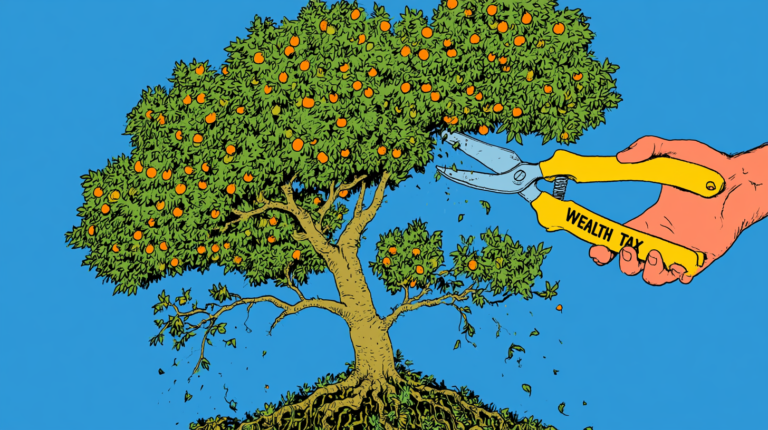

And a wealth tax is not the answer.
Few slogans travel through modern politics with as much confidence and as little scrutiny as the claim that inequality is a social ill to be corrected at nearly any cost. Yet a fair reading of the evidence suggests the opposite conclusion. Inequality is not a defect in the system. It is the primary mechanism by which human achievement compounds, wealth spreads, and living standards rise for the great majority of people who never come close to the top of the distribution.
Consider what a world without inequality of talent and reward would actually look like. Strip away the possibility that some minds could rise far above the rest, and Newton never isolates the laws of motion, Einstein never reconceives space and time, and the intellectual scaffolding of modern physics simply does not exist. Glaring mediocrity, not shared flourishing, is what awaits a society that refuses to let exceptional minds pursue exceptional outcomes. The same logic extends from the laboratory to the marketplace. Had the founders of Amazon and Google possessed only ordinary ambition and ordinary intelligence, neither company would have grown into the infrastructure of daily life that it is today. Millions of people rely on Amazon to have packages delivered to their door within two days, sometimes in a matter of hours, while billions of search queries flow through Google each year because someone was allowed to become exceptionally rich by building something extraordinarily useful. The founders of these companies did not become billionaires by extracting value from society. They became billionaires by creating it, and the rest of us have been made better off in the bargain.
It is worth pausing on where that kind of wealth actually comes from, since so much of the case against inequality rests on the assumption that fortunes are inherited or simply extracted from others. According to one estimate that explored the wealth of the 10 richest men in 2024, none built his fortune through inheritance, and most grew up in middle- or upper-middle-class households before building companies worth hundreds of billions or trillions of dollars. Nor does that wealth sit idle. Among that same group, a median of about 89% of net worth was concentrated in the companies they built, which means that their fortunes rise and fall with the performance of the businesses they created rather than sitting in a cash hoard or a stockpile of assets. The economy, in fact, depends on some people having more wealth than they need to consume, because it is precisely that surplus, channeled into capital markets, that funds business operations, research, inventories, payrolls, and private lending across the country. Strip that surplus away, and the machinery that finances new enterprises loses its fuel.
That machinery has a name, and it happens to be one of America’s most underappreciated advantages. The United States possesses the deepest and most dynamic venture capital ecosystem in the world, and it is no accident that this ecosystem has produced companies like Facebook and Oracle. These enterprises began as ideas funded by investors willing to risk capital on unproven ventures and now anchor entire sectors of the global economy. Without a surplus of wealthy individuals willing to deploy their capital into early-stage companies, private credit, and long-shot ventures, the American entrepreneurial system would be starved of the very funding that allows a garage startup to become a Fortune 500 company. Every dollar of wealth a billionaire earns from a company he built typically generates seven or more dollars for other investors, whether active traders or ordinary Americans whose retirement accounts track a rising stock market, which means that the surplus wealth concentrated at the top does not sit apart from the rest of the economy, but continuously reinvests itself into it.
This same confusion between enrichment and impoverishment runs through the popular narrative about the American middle class. Politicians on both sides of the aisle have insisted for years that the middle class is disappearing, hollowed out by decades of stagnation and elite capture. Turning to the data tells a different story, and a more encouraging one. The share of American families in the “core” middle class did fall, from 36% in 1979 to 31% in 2024, but that decline was not the product of families sliding into hardship. It was the product of families experiencing social advancement. The upper middle class, home to just 10% of families in 1979, grew to 22% by 2001 and then to 31% by 2024, a tripling that left it as large as the core middle-class itself and nearly as large as the two downscale groups combined. By 2024, America achieved a milestone: more families sat above the core middle class threshold than below it, and the combined share of families in the lower, core, and upper middle classes rose from 70% to 78% since 1979. Whichever way the numbers are sliced, the story is the same. Families are not falling out of the middle class. They are graduating out of it and into a tier of prosperity that scarcely existed a half-century ago.
The gains show up just as clearly in the share of the nation’s income each group commands. The upper middle class alone now receives half of all family income, and its share of the total nearly doubled between 1979 and 2024. Combined with the richest Americans, the upper middle class and the rich together saw their share of income rise from 28% in 1979 to 68% in 2024. Even families near the bottom of the distribution shared in this progress, with those at the 10th percentile ending up approximately 30% better off than their peers a generation earlier. That is not a portrait of stagnation. It is a portrait of an economy that has manufactured upward mobility on a scale large enough to reshape the entire class structure of the country. Nor is the richer classes’ larger share of the pie evidence of a stalled economy. Wealthy Americans tend to work longer hours than their peers, and the innovations they have driven have made the broader economy more productive, which means that their growing share of income reflects a growing pie rather than a shrinking one for everyone else. What critics label a shrinking middle class is, more accurately, a booming upper middle class, and it is difficult to see how a nation becoming more prosperous at that pace constitutes a crisis.
Given this record, it is worth asking why calls for a wealth tax have grown louder on the political left, culminating in proposals such as California’s billionaire tax, arguably the most direct assault yet on accumulated wealth itself. The trouble is that the empirical case for such a tax is thin at best, and where evidence does exist, it points toward harm rather than benefit. A study using data from 20 OECD countries between 1980 and 1999 found that wealth taxes dampen economic growth in a manner that is remarkably consistent across statistical methods, estimating that a one-percentage-point increase in the wealth tax rate reduces economic growth by roughly 0.035 percentage points. That relationship held up under a battery of robustness checks, with estimated effects ranging narrowly between 0.026 and 0.042 percentage points regardless of which variables were treated as endogenous or which instruments were used. Wealth taxes, in other words, do not merely fail to help growth. They actively work against it.
Spain offers perhaps the clearest illustration of just how little a wealth tax accomplishes relative to the damage it inflicts. In 2002, despite levying rates as high as 2.5% on net wealth exceeding roughly €10.7 million ($12.2 million), Spain’s wealth tax generated a mere 0.002% of GDP in revenue, a figure so small that it barely registers against the country’s overall tax base. Compare that with countries like Switzerland and Luxembourg, which collected far more relative to GDP despite far lower rates, and the disconnect between statutory ambition and actual collection becomes impossible to ignore.
More recent research on Spain only deepens the case against the tax. After Spain reintroduced its wealth tax in 2011 in the wake of the Great Recession, researchers found that taxpayers responded aggressively to avoid it. A 0.1 percentage point increase in the average wealth tax rate led to a 3.21% reduction in taxable wealth over four years, driven largely by taxpayers shifting assets into exempt categories, particularly business-related exemptions. Taxpayers also restructured their income and asset portfolios to take advantage of the limit on total tax liability, a maneuver that accounted for 92.6% of the impact on revenue reduction. The cumulative effect was staggering. Between 2012 and 2015, revenue losses attributable to these avoidance strategies amounted to 2.75 times the wealth tax revenue collected in 2011.
Norway supplies a third case study, and it confirms just how mobile wealth becomes the moment it is taxed. When the small northern municipality of Bø cut its marginal wealth tax rate from 0.85% to 0.35% in 2021, average taxable wealth in the municipality rose by 60% for every one percentage point cut in the rate, and by 68.7% among those actually subject to the tax. The mechanism behind that surge was migration. In the year before the reform took effect, 68% of the net wealth held in Bø belonged to people who had just moved there, and wealthy individuals with a net worth above NOK 10 million ($1 million) became more than three times as likely to relocate to the municipality once its wealth tax fell. If a single town of fewer than 3,000 residents can pull in dozens of wealthy taxpayers simply by cutting its rate, it should surprise no one that wealth flees jurisdictions that raise theirs. A tax base that is this responsive to rate changes is not a reliable source of revenue. It is a reminder that capital, unlike labor, can simply get up and leave.
Similarly, Jamaica presents a cautionary tale for anyone eager to punish the wealthy through the tax code. In the 1970s, Jamaica experimented with democratic socialism under Prime Minister Michael Manley, who was bold enough to tell his critics that they were free to leave for Miami if they disliked his policies. Many of the country’s elite families took him up on the offer. Without their financial and human capital, the economy contracted, and Jamaica’s real GDP per capita, adjusted for inflation, was 20% lower in 2022 than it had been in 1970. Half a century later, similar rhetoric has resurfaced in American politics, with democratic socialists once again berating the wealthy for having too much. And just as in 1970s Jamaica, the elites targeted by that rhetoric are not staying to absorb the blow. They are leaving states like California and New York for Miami, taking their capital and their businesses with them.
Wherever it has been tested, punishing wealth does not redistribute prosperity so much as drive prosperity elsewhere, and the closer a society comes to Jamaica’s experiment, the more of its own future it forfeits in the process. Inequality of talent, ambition, and reward is not the disease afflicting American life. It is the engine that has driven scientific discovery, built the companies that define modern convenience, financed the venture capital ecosystem responsible for firms like Facebook and Oracle, and lifted millions of families into the upper middle class over the past half-century. Attempting to legislate that inequality away through instruments like the wealth tax or statist policies will not narrow the gap between rich and poor so much as slow the very growth that has allowed so many Americans to climb the ladder in the first place, all while failing, as Spain, Norway, and Jamaica each demonstrate in their own way, to deliver the revenue and fairness its advocates promise.