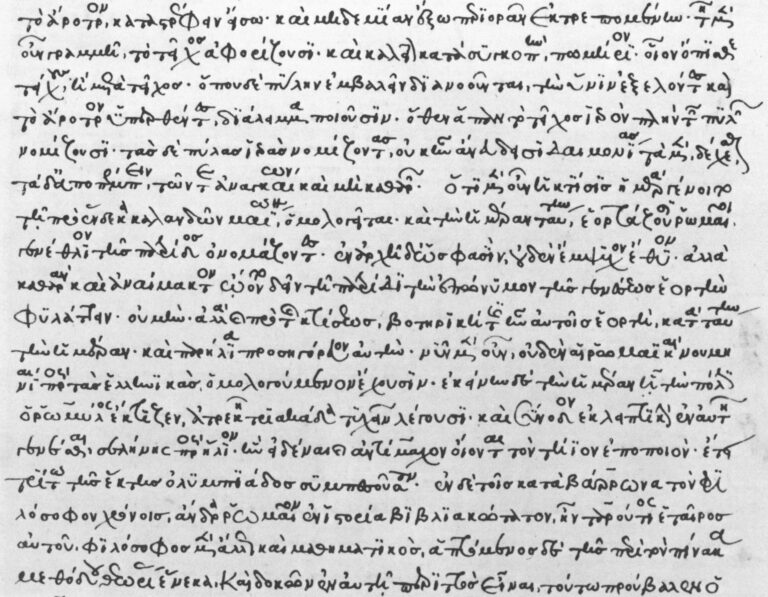

I recently came across an interview with Yiyang Zhuge, a young Chinese political theorist who has published the first Greek-to-Chinese translation of Plutarch’s Moralia. She went viral after her great interview with Christopher Nolan, which allowed him to dive into the importance of xenia in his film as a manifestation of a very human “golden rule.” She’s great as an interviewer and even better as an interviewee. The first thing that jumps out of her interview with the Jack Miller Center is her gratitude to the West. She is genuinely appreciative of the ordinary miracle of a peaceful and prosperous order that leaves a person free to engage in intellectual pursuits:
The American political culture and education system, with its unprecedented openness and excellent erudition, provided the structural conditions that allow me to pursue a relatively peaceful life of thinking and writing. I, like Plutarch, don’t take such protection for granted.
In her interview, she contrasts that gratitude with the way most East Asian intellectuals engage the Western tradition. What reaches curious readers in Beijing or Seoul or Tokyo is, in her words, “an impoverished understanding of the West”:
The Western tradition was imported into and voraciously absorbed by non-Western cultures (I am speaking specifically about East Asia) in the 19th and 20th century only in its revolutionary form. When the Western tradition travels to East Asia, it usually arrives in the form of progressivism, Marxism, and postmodernism.
And this has been remarkably effective, continues Zhuge:
[I]t has successfully convinced large swaths of non-Western intellectuals who are most open to learning from the West that the Western tradition ought to be chipped away and ultimately abolished. The Western tradition in its current form has self-castrated its evangelical function. It is not offering foreign inquirers any reason to love it and become its friends.
Zhuge’s answer is, in a wonderfully literal sense, translation. She translates Plutarch because she wants Chinese readers to encounter the Western tradition not only through its modern critics, but through the tradition itself, in its historical depth, richness, contradictions, and achievements.
I love this partly because it is a real experience she is describing rather than a thesis, and partly because it points to a much broader pattern. Why are so many non-Westerners exposed to the West through the critics of the West? And it is not only East Asia. She says so herself, and I can bring it closer to home.
I am from Brazil. I grew up in Brazil. Yet I was barely exposed there to the American intellectual tradition of Hamilton and Madison, Tocqueville and Jane Addams. What reached me in Brazil was anti-Americanism. It was Chomsky and the Frankfurt School and their descendants. The richness of the American tradition stayed behind while the indictment traveled.
And I see the same thing in economic education. For many people, the first serious explanation they receive of markets comes from someone explaining why markets fail. Their first exposure to rational choice is a criticism of rational choice. Their introduction to price theory is a dismissal of price theory.
Imagine learning Christianity through Nietzsche. That would not teach you nothing, since Nietzsche was a formidable critic. But it would be a strange way to begin. You would be introduced to a civilization’s inheritance through someone engaged in combating it.
That is the pattern, though. Non-Westerners are exposed to the West by anti-Westerners; non-Americans are exposed to America by anti-Americans; non-economists are exposed to economics by anti-economists.
But why is that a pattern?
Part of the explanation is something we have explored in this newsletter before. Criticism reaches a broad audience more easily when it appeals to our zero-sum mentality. It is more portable. Markets exploit workers. America only got rich by plundering the world. Western ideas were purely instruments of domination. The zero-sumness of the criticism travels far more easily than the complexity of the American constitutional order, or of how markets coordinate dispersed knowledge, or of how the Western canon and Western institutions developed into something that transformed the world. Zero-sum mechanisms are immediately understandable while positive-sum explanations are harder to grasp.
The second mechanism is the Schumpeterian surplus of critics. Schumpeter argued that capitalism generates its own opposition, that a successful commercial order produces an intellectual class with the leisure, the literacy, and the protected platforms to attack the institutions making all three possible. Notice that everything on Zhuge’s list is Western: Marxism, the Frankfurt School, postmodernism. Dependency theory is Western in method as it is Latin American in authorship. Closed societies do not produce celebrated critics of themselves. Open ones do, and that openness is part of why they succeed.
What I find most interesting in Zhuge, though, is a third mechanism. When you are outside a discipline or outside a society, you meet it first through your local gatekeepers. You meet America, the West, and economics through their translators: public intellectuals, journalists, professors. They decide what reaches you. When I was in school in Brazil, my teachers, the journalists writing in the newspapers, and the authors on the shelves were not choosing to explain America through Leonard Read, Robert Nisbet, Thomas Sowell, and Jane Jacobs. They were choosing the anti-Americans to explain America. Chomsky and the Frankfurt School were the ones being handed to me. What I received was the interpretation of America chosen by its opponents, as well as the interpretation of economics chosen by its opponents. Plenty of students learn economics from a sociology teacher, or a history teacher, or a literature teacher. I love sociology and history and literature. But that is still a translation, and translators are not neutral.
So what follows from this?
First, we have to build the explanations. We have to go after the zero-sum brain deliberately and teach positive-sum thinking, understanding that the asymmetry is structural and will not correct itself. Complex social orders, whether concrete like America or theoretical like the price system, have to be explained on purpose.
Second, we have to use our intellectual surplus to produce explainers and not only critics. We need people who regard explanation itself as an intellectual vocation, people who understand the institutions that made their own work possible and who feel some responsibility toward them. Zhuge is the model here.
Third, we need better translators. We have to be and form the translators. We cannot assume that students will naturally wander into a good economics classroom. We cannot assume that the first explanation they hear of capitalism, prices, entrepreneurship, or trade will come from someone who deeply understands those institutions.
If we care about economic literacy, we have to compete at the translation layer. We need to do what Zhuge is doing. She is literally translating. She goes to the Western canon and brings it over directly. Do not go through your local translator. Find the thing itself, in its wealth and its richness.
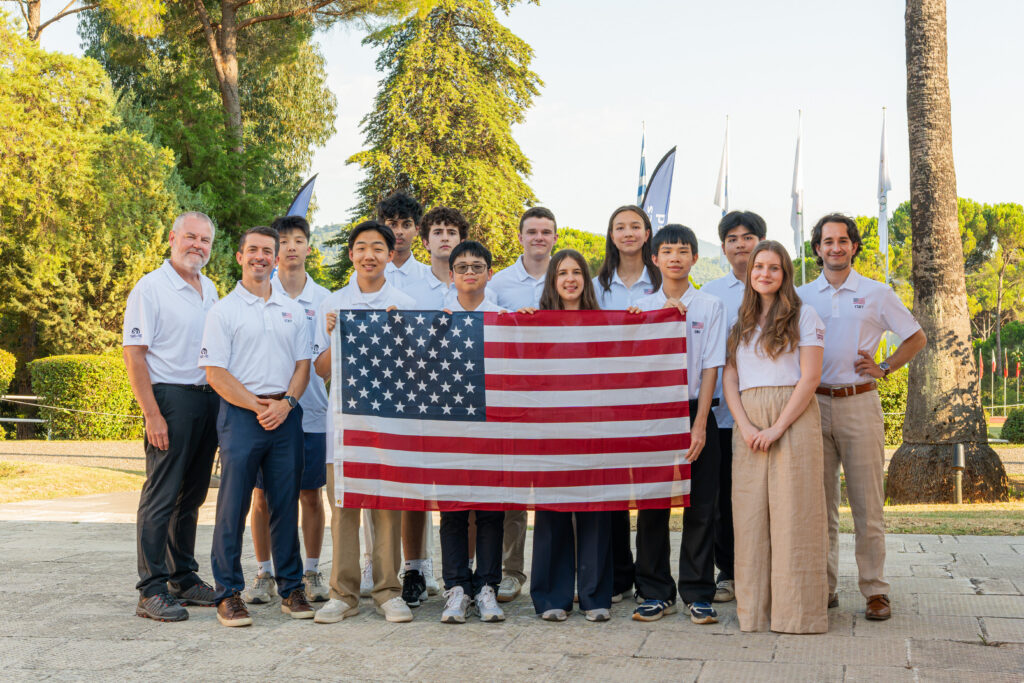
This is why I care so much about the Economics Olympiad, and why I am glad that FEE is coordinating the Americas side of it. In fact, our team is on its way back from the international final in Ancient Olympia. Ten students from the US went, and seven came home with medals, including two gold medalists who finished in the top ten. The Olympiad works as a lighthouse. A student encounters economics not as a dreary ideological dispute, but as an intellectual adventure. There are difficult problems to solve, prizes to win, friends to meet, places to travel, and ideas worth mastering. It tells them not to learn economics from its translators. Learn it from economists.
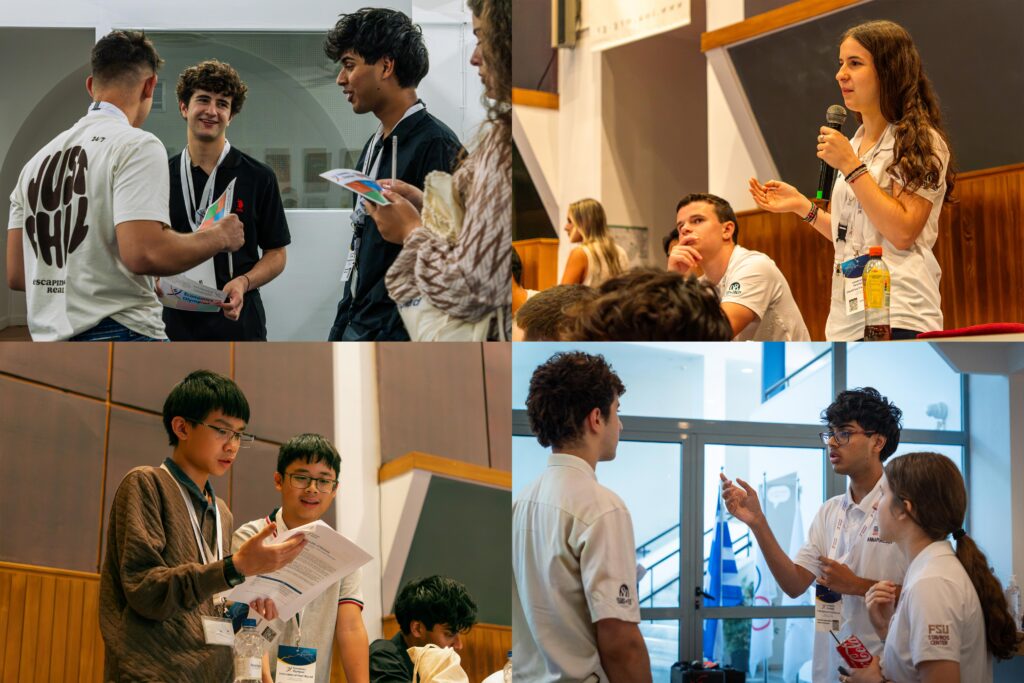
Those students then become translators themselves, and we should send them everywhere. They can carry economic thinking into schools, universities, professions, communities, and countries where economics might otherwise arrive primarily through its critics.
Otherwise, we hand the translation to people who will select for critics, compress everything into a zero-sum message, and win precisely because that message is easy to carry.
Perhaps the most successful intellectual export of the West has been anti-Westernism, and the most successful export of economics has been anti-economics. That can change, but only if the positive inheritance becomes exciting again. Explaining markets. Translating economic liberalism. Translating America. Translating the West. Not because any of these things are perfect, since none of them are, but because they are human achievements worth understanding before we try to dismantle them.
Zhuge is doing something wonderfully simple by translating Plutarch. The best answer to a bad translation is forming better translators.




.jpg)