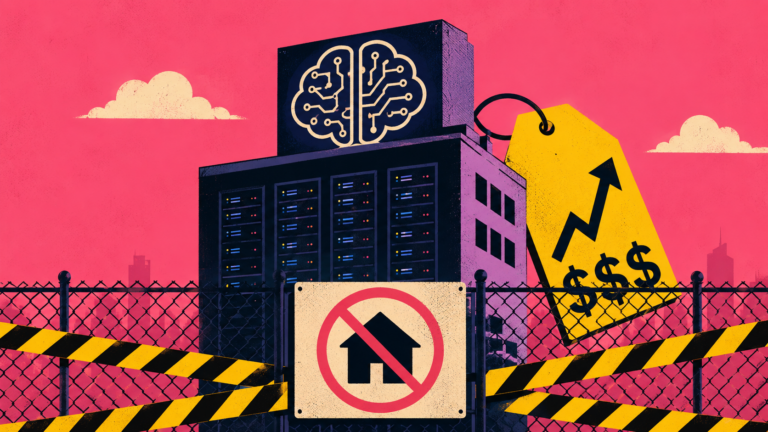

A central failure of the modern American economy is its inability to extend the affordability gains we see in televisions, software, and cellphones to homes, hospitals, and schools. A generation that wants to graduate, buy a home, and build a family feels locked out because the things it needs have become proportionally more expensive than the things it wants. You can buy on Amazon, but not on Zillow.
Much of the affordability crisis is the work of scarcity-creating regulation: housing restrictions, limits on medical supply, and distortions in higher education. Now a new front is opening, and it is likely to follow the same script.
On July 14, New York Governor Kathy Hochul signed an executive order imposing a one-year pause on state environmental permits for new hyperscale data centers—those capable of consuming 50 megawatts or more. It is the first statewide moratorium of its kind. Lawmakers in 14 other states have introduced similar restrictions on data center construction.
The arguments are familiar. Gallup finds that 7 in 10 Americans oppose a data center in their area. Their leading concerns are water use and energy use, with 15% citing higher utility bills. But the Electric Power Research Institute estimates that data center growth actually modestly reduced average retail electricity rates from 2015 to 2024 by spreading fixed costs. Sure, if states allow demand to grow while blocking new generation and transmission, electricity prices will rise. But that is a failure to expand the grid, not proof that productive customers should be prohibited.
Public debate also exaggerates water consumption. Virginia’s legislative watchdog found that most data centers it examined used no more water than a large office building. Some used less than a typical household. In 2023, US data centers consumed 17.4 billion gallons on site, about one-thirtieth the water applied to golf courses in 2024. Data centers undoubtedly require resources, but the appropriate response is better technology and more abundant infrastructure.
Moratoriums choose scarcity instead. They make data centers, and therefore artificial intelligence, more expensive. As AI becomes essential for productivity, research, and education, access should be abundant and cheap. Chokepoints that keep the best models from reaching the public will favor large companies that can afford computing capacity. Startups, nonprofits, small businesses, universities, schools, and researchers will pay the premium—or go without.
Studies show that AI can disproportionately raise productivity among the less skilled and less experienced workers. But that result presupposes access to the same models. Make the best models scarce, and the workers with most to gain will be the first priced out.
The stakes are global. As Abi Olvera, a special adviser at the Golden Gate Institute for AI, has observed, free AI tiers are among the most humanitarian features of the computing boom. They turn a luxury for the rich into an everyday good. But free access is likely to be among the first casualties of computer scarcity. Affluent consumers will pay the premium. People in poorer countries may not. When we ration intelligence, we limit it away from those who have the least.
Communities should also consider what they gain with compute infrastructure. In Loudoun County, Virginia, data centers occupy about 4% of commercial parcels while producing 38% of general-fund revenue. That revenue has helped the county reduce its real-property tax rate to the lowest of any county in Northern Virginia. Not every locality might achieve that result, but it shows that data centers can provide broad fiscal benefits when the rules are designed well.
New York’s moratorium treats rising demand for AI as something to be restrained rather than a sign that more should be built. It also gives organized opponents a year to strengthen political barriers against future projects. The people who will depend on cheaper computing 5 or 10 years from now aren’t organized at public hearings today. Nor are the companies that cheap AI would make possible.
This is the political imbalance that created America’s housing shortage. Existing residents experience the visible inconvenience of construction while future residents remain invisible. Officials block supply with zoning restrictions, prices rise, and politicians respond with subsidies, exemptions, and rationing.
The economics of water, electricity, and computing are the economics of the near future. They can all make sense, and keep America on the edge of AI development as well as AI usage among individuals and firms. That is the future we can grasp and build if we start from economic thinking.
You cannot blame the affordability crisis on Americans wanting too many homes, hospital visits, or college degrees. It is the result of institutions making essential supply difficult to build. Data center restrictions are zoning restrictions on intelligence. We should not repeat the same mistake with the technology that may drive the next generation’s prosperity.
If you still haven’t, take three minutes to answer the Million Dollar Question. This essay is one answer to the question FEE is asking the whole country: What’s behind the affordability crisis? You could be one of twelve contestants competing in our Affordability Showdown in Atlanta, where one person will walk away with $1,000,000. Entries close August 31.