

Christopher Rufo has decided that the problem with free-market economics is its favorite essay.
Responding to Emma Camp’s Wall Street Journal video comparing a vintage refrigerator with its modern counterpart, he concedes the economics: markets work, prosperity is real, supply responds to demand, and entrepreneurial capitalism has transformed human welfare. Then he turns his fire on economics as a mode of discourse.
Pointing to cheap consumer goods, Rufo argues, will not change hearts and minds in 2026. The left’s easy counter is that you can buy a cheap fridge but cannot afford housing, education, or healthcare. He concludes that we will not win “the DSA generation” through “an appeal to consumerism and recycled arguments from ‘I, Pencil.’”
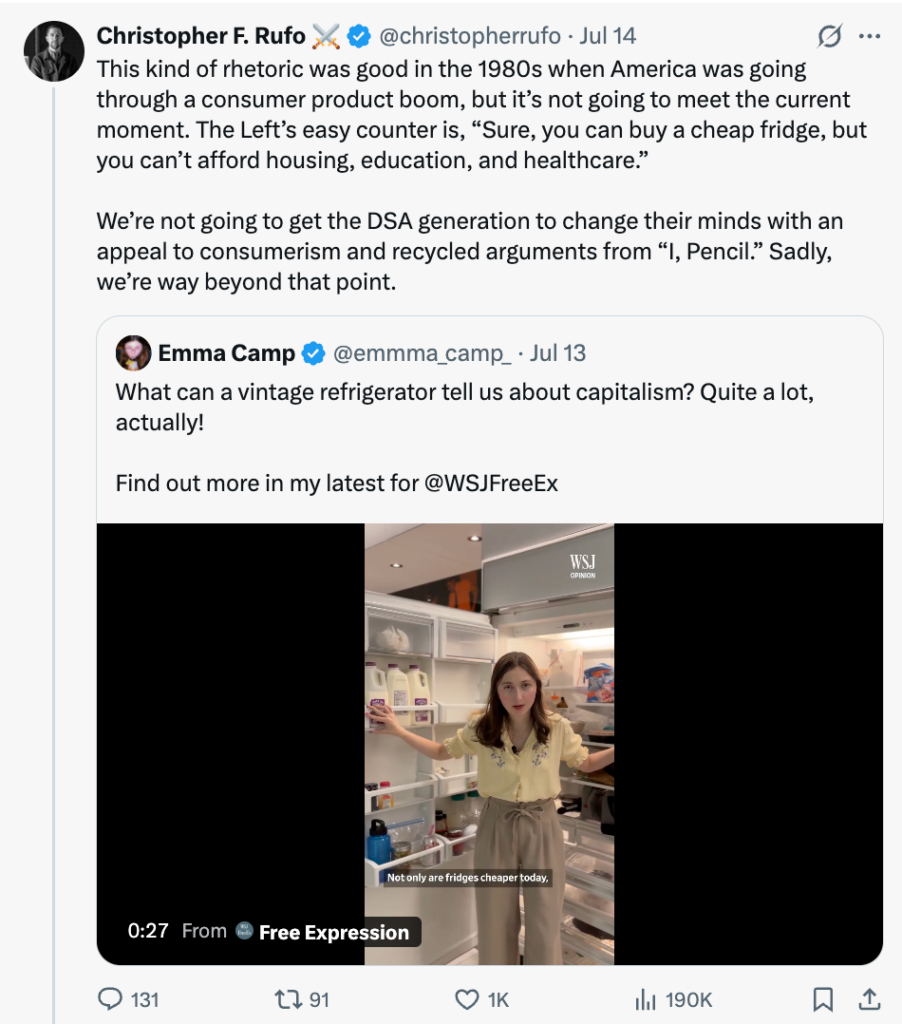
Let me begin with the context. Emma’s video was a response to a whole genre of online commentary that had formed around a vintage refrigerator, using it as evidence that capitalism had deprived young Americans of something their grandparents enjoyed. Emma answered a factual claim with, well… facts. Measured in working time, the old refrigerator was far more expensive. Its modern successor is more affordable, more efficient, more spacious, and much nicer.
Emma was not offering a complete theory of political persuasion, national identity, or the good life. She was definitely not running a political campaign on cheap fridges. She was doing economic education against an economic misconception powerful enough to sustain an entire line of online discourse.
That also suggests that the premise that people do not really care about material improvements is overstated. People care about having nice things: nice refrigerators, nice furniture, nice cars, and, yes, nice homes. And that brings us to the refrigerator’s political lesson.
Homes.
What the refrigerator comparison reveals is that, where markets have been allowed to work, life has become more affordable. In appliances, electronics, clothing, and toys, production scaled. Innovation and competition worked in a virtuous cycle. Prices fell relative to wages.
Meanwhile, the sectors in which Americans feel crushed—healthcare, education, childcare, and especially housing—are precisely those in which these mechanisms have been constrained, distorted, or weakened by supply restrictions, subsidies, restrictive credentialing, and limited competition. The fridge is the control group.
At FEE, we adopted a deliberately provocative mantra: what Gen Z hates about capitalism is actually socialism. It is a humorous way of making a serious point. The American economy has transferred enormous productivity gains into computers, electronics, appliances, and toys, but not into homes, hospitals, and schools. That failure is largely the work of institutional bottlenecks and scarcity-creating rules: restrictions on housing construction, limits on medical supply, and subsidy structures that insulate higher education from competition. Young people raging at markets because the rent is too damn high often live in cities where housing markets are the most controlled. That is the logic behind FEE’s Million Dollar Question campaign.
Here is the sequence of economic education for the affordability era: first, demonstrate that markets make things affordable as a general phenomenon, which is what the refrigerator does. Then turn to the areas where life has become less affordable and trace the bottlenecks blocking economies of scale, innovation, competition, and better allocation.
But that only answers Rufo’s criticism of the refrigerator. His deeper charge is that economic argument is inherently materialistic. Rufo invokes the founding generation’s “anti-materialist and anti-consumerist streak.” He points to the boycotts and non-importation campaigns as evidence that the colonists believed that “virtue and freedom were more important than consumer goods.”
I dispute this equivalence of economic understanding with materialism or consumerism. The great lesson of economics—the one Leonard Read spent his life teaching—is that freedom, character, and prosperity are intimately aligned. The society capable of the American ideal and the society that delivers the American dream are the same society. The ideal is the macro. The dream is the micro.
This is why Rufo’s criticism of “I, Pencil” cannot survive a close reading of the essay. “I, Pencil” is not principally about the price of a pencil. It is about the astonishing social order behind one: millions of strangers across borders, languages, religions, and rivalries cooperating to produce something no single one of them knows how to make, all without a single directing mind. Its lessons are humility before dispersed knowledge and wonder at peaceful cooperation. Yes, the market produces more stuff. But its moral achievement is that it transforms strangers into collaborators. If we lose our admiration for a world of peaceful human cooperation, what exactly is winning for?
This is not merely a dispute over the interpretation of an old essay. It is a contest over which political movement gets to tell the civilizational story of building. Coming from the center-left, the Abundance movement is an explicit attempt to fuse progressive identity with supply-side instincts: you can be a progressive and still want to remove obstacles, build housing, build energy, and build the future. Whatever its blind spots, it is a bid to own the civilizational story of building.
The American right once owned that story outright. There was a vision that fused America’s ideal with economic progress and treated building prosperity as the American civilizational quest.
It is the vision of Benjamin Franklin, who saw no tension between the printing shop and the republic, or between commercial improvement and civic virtue, because they were all part of one project. It is the vision of the Wright brothers’ bicycle shop and Ford’s assembly line. It is the vision behind the rise of the great American cities, the Apollo program’s journey to the Moon, and Starship’s ambition to reach Mars. It is the vision of Walt Disney’s Tomorrowland, where technological progress is an expression of American confidence. And it is the vision of “I, Pencil” which asked Americans to look at the most ordinary object on their desks and see behind it a civilization built on invention and voluntary cooperation.
Recovering that awe is itself a rhetorical strategy, and the only one adequate to a continental republic. The alternative offered by both populisms is antagonism: politics as the identification and punishment of enemies. Suppose it works. You win against 49% of your own country. Then what? What do you do with them?
Antagonistic politics can produce rhetorical victories forever without ever producing a civilizational victory, because civilization is precisely what you share with the people you defeated.
Economics, in Read’s tradition, teaches the opposite lesson: that free and virtuous people prosper together. A political rhetoric worth winning must offer a moral account of prosperity, one in which free people, cooperating across differences, enlarge the space for family, community, and virtue. The American dream and the American ideal are the same project at different scales. That is the American answer to consumerism and materialism. That is Americanism.