

Capitalism is the only economic system that does not force behavior.
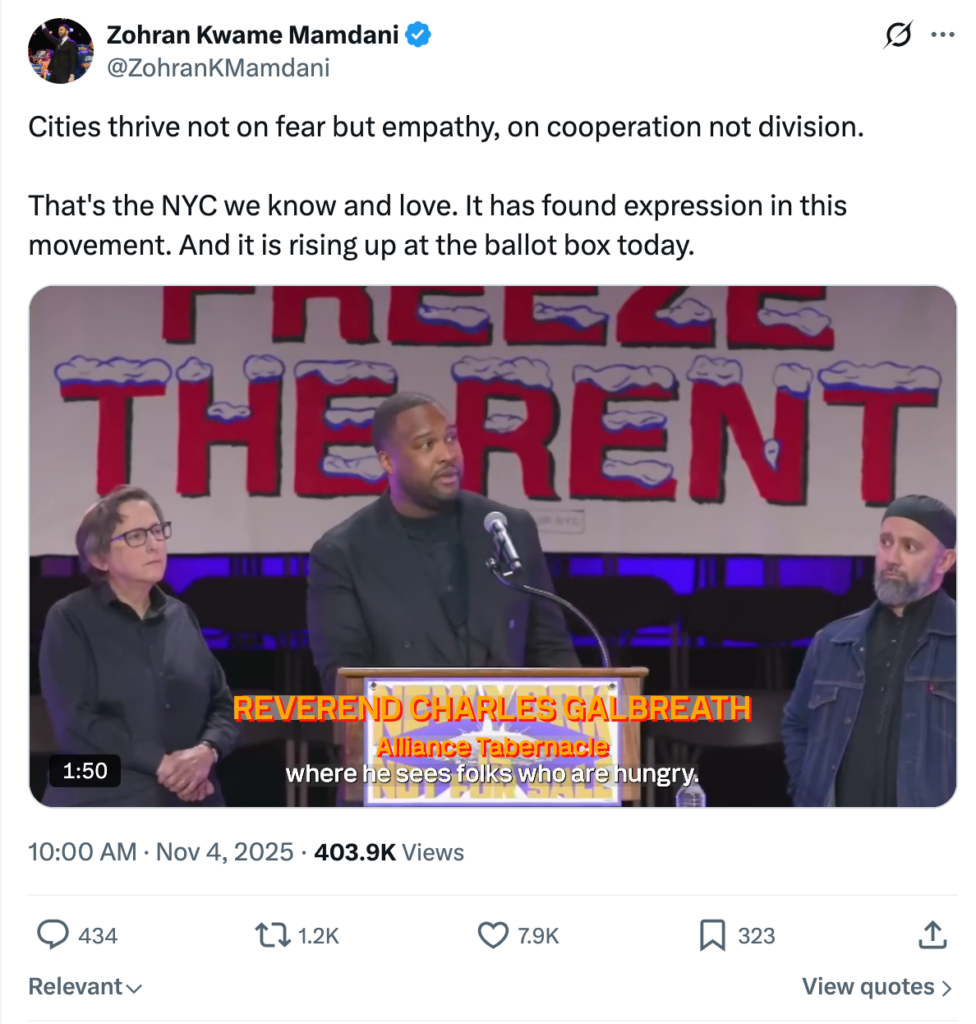
A classic argument against free-market principles is that they are not humane. Capitalists supposedly don’t care that people can’t pay for rent or groceries; that many CEOs receive thousands of times more income than the median worker pay; and that people will die if the government doesn’t provide for them. As Zohran Mamdani, Democratic Socialist and mayor of New York City, put it, “Cities thrive not on fear but empathy.”
The implicit argument here is that capitalism is inhumane and unempathetic while socialism is the moral and humane alternative. But the real question that needs to be asked is: Can economic systems really be moral or immoral?
The end of all economic systems, according to one interpretation of Plato’s Republic, is justice. “Plato’s starting point is that the organization of society depends ultimately upon knowledge of the end of existence,” John Dewey, the father of modern education, writes:
If we do not know its end we shall be at the mercy of accident and caprice. Unless we know the end, the good, we shall have no criterion for rationally deciding what the possibilities are which should be promoted, nor how social arrangements are to be ordered.
Dewey is correct, that without a certain end, we shall be at the mercy of accident and “caprice”—meaning unpredictable and sudden changes. But Dewey is wrong (and potentially Plato as well) both about approaching economics from a collective angle, and implying that social arrangements even need to be artificially ordered.
Moral values are only individual. A society cannot be good unless it is made up of good individuals. While a family is certainly a collective unit, a parent would not say that the family is moral or good unless every individual has chosen to be moral or good. The parent could confiscate drugs, demand curfews, beg them to forsake homosexuality—but they cannot change the desires of their children’s hearts or force them to be moral persons.
Likewise, economics does not start with the collective. It starts with the individual. This is an important distinction, because while specific types of governments and economic systems can influence a person’s behavior, it is ultimately up to the individual to uphold certain moral values. “Thus the principle of collective right,” Frédéric Bastiat wrote in The Law, “is based on individual right.”
While moral values are only individual, there are wrong and right ways for individuals to deal with others in governments and collectives. In a communist society, many believe that each person gets what he or she needs (“from each according to his ability, to each according to his need,” as Marx wrote in The German Ideology). This type of communal living supposedly supports morality in that it satisfies the demands of justice from the poor, and allows everyone to work for each other, and not just for himself. This anti-free market propaganda continues to flow through Zohran Mamdani’s tweets.
But communism and socialism are not simply economic systems. They are political systems as well. Political systems—governments—are only successful insofar as they enforce laws. Socialism is not a way to express empathy or charity; it is an entity of force.
In relations with others, it is actually impossible to force a person to be selfless or just. Forcing another person to reach our set of ideals is, in fact, extremely self-interested. The will of an individual will always be his or her own. “Coercion is evil precisely because it thus eliminates an individual as a thinking and valuing person,” Friedrich Hayek wrote in The Constitution of Liberty, “and makes him a bare tool in the achievement of the ends of another.”
When force is involved, as Dewey picked up on, a level of security is achieved. Socialism sacrifices accident and caprice at the cost of liberty, yet without ever achieving the desired end. Dewey also implies that it’s even possible to order social arrangements perfectly—with the production and dissemination of food, resources, and housing organized every day in exactly the perfect way.
A free-market economic system makes no such claims that it cannot keep. While socialism promises many moral “ends” that it never fulfills, capitalism promises no such moral ends. Because communism combines political and economic power and therefore forces an individual to an arbitrary and unachievable end, it is immoral, or “evil,” as Hayek put it.
The free market allows people to check individuals through refusal to buy products or work for certain employers, instead of governments forcing whole societies to follow certain arbitrary rules. This does leave us at the mercy of some “accident and caprice,” but instead of ensuring through force the adoption of a moral system determined by the State, individuals are allowed to arrive at their own true internal morality.
“Capitalism per se is not humane or inhumane,” free-market economist Milton Friedman said in a lecture, “but capitalism tends to give free rein to the more humane values of human beings. It tends to develop a climate that is more favorable to the development on the one hand of a higher moral atmosphere of responsibility and on the other, to greater achievements in every realm of human understanding.”
Neither socialism, communism, nor capitalism can guarantee the morality of societies or individuals. This is because when economic systems combine with political systems, they use coercion for evil. Economic systems founded on freedom are amoral, because when free-market principles are at work, people are free to choose for themselves.