
The new strategic frontline for liberal democracies.
The global debate over the need for energy security is growing by the day. With scorching summers plaguing Europe, the promise of freezing winters ahead, the rise in overall technology consumption, and the increased use of electric vehicles, countries around the world now view their electricity supply as critical infrastructure that requires both physical and digital protection, given the increasing risks of hacking. Moreover, the wars in Ukraine and Iran have made this urgency impossible to ignore. Russia’s invasion of Ukraine exposed the risks of relying on authoritarian energy suppliers, and the crisis around Iran and the Strait of Hormuz reinforced how quickly fossil fuel dependence can become a domestic economic shock, especially for countries vulnerable to fuel-price spikes.
In this context, electrification has become a tool of strategic resilience, but electrification—both in appliances and in alternative and green energy supplies—depends on batteries, and batteries depend heavily on lithium; and who owns lithium? Few are asking this question, and, most importantly, how it affects liberal countries, the state of democracy in the Global South, and international supply chains.
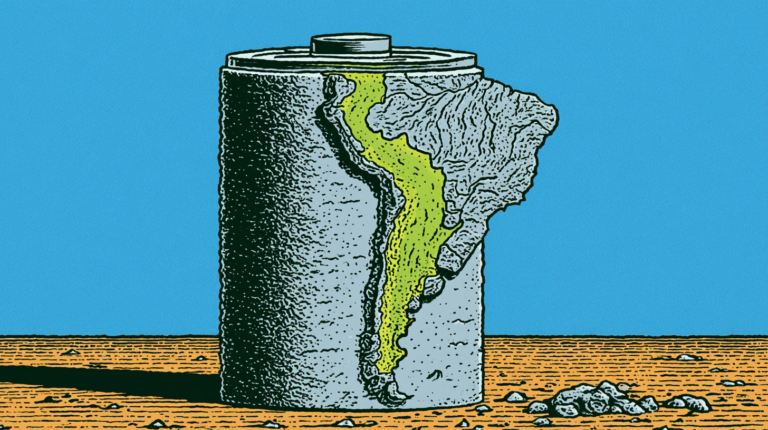
This is why the lithium market now sits at the center of geopolitical competition. The so-called Lithium Triangle—Argentina, Bolivia, and Chile, or ABC—contains 50–60% of the world’s lithium reserves, making South America a decisive region in the future of clean technology and industrial autonomy. In 2024, lithium production in the triangle accounted for 29% of global supply, furthering its significance in the race to secure this natural resource. Whoever secures stable access to extraction, processing, and battery supply chains will shape not only the EV market but also the broader balance of technological power; most electrical appliances—phones, computers, and even solar panels—depend on lithium-ion batteries to function.
China understood this earlier than most liberal democracies. Its dominance in the production results from a vertically integrated strategy that links mining, refining, battery production, manufacturing, subsidies, and export expansion. Companies like Tianqi rushed to secure access to lithium, and the company bet on Chilean SQM in 2018 at a price that later put it in financial stress, since the commodity didn’t reach the expected levels. Even more, the main lithium export destinations from the triangle include China, the world’s largest consumer (which holds approximately 55% of the global share), and later the United States and Europe. This is no surprise, as China also produces roughly 70% of the global EV supply and has leveraged that advantage to exert market influence across Latin America. Yet the more important question is upstream: Who controls the lithium and the battery chain before the vehicle is even assembled?
China’s dominance of these markets matters for several reasons, including the ongoing geopolitical competition with Western economies and the documented impact of Chinese political and economic pressures. Beijing’s presence in Latin America is not always a neutral commercial presence. In Peru and Bolivia, Beijing’s growing influence in strategic sectors connected to mining, infrastructure, and battery supply chains has increasingly resembled coercive economic statecraft. Chinese firms do not operate in isolation from the strategic priorities of the Chinese state. Their expansion can create dependencies that limit local policy autonomy, shape infrastructure decisions, and reduce the bargaining power of host countries.
Bolivia is particularly important because of its enormous lithium potential and long-standing difficulty converting reserves into industrial capacity. Chinese involvement may bring capital and technology, but it also risks locking the country into an asymmetric relationship in which extraction and processing serve external industrial priorities over local development. Peru, meanwhile, demonstrates how Chinese dominance across mining and infrastructure can create a broader ecosystem of leverage. In both cases, China should be understood not merely as an investor, but as an aggressive strategic actor using market entry, financing, and control over supply chains to shape political and economic outcomes.
Chile shows the most advanced version of this dilemma. As a leading lithium producer with stronger institutions and a clearer national strategy, Chile has tried to avoid becoming merely an exporter of raw materials. Yet the controversy over Chinese participation in lithium extraction and processing projects reveals the central challenge: how to attract investment without surrendering strategic control. The issue is not simply whether Chinese companies should participate, but under what conditions, with what safeguards, and with how much technological transfer, local value-added production, and democratic oversight.
For liberal democracies, Chile should be treated as a strategic partner, not just a supplier. If Europe, the United States, Japan, South Korea, and other democratic actors fail to offer credible alternatives, Chile and its neighbors will naturally turn to the actor that arrives fastest, finances most aggressively, and accepts higher political risk: China. The result would be a lithium order in which democratic economies remain dependent on authoritarian-centered supply chains even as they attempt to decarbonize.
This would repeat the central mistake of the fossil fuel era. Liberal democracies spent decades building prosperity on energy systems vulnerable to authoritarian suppliers, chokepoints, and geopolitical blackmail. The transition to clean energy was supposed to reduce that vulnerability. But if lithium extraction, battery processing, and EV supply chains become concentrated in the hands of a single authoritarian power, the green transition will simply replace one dependency with another.
EVs are therefore strategically important, but only as the downstream expression of the lithium race. The true contest is over who controls the inputs, standards, financing, processing capacity, and industrial ecosystems behind electrification. Cars may shape public perception, but lithium shapes the balance of power.
Liberal democracies need a coordinated lithium strategy. This means long-term investment in extraction and refining, support for environmentally responsible mining, partnerships with Latin American democracies, technology transfer, and credible financing that does not force countries into dependency. It also means helping partners such as Chile move beyond raw extraction toward processing, battery components, and higher-value industrial participation.
The lithium market is not just about climate policy. It is about strategic autonomy, democratic resilience, and the future of industrial power. The countries that control lithium supply chains will shape the next era of mobility, energy storage, and technological competition. Liberal democracies cannot afford to treat this as a secondary issue. The lithium market is no longer a niche commodity, but a test of whether they can secure the material foundations of the next energy order without reproducing the dependencies that made the fossil fuel era so politically dangerous.