
The Spanish government’s diversionary tactics.
Spain was the second-largest beneficiary of the EU’s Next Generation funding scheme (NGEU), rolled out in 2021 to help member states recover from pandemic-era lockdowns. Its total allocation was €163 billion ($190 billion, after Italy, which received €194 billion, or about $226 billion), enabling Socialist prime minister Pedro Sánchez to unveil a record-breaking budget for 2022, boosted with the first €26 billion ($30 billion) from this historic program.
Yet from the beginning, Spain’s deployment of NGEU money, access to which depends on hitting investment targets set by Brussels (most of them designed to further the EU’s green agenda), has been surrounded by controversy. The latest scandal over Madrid’s alleged misuse of these funds has highlighted one of the most contentious issues in the bloc—namely, the viability of mutual debt schemes. With negotiations already underway over the next EU budget, during which NGEU repayments kick in, the debate has assumed a greater urgency than ever before.
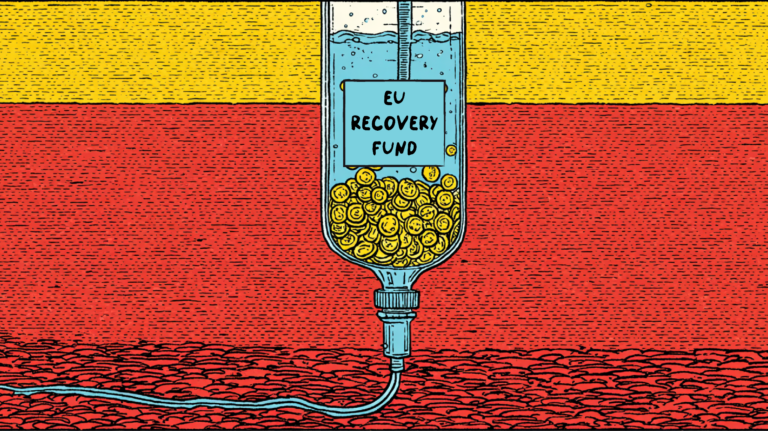
Earlier this month, the Spanish Court of Auditors (ECA) published a report on the spending activities of Sánchez’s government throughout 2024. Its most explosive allegation was that €2.4 billion ($2.8 billion) was diverted from the Recovery and Resilience Facility (RRF)—the main funding instrument of the Next Gen scheme—to cover civil service pensions. In total, it is alleged that Madrid redirected around €10 billion ($11.65 billion) of Brussels’s money to cover welfare costs.
Madrid insists that diverting EU funds earmarked for investment to cover budgetary costs is “routine and fully lawful.” Surprisingly, Brussels has backed this claim. Raffaele Fitto, the EU Commission’s Vice President for Cohesion and Reforms, maintains that “it could be possible for member states to temporarily use some of the liquidity from RRF disbursements to cover other budgetary outlays,” and that doing so would have “no impact on the protection of EU funds.” As the EU examines the Spanish auditors’ report, several of the bloc’s more hardline members have reacted with fury to its contents.
“If these allegations are confirmed,” said Tomáš Zdechovský, a Czech member of the center-right European People’s Party (EPP) and the EU Parliament’s Budgetary Control Committee, “we are facing a serious abuse of European taxpayers’ money.” Dirk Gotink, a Dutch member of the EPP, said that, if true, the Spanish auditors’ claims “would confirm our worst fears about these funds.” Alice Weidel, leader of Alternative für Deutschland, posted on X that “German taxpayer’s money is financing socialist mismanagement in Europe,” while Michael Jäger, president of the European Taxpayers’ Association, called it a “first-order scandal.”
Even if the diversion of EU funds into Spain’s pension pot was legal, it still shows the problems caused by Sánchez’s lack of fiscal mandate. His minority coalition relies on the support of mercurial independence parties from Catalonia and the Basque country, and has not been able to pass a budget since 2023. The auditors cite this fiscal paralysis in their report, saying that the rollover spending plan of 2024 “caused uncertainty regarding the applicability… of certain rules linked to budget management.” For opposition leader Alberto Núñez Feijóo, Sánchez’s repeated failure to pass budgets is unconstitutional—evidence of his determination to cling to power whatever the cost.
The duration of his budgetary vacuum coincides with what the Spanish think tank Funcas calls a “downward trend in spending agility” in Spain’s execution of RRF funds. In 2022, the year of that historically bloated welfare budget, only 30% of Madrid’s NGEU money was disbursed; in 2023, that figure dropped to 24.5%; and in 2024 to 22%. In July 2024, the ECA named Spain as the least effective spender of EU funds, and demanded that it return or repay those which had not been used properly.
There are also concerns about opacity and corruption. As early as February 2023, Monika Hohlmeier, Chairwoman of the EU Parliament’s Committee on Budgetary Control, traveled to Madrid in an attempt to ascertain where Spain’s NGEU money was going. The EU is also investigating the possibility that RRF funds were misused in connection with the Koldo corruption scandal, in which two of Sánchez’s former allies are charged with receiving kickbacks on face mask contracts during the pandemic (the trials are complete and a verdict is expected in the coming weeks).
This is not just a domestic matter. The Spanish auditors’ report has come at a difficult time for European finances, with the bloc’s current budget, or Multiannual Financial Framework (MFF), expiring in 2027. Under the next MFF, which will cover the period 2028–34, repayment of the €750 billion ($874 billion) debt issued on international markets to fund the NGEU scheme is set to begin (the bonds will continue maturing up to 2058, guaranteeing the next generation of EU taxpayers a financial burden, if nothing else). Spain is one of several members that want to delay the inevitable.
For Spain’s Economy Minister Carlos Cuerpo, NGEU is a model for how the bloc should operate going forward. He has recently called for long-term joint EU debt issuance, claiming that it would result in €25 billion in annual savings. Cuerpo is backed by France and Greece, both of which also support more mutual debt or postponing NGEU repayments. Last month, French president Emmanuel Macron said it was “idiotic” to start repaying €25 billion ($29 billion) a year from 2028, while his Greek counterpart Kyriakos Mitsotakis rhetorically asked: “What sense does it make right now to go and repay the Recovery Fund, thereby eating into the budget for the next six years, when we have no reason to do so…?”
Here are two reasons to do so: 1) that the bonds that funded NGEU’s “non-repayable” grants start maturing in 2028; and 2) that there are concerns that large chunks of this money have been wasted or not spent at all. According to the ECA, only about half of NGEU funds paid out to national governments have reached their final recipients. Incredibly, there is confusion over what counts as a “final recipient,” with some member states seeing it as companies or public entities (surely correctly), and others taking it to mean the governmental departments responsible for disbursing the funds—or, in many cases, just sitting on them. The ECA claims that the Next Gen scheme has had practically zero impact on European economies, and that the “absence of a dedicated source of EU funding” will place enormous strain on future EU budgets.
Then there’s the proliferation of private-sector fraud. By the end of last year, the European Public Prosecutor’s Office (EPPO) had launched 518 investigations tied to the RRF facility, representing almost a quarter of its total cases. EPPO estimates the damage to the EU’s finances at €5 billion ($5.8 billion), with procurement fraud the most common offense, typically facilitated by the forgery of invoices or contracts.
It will be several more years before the efficacy of the NGEU program can be properly assessed. The evidence so far, however, indicates that bureaucracy, political deadlock, and corruption have severely diluted its economic impact. The EU’s immediate focus should be on working out a sustainable repayment program, not channeling more jointly-financed debt to unknown destinations.