Home » The Goal Is Freedom \ Tags: , ,

The Goal Is Freedom

Regulation Red Herring

Why There's No Such Thing as an Unregulated Market

By Sheldon Richman
Published: 5 June 2009
Regulation Red Herring

Most people believe that government must regulate the marketplace. The only alternative to a regulated market, the thinking goes, is an unregulated market. On first glance that makes sense. It’s the law of excluded middle. A market is either regulated or it’s not.

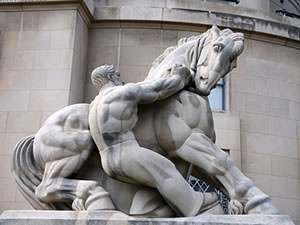
Cashing in on the common notion that anything unregulated is bad, advocates of government regulation argue that an unregulated market is to be abhorred. This view is captured by twin sculptures outside the Federal Trade Commission building in Washington, D.C. (One is on the Constitution Ave. side, the other on the Pennsylvania Ave. side.) The sculptures, which won an art contest sponsored by the U.S. government during the New Deal, depict a man using all his strength to keep a wild horse from going on a rampage.

The title? “Man Controlling Trade.”

Since trade is not really a wild horse but rather a peaceful and mutually beneficial activity between people, the Roosevelt administration’s propaganda purpose is clear. A more honest title would be “Government Controlling People.” But that would have sounded a little authoritarian even in New Deal America, hence the wild horse metaphor.

What’s overlooked—intentionally or not—is that the alternative to a government-regulated economy is not an unregulated one. As a matter of fact, “unregulated economy,” like square circle, is a contradiction in terms. If it’s truly unregulated it’s not an economy, and if it’s an economy, it’s not unregulated. The term “free market” does not mean free of regulation. It means free of government interference.

Ludwig von Mises and F. A. Hayek pointed out years ago that the real issue regarding economic planning is not: To plan or not to plan? But rather: Who plans (centralized state officials or decentralized private individuals in the market)?

Likewise, the question is not: to regulate or not to regulate. It is, rather, who (or what) regulates?

All markets are regulated. In a free market we all know what would happen if someone charged, say, $100 per apple. He’d sell few apples because someone else would offer to sell them for less or, pending that, consumers would switch to alternative products. “The market” would not permit the seller to successfully charge $100.

Similarly, in a free market employers will not succeed in offering $1 an hour and workers will not succeed in demanding $20 an hour for a job that produces only $10 worth of output an hour. If they try, they will quickly see their mistake and learn.

And again, in a free market an employer who subjected his employees to perilous conditions without adequately compensating them to their satisfaction for the danger would lose them to competitors.

Market Forces

What regulates the conduct of these people? Market forces. (I keep specifying “in a free market” because in a state-regulated economy, market forces are diminished or suppressed.) Economically speaking, people cannot do whatever they want in a free market because other people are free to counteract them. Just because the government doesn’t stop a seller from charging $100 for an apple doesn’t mean he or she can get that amount. Market forces regulate the seller as strictly as any bureaucrat could—even more so, because a bureaucrat can be bribed. Whom would you have to bribe to be exempt from the law of supply and demand?

It is no matter of indifference whether state operatives or market forces do the regulating. Bureaucrats, who necessarily have limited knowledge and perverse incentives, regulate by threat of physical force. In contrast, market forces operate peacefully through millions of participants, each with intimate knowledge of his or her own personal circumstances, looking out for their own well-being. Bureaucratic regulation is likely to be irrelevant or inimical to what people in the market care about. Not so regulation by market forces.

If this is correct, there can be no unregulated, or unfettered, markets. We use those terms in referring to markets that are unregulated or unfettered by government. As long as we know what we mean, the expressions are unobjectionable.

But not everyone knows what we mean. Someone unfamiliar with the natural regularities of free markets can find the idea of an unregulated economy terrifying. So it behooves market advocates to be capable of articulately explaining the concept of spontaneous market order—that is, order (to use Adam Ferguson’s felicitous phrase) that is the product of human action but not human design. This is counterintuitive, so it takes some patience to explain it.

Order grows from market forces. But where do impersonal market forces come from? These are the result of the nature of human action. Individuals select ends and act to achieve them by adopting suitable means. Since means are scarce and ends are abundant, individuals economize in order to accomplish more rather than less. And they always seek to exchange lower values for higher values (as they see them) and never the other way around. In a world of scarcity tradeoffs are unavoidable, so one aims to trade up rather than down. The result of this and other features of human action and the world at large is what we call market forces. But really, it is just men and women acting rationally in the world.

The natural social order greatly concerned Frederic Bastiat, the nineteenth-century French liberal economist. In Economic Harmonies he analyzed that order, but did not feel he needed to prove its existence—he needed only to point it out. “Habit has so familiarized us with these phenomena that we never notice them until, so to speak, something sharply discordant and abnormal about them forces them to our attention,” he wrote.

…So ingenious, so powerful, then, is the social mechanism that every man, even the humblest, obtains in one day more satisfactions than he could produce for himself in several centuries…. We should be shutting our eyes to the facts if we refused to recognize that society cannot present such complicated combinations in which civil and criminal law play so little part without being subject to a prodigiously ingenious mechanism. This mechanism is the object of study of political economy….

In truth, could all this have happened, could such extraordinary phenomena have occurred, unless there were in society a natural and wise order that operates without our knowledge?

This is the same lesson taught by FEE’s founder, Leonard Read, in I, Pencil.

Most people value order. Chaos is inimical to human flourishing. Thus those who fail to grasp that, as Bastiat’s contemporary Proudhon put it, liberty is not the daughter but the mother of order will be tempted to favor state-imposed order. How ironic, since the state is the greatest creator of disorder of all.

Those of us who understand Bastiat’s teachings realize how urgent it is that others understand them, too.

17 Comments »

  1. This is an excellent piece. It is made even better by the fact that I agree with it completely.

    A few years back I heard about a survey where Americans were asked what would keep them from becoming an entrepreneur and starting their own business. About 70% of Americans said they felt that the number one issue would be complying with all of the government regulation. Strangely, the American public has demanded this onerous regulation over the years yet cannot see how much it has hurt our economy.

    There was an editorial on this website some time back where a young man mused that the costs of complying with regulation were about 10% of our GDP.

    Finally, I am one who believes that the EPA has actually hurt the prospect of alternative fuels and the FDA has diminished the quality of healthcare in our country.

  2. People see a pocket watch and assume a watchmaker. They see an ordered universe and assume God. They see a society/marketplace and assume a planning entity. I believe that our desire and ability to “act” or improve our circumstances is analogous to “god” or life force in nature. In both cases, order is not imposed but arises from infinite interactions and actions with the purpose to survive or improve.

  3. Ed, amen.

  4. I’m a libertarian, too- I just don’t trust the libertarian next door.

    What you don’t mention is that the sweet flow of the “unregulated economy” can be disrupted for brief periods of time by lies and stupid forms of deregulation (oops- I guess I meant regulation).

    When Phil and Wendy conceived of the mortgage backed security as a cool way of collecting all the new money that the burgeoning worldwide middle class was earning and needing to save, they sold the stupid millions on the idea that an un-appraisable instrument (let’’s call it an apple) would never go down in value. Well, but you are right. In the end the public decided that the apple wasn’t worth $100. Unfortunatley, by then their betters, the Masters of the Unverse who run their 401K’s, etc, had already bought the apple’s for them.

    Regulation can be light handed, but it takes thinking. Henry Paulson actually admitted he didn’t understand mortgage backed securities: Real Estate isn’t his specialty! Come on. Even I get them!!

    The biggest banks and insurance companies in the world were regulated by the OTS (not sure about the acromin, but at least I admit it). This agency was to be paid by the regulees. The regulees were allowed to pick their regulators!!!!!!

    That’s not a regulator. That’s a servant!

    Get a grip you ideological ….

  5. I would say that this is a nice work-over. Howver, the work ought to have sited a lot more convincing quotations from more authorities than this.

    Keep it up, all the best.

  6. \"When Phil and Wendy conceived of the mortgage backed security as a cool way of collecting all the new money that the burgeoning worldwide middle class was earning and needing to save, they sold the stupid millions on the idea that an un-appraisable instrument (let’’s call it an apple) would never go down in value.\"

    You left out a rather important fact. The government, through Fannie, Freddie, and other devices, encouraged the writing of weak loans. It was called \"Affordable Housing Policy.\" Then the government stood in the background winking and saying, \"Don\\\’t worry, banks and investors, we\’ll bail you out if things go wrong. We know you\’re too big to fail.\"

    Without that scheme going on, you don\’t get a housing bubble and financial breakdown.

  7. “the work ought to have sited a lot more convincing quotations from more authorities than this.”

    I wasn’t convincing enough? Besides, there IS no better authority than Bastiat.

  8. Sheldon,

    You’re amazing. Not only do you find excellent shibboleths to deconstruct (ie the long-standing statues and their titles, which represent fallacies that require refutation), you provide long-lasting lessons for people both new to the free-market concepts and those who are familiar with them.

    This is an essay that should be shared with as many people as possible. It’s a true classic… Well done!

  9. Sheldon,

    Since your writing is so good and your points so spot-on, I will pick one nit because I have one to pick.

    You wrote, “I keep specifying ‘in a free market’ because in a state-regulated economy, market forces are diminished or suppressed.”

    But I disagree, and I think so would Mises. One of his most important insights was: not only does government intervention not work, it can’t work because it can’t diminish or suppress the forces of the market. The very reason government interventions in the economy can’t work is that market principles are always and forever acting on everyone and everything in the economy. This includes coercive gangs that are trying to abrogate those principles. Market forces don’t change and they can’t be messed with. Professional criminals can evade, lie about, deny, or cover up the consequences of these market forces, but they’re always acting, no matter the level of freedom in the marketplace.

  10. “ou left out a rather important fact. The government, through Fannie, Freddie, and other devices….”

    Actually, I didn’t leave that fact out. Phil and Wendy Gramm (and of course, many many others) were, in effect those very actors.

    But of course, they and the (lack of ) regulation they fostered were only possible because of the “trend” of those years. I partially agree with your tenants, but only partially. Bubbles cannot be prevented, I’m betting, but they can be abetted. Prevented for too long they become much worse. For instance, had Bush succeeded in putting our Social Security money into Wall Street, the bubble might have been delayed. The consequences would have been much worse.

    On the other hand, had “OTS” had real oversight capability, Indy Bank and WAMU might not have imploded so badly. Similarly, Enron might have been prevented from taking down its 401 owners and the state of California. Madoff could have been discovered much earlier. For that matter, 911 should have been uncovered. These events only occurred because of a purposeful abandonment of “oversight”. But of course oversight is never infallible. It often depends on those in charge! Isaac Newton saved the Bank of Briton. Thank God his motives were good. Similarly, in 1907 our banking system was saved by an individual. I’m betting he understood better than anyone the benefit to himself of that “altruistic” act, but the reciprocal to that problem was that almost no-one understood what was going on in the banking world but him!

    The point is that some regulation is absolutely required. I object most to the word being given a negative meaning. The missing ingredient is thinking and debate. I object even more to ideological belief systems like Libertarianism. Look where it got Greenspan- and us- when he substituted that ideology for thinking. I think Libertarians think that their system would be the fairest, but in fact, unfettered Libertarianism more likely leads to a feudal stasis where those who have have, and those who do not don’t- the opposite of Libertarianism, in fact. See Guatemala.

    In the end, there is no single answer. Multi party systems force the change that hopes to contain “gaming” and other market behaviors. The only constant that works is change. Perhaps future 401 owners will maintain their accounts more attentively, and maybe more Libertarians will be inspired to distrust their Libertarian neighbors. Both trends would be an improvement. Oh yeah- great wealth breeds great stupidity. Perhaps this is all to the good.

  11. @Stephen

    If I may both defend the author and toot my own horn, I wrote a piece on the various ways the government destroyed regulation by the market in the case of the housing crisis last year:

    http://cooperationwithoutcoercion.com/2008/10/10/housing-crisis-and-credit-meltdown/

    Many people say the housing crisis and subsequent credit meltdown were caused by inadequate regulation: they’re right. In a free market, business behavior is severely regulated by the potential to lose money when bad decisions are made. What the government did was eliminate that regulation by guaranteeing people against losses, thereby encouraging outrageously risky behavior:

    (1) Two government-sponsored enterprises, Fannie Mae & Freddie Mac, bought mortgages from banks, eliminating the risk to banks of lending to people with poor credit and inadequate down payments.

    (2) An implicit guarantee by the government that it would bail out the FMs (make up your own obscene alternative meaning for the initials), allowed them to borrow at extremely low rates and profit from accumulating TRILLIONS of dollars of debt to acquire mortgages: they were able to borrow amounts equal to FORTY TIMES their net worth.

    (3) FDIC insurance has caused depositors to pay no attention to the soundness of the banks where they keep their money. Thus, prudent behavior by banks not only isn’t rewarded, but is actively discouraged, as they make more money by taking on risk and don’t need to fear a loss of confidence when they engage in irresponsible behavior.

    (4) Having a central bank (the Fed) with the power to create money in unlimited quantities creates a false sense of security throughout the banking industry, one which will last until a hyperinflation that destroys the buying power of those dollars makes it clear that the government can’t create wealth just by printing it.

    The bottom line is that past government interventions have destroyed the regulatory nature of markets, and the current proposed ones only make it worse. We SHOULD regulate bankers and punish bad behavior. By ENDING government intervention.

  12. @ Less

    I am in no way trained in economics. In the end, it seems to me that neither swing of the pendulum is the answer. In fact it is the swing itself, from left to right, from libertarian to socialist, from highly regulated to unregulated that keeps everyone on their toes.

    I am thinking today of the group of 400± newly minted MBS’s who have taken a pledge to behave morally in business. It seems silly to me. How can a businessman self handicap and plan to survive. Sure, we all have our limits, but that doesn’t mean we can predict another’s behavior.

    More logically, just as we have laws against murder, driving on the wrong side of the road, speeding, selling improperly designed and dangerous goods, we should logically have some rules of behavior in business. The benefit of that is that then businessmen will be able to unleash their ruthless natures most effectively, knowing the limits of acceptable behavior. Of course, as in the 70’s, if the business schools start preaching the social value of ‘greed’, eventually the Phil Gramms and Tom Delays, even Hollywood, will usurp those thoughts for their own gain. Then the Congress acts on our behalf and relaxes regs in all the wrong ways That is what I meant when I referred to a “trend”.

    As to the swing of the pendulum- rules will change over time. The Germans have a different attitude about auto speed than we do. Fine. In fact, rules have to change over time or they will be gamed too effectively, or bureaucracies become to entrenched, like in the Japanese banking system.

    I completely agree with your comments about the FM’s. But a reasonable level of FDIC insurance doesn’t mean the big investors can ignore the quality of their bank; on the other hand it protects the little saver. That is what is was for.

    Now the Fed, that is another matter. I don’t have a clue about that. The argument goes all the way back to Hamilton, of course. My instinct is that it is a kind of a cartel. It the very least it is the banks picking their own regulator. In 1907, Carnegie (I think it was) functioned as a one man Fed. There are times when that function is kinda needed to avoid “the end”, though eventually “the end” will arrive. Is there a better way than having a Fed? Certainly Congress isn’t the answer. They are even less reliable. Perhaps our Supreme Court is a model. Certainly it was formed with many of the same goals of objectively and fairness in mind.

    You and I will have to agree to disagree on the need for something to play the role of Fed, I guess, though I am inclined to think that we may not have the best answer. Functionally it is supposed to be no more than a governor- as on a motor- is it not?- a kind of dampener to limit the swings of mad business?

  13. It is understood that economics is the study of scarce resources that have multiple uses. It is also understood that price is the key factor in regulating the markets force and volatility. When the government steps in regulating the free flow of the economy you, more often than not, will have a negative impact such as we are seeing today due to several decades of government manipulation and intervention. The idea that we can borrow and or print money, throwing it at a wish list of projects is for all intents and purposes a recipe for disaster.

  14. I found this post around 9 pm. Usually I take several days to translate it, and that’s when I’m motivated. But it was so good that I decided to make it right ahead. Excellent.

    http://comedieus.blogspot.com/2009/06/sheldon-richman-le-faux-probleme-de-la.html

    “Pourquoi Il n’y a Rien de Tel qu’un Marché Non Régulé

    Par Sheldon Richman

    Publication: 5 Juin 2009

    Le Faux Problème de la Régulation

    La plupart des gens croient que le gouvernement doit réguler le marché. La seule alternative à un marché régulé, selon ces derniers, est un marché non régulé. A première vue, cela a du sens. C’est la loi du milieu impossible. Un marché est régulé ou il ne l’est pas.” (french translation)

  15. Sheldon, you have really outdone yourself in this simple but effective article. I can hardly wait to pass along this article to all my liberal/Statist friends-who are constantly saying that if the government does not regulate the free market, then all hell would break loose.

    Regarding the title of the statute: “Man Controlling Trade” (which happens to be located two blocks from where I work), I think you could title your article (by juxtaposing the words of tthat title) to be: “Trade Controlling Men.” How about a statute of two men facing each other with two Stallions situated between them, with each horse rearing up on its hind legs and each of the horses facing one of the two men. This statute, of course, would have the inscription “Trade Controlling Men.”

  16. [...] has been no unfettered market. (Even free markets are not unfettered, as I point out here.) Government influence, control, and privilege are pervasive and have been for generations. [...]

  17. [...] that doesn’t include the abolition of the FDA and other regulatory monopolies in favor of a competitive system of regulation and tort is not serious about health care reform. It also makes clear the difference between [...]

Have your say!

Add your comment below, or trackback from your own site. You can also subscribe to these comments via RSS.

Be nice. Keep it clean. Stay on topic. No spam.

You can use these tags:
<a href="" title=""> <abbr title=""> <acronym title=""> <b> <blockquote cite=""> <cite> <code> <del datetime=""> <em> <i> <q cite=""> <strike> <strong>