
Every generation of cultural critics feels compelled to declare that social reality has caught up with its own parody. That was true in the 1970s. Tom Lehrer declared political satire dead when Henry Kissinger won the 1973 Nobel Peace Prize. The cliché moved on to the Reagan 1980s, the O.J. Simpson 1990s, and the George W. Bush 2000s.
Now, Joseph Bernstein writes for The New York Times Magazine that the 2020s are the decade reality finally outran satire. His proof: the release of Grand Theft Auto VI. Through police chases, armed robberies, drug dealing, and hypersexualization, the game franchise has satirized American urban life since the 1990s. But its latest and greatest iteration, according to Bernstein, has run out of things to satirize, and what was previously regarded as absurdity has become an accurate description of American society today. Mind you, Bernstein is not talking about DC, but Florida. And GTA’s rendition of South Florida does not even include a Mar-a-Lago. Instead, the piece brings its own bag of absurdities as evidence: Ozempic, Liquid Death, NFTs, MrBeast… as if we could lump together an incredible metabolic drug and clever packaging for spring water and call it civilizational “derangement.”
To be fair, there seems to be one kind of satire that has stopped working. The mid-2000s Jon Stewart mode of satire performed really well when you had a more cohesive coastal cultural consensus pointing and mocking “flyover country” from a position of shared superiority. Part of what feels like social derangement is actually a political backlash against the high elitism of that era. I don’t think reality is too weird for parody these days. It’s just more culturally decentralized.
The piece tries to draw a contrast between an “incoherent present” and the “coherent past” of the earlier GTA era (2001–2013). That would have been a time when Americans still held “faith in the national project.” We should resist looking at our recent past with the monocle of monoculture. Between 2001 and 2013, we had 9/11, two disastrous foreign wars, the Great Recession and its bailouts, and we saw the rise of the Tea Party and the Occupy movement. Sure, maybe that country was more legible from Manhattan, but only because those facts were being interpreted through a handful of institutional gatekeepers.
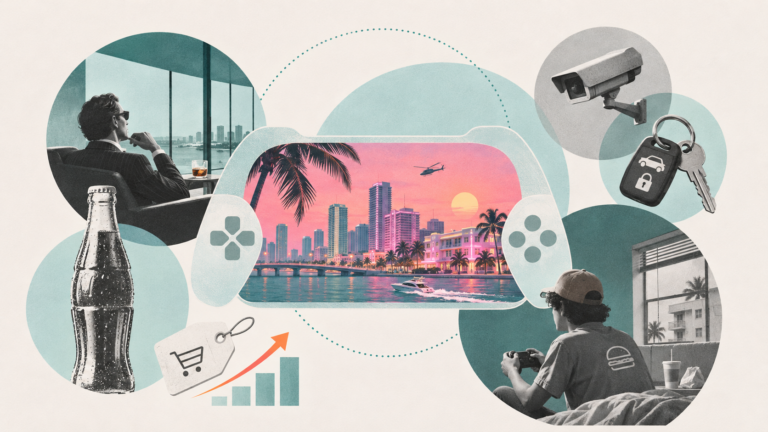
I don’t want to use this space for an anti-elitist rant, since what I find most objectionable about the piece is its description of the American economy. The piece portrays the first chapter of GTA VI as a faithful translation of late-capitalist American struggle, a kind of American Underclass: The Game. But look at Bernstein’s evidence. Playing a videogame criminal in the 2020s became more of a struggle because cars now have anti-theft trackers and convenience stores use CCTV. It’s hard to commit crimes anonymously when bystanders can film robberies on their phones and delivery vans come with security guards.
Yes, present this list to an ordinary American, and I don’t think they’ll read it, as the piece puts it, as a “Boschian landscape of hierarchy.” Without the NYT Magazine soundtrack, that list sounds like advances in public safety and the protection of property rights. Treating anti-theft technology that prevents casual robberies as evidence of the “tech oligarchy” oppressing the working class sounds like self-parody. The piece also details that you only get to enjoy virtual life later in the game, when Jason and Lucia, the couple you play as, make more money. That’s when the game feels “looser and lighter.” That might be true, but it’s also true of any other RPG or mafia game. It’s the basic progression of video games as well as of the archetypal American Dream.
The most revealing part of this piece is that it moves on from moral panic to malaise. NYT reviews and commentary of earlier GTA games would focus on their extravagance of violence and immorality, and on how GTA III had “crossed the line into bad taste.” These days, commentary feels more cynical and resigned. Where you would find punches, now you find a shrug. Bernstein places video games alongside “dating apps or legal weed” as things with “poorly understood side effects” that America has simply given up fighting.
I would question that. Americans didn’t become more apathetic toward GTA because the moral panic faded into resignation. It faded because the moral panickers were wrong. Over the last three decades, as GTA sold millions of copies and became a bigger media franchise than any movie or music act, youth crime plummeted to historical lows. The generation that grew up with the excesses of games like GTA is now partying less and committing fewer crimes. We shouldn’t treat as apathy what should be celebrated as a case of social maturity.
This is not the only cause for celebration. We should celebrate GTA VI as an American cultural achievement in itself. This America that Bernstein dismisses allowed the company to create what he recognizes as a masterpiece painted by 5,000 hands. It is a cultural milestone for America, and it’s also proof that American capitalism is still delivering masterpieces. If you examine it by any economic measure, you’ll find that GTA VI is one of the most aggressively capitalistic artifacts ever assembled. It is the product of a multibillion-dollar, publicly traded conglomerate. It provided compensation and employment for a decade of digital artisanship. Its estimated budget exceeds $1 billion, comparable to the entire GDPs of small nations. It has broken earnings records, with its projected launch-week revenue of over $3.3 billion set to dwarf cultural projects like Taylor Swift’s entire Eras Tour, Hamilton’s 10 years of Broadway production, or Comcast’s revenue from the 2024 Paris Olympics.
As I wrote in my previous newsletter, “The most astonishing fact about modern civilization is not the scale of the wonders we can make, but the scalability of how we make them.” And scalability comes with democratization. If you want a product that serves a billion people, you need to make it affordable for a billion people. GTA VI’s launch price of $79.99 is actually lower than that of its predecessors. Grand Theft Auto III cost $49.99 in 2001 (roughly $90 in today’s dollars). What cultural critics miss is that this monumental digital achievement was not produced to cater exclusively to the 1%. No billionaire—not even Elon Musk or Jeff Bezos—can justify privately commissioning a Grand Theft Auto. The most complex and expensive entertainment product in human history owes its existence to the possibility of selling it to tens of millions of people at a mass-market price. As American capitalism scales up, it also equalizes.
That was the paradox of American capitalism Andy Warhol saw in a Coke bottle. “What’s great about this country,” he wrote, “is that America started the tradition where the richest consumers buy essentially the same things as the poorest. You can be watching TV and see Coca-Cola, and you know that the President drinks Coke, Liz Taylor drinks Coke, and just think, you can drink Coke, too. A Coke is a Coke and no amount of money can get you a better Coke than the one the bum on the corner is drinking.”
Half a century later, the Coca-Cola paradox is alive in GTA VI. The most expensive virtual playground on Earth is also an incredible equalizer. This weekend, a hedge fund manager in Manhattan and a teenage fast-food worker in rural West Virginia will be driving through the same streets of Vice City. They’ll be laughing at the same satirical jokes, unloading their guns at the same NPCs, traveling through the same bizarre neighborhoods, and living through the same Jason and Lucia storylines. The size of their screens might differ, but the teenager might have even more fun and more time to spend on missions and side hustles. And yes, as they enjoy a Coke with it, they’ll experience GTA as a social commentary on America through a game about hustle and grit, the pursuit of wealth and glamour, violence, and consumer excess.
But I hope some of them will also be reminded that the very game we treat as American capitalist derangement is itself evidence of modern capitalism’s extraordinary productive and democratizing capacity. Reminded that only America can draw on talent from around the world to transform a satire of its own excesses into an extraordinary, hyper-detailed, gaudy, record-breaking global export. (I don’t expect we’ll be playing GTA: Forbidden City anytime soon.) And reminded that no amount of money can buy you a better Grand Theft Auto VI.