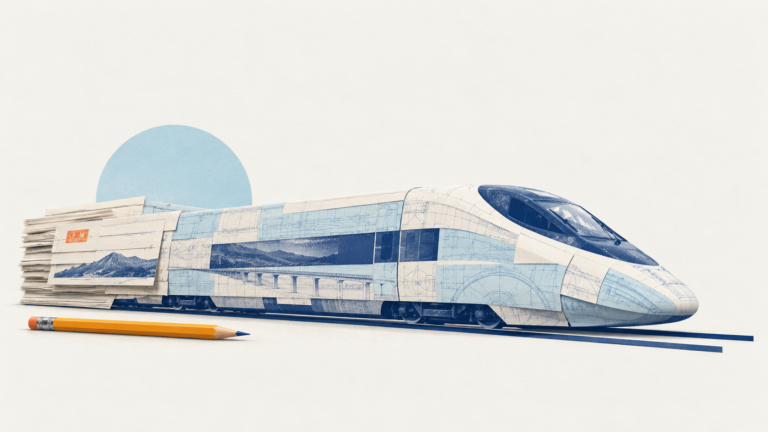
I am a train, a high-speed train. I’m not any generic train, but a specific train that is to take you from Los Angeles to San Francisco as well as the other way around. Each nonstop leg is to take only 2 hours and 40 minutes. I was voted into being by Californians around the time this year’s college freshmen were born. Moving is my vocation, but paralysis became my reality.
If you’ve never seen me, that’s the point. Nobody has. Next week I turn 18, and I still haven’t been born. That’s why I’m writing.
You might remember the story of the pencil and its family, told long ago. And you might remember that part of his family, his cedar wood more specifically, also came from California. We are neighbors. The story of the pencil is that of a small marvel no one knows how to make, yet it is abundant. Everyone uses it. Pencils are cheaply made by the millions every day.
My story runs in reverse. I’m not as plain as a pencil. Quite the contrary: I’m a complicated feat of engineering. And yet, I was planned and designed by a group of people who all claim to know how to make me. They’ve seen my older siblings connecting Tokyo to Osaka since 1964, or running through the French Alps, the Spanish cities, or the Chinese plains. They know where to assemble my family of materials, blueprints, and engineers.
They had that assembly plan in mind when, in 2008, California voters approved $9.95 billion in bonds to help bring me to life, with the initial line expected to cost about $33 billion and open by 2020. Since that vote, I could have made that trip roughly 59,000 times if I’d run around the clock. So far, I’ve made it zero times, as not a single mile of high-speed track has been laid. If the pencil was a miracle of creation, I represent the curse of paralysis. The pencil showed what strangers were able to accomplish when their creative forces were unleashed. I can show you what acquaintances with very well-written plans are not able to deliver.
My Family Tree
I have a family tree, but since I never materialized, it remains an organizational chart. I’ll introduce you to a few of my relatives. While the pencil’s family brought it into existence by following their self-interest without actually desiring the pencil, all of mine have said it was in their self-interest for me to come into being. My non-biography is a series of plans and wants that somehow remain unfulfilled.
Let’s start with the voters of 2008. They wanted me. They were shown a price, a timeline, and an expected travel time. They voted for me at the ballot box, but, as it happens, the ballot box registers a promise without having to keep it.
Consider the elected officials. They wanted me to happen. They wanted me to move between LA and SF, but they wanted me to stop in specific places. Those are politically influential places, and they bent my path to make sure the politically favored spots became stops. I could have taken the shorter route through the Grapevine, but Palmdale had friends in the right places, so they diverted me to swing over the Tehachapi Mountains.
Or consider Washington, DC. The 2009 stimulus brought money to California, but also a deadline aligned with political urgency. The dollars had to be spent fast. And fast meant places where there would be less opposition because there were fewer people to oppose me—but also fewer potential passengers than in LA or SF. That’s the farmland in the Central Valley, between Madera and Bakersfield, where I could begin to be built without yet taking anyone from point A to point B. Washington has also changed its mind a few times. In 2019, it rescinded $929 million. In 2021, it restored that funding. In 2025, it canceled more than $4 billion. California then sued the federal government and later dropped the lawsuit. Everyone had a public justification for acting. That was not enough to bring me to life.
Then, there are the landowners. My path was not only crossing unused land. It was crossing farms and orchards and groves. My builders needed to negotiate prices or go to court. Construction contracts began to be signed in 2013, before securing sufficient land. Only in 2026, 13 years after land acquisition began, would all the parcels needed for my first 119 miles be delivered. I’m not trying to argue how right or wrong this process was, only how slow.
Now, there are also the public officials. My plan included reviewers and approvers. Environmental documents needed to clear the entire route from Los Angeles to San Francisco. My environmental reviews began in 2001, and only in 2024, 23 years later, did the route from San Francisco to Los Angeles finally receive clearance.
Look at the first 119 miles of my total path, and you’ll be able to count roughly 80 entities with a right to approve or permit some part of me. We’re talking about counties and cities, utilities and railroads, water agencies and state departments. Each one wanted me and asked me to wait for their signature. They all had their own very reasonable and thoughtful reasons for that waiting time. Sum that up, and that reasonableness has helped stretch construction across a decade.
My contractors get paid for the work they do and paid again for the work that has to be redone when the plans change. The utilities also get paid for the pipes and the wires they have to move to make way for me. The consultants are paid to manage the contractors, and additional consultants are paid to oversee the consultants. My family tree has a board and an executive committee. It has a Peer Review Group and an Inspector General, a Legislative Analyst and a State Auditor. I have infinitely more supervisors than I’ve ever had riders.
My planners have been keeping busy. Legislation requires a new business plan every two years. I have had more business plans than actual business. My plans should be written with the famous pencil rather than a pen, since we need its eraser to change the dates every couple of years.
Finally, the California governors. They wanted me as much as they wanted that dreamy ceremony where they could cut the ribbon and take the first ride. But they’ve had to settle for some ceremonial steps. In January 2025, the governor marked the start of work on a railhead with a ceremonial spike in Kern County. It was a celebration of progress. The track-laying phase had supposedly begun. It’s been 21 months, and the high-speed track-laying is still ahead of me. He said, at the time, that he had “never thought of this, fundamentally, as a project that’s just about rail.” It’s still not. And, to be fair, it has been a splendid jobs program. By the governor’s count, I have created over 16,000 construction jobs, which is an impressive number since I still haven’t had a single seat.
The Visible Hands
When readers go through my family tree in search of the villain, the one inimical ancestor who was able to derail me out of existence for almost two decades, they don’t find one easily, because I don’t have that many powerful enemies. My ancestors are my friends. They say great things about me and who I am going to become. But they all have this one little detail, this one little concern, this one little process that I need to get through before I can go through the geography of California. Just this one district, this one patch of land, this one study, this one mitigation, this one precaution, this one election. Compared to the whole, each small concern, each small veto looks small, even sometimes reasonable. Add them all together, and they add up to 18 years and counting.
The humble pencil had no mastermind behind his creation. I have masterminds to spare. I have an entire Authority behind me whose job is to know how to make me. I’m not in need of masters; I’m in need of customers whose orders bring together dispersed knowledge and effort, tying together the miner, the logger, and the trucker who make a pencil they’ll never see. My masterminds, on the other hand, concentrate knowledge that gets untied at each step of my execution. So far, they’ve also never seen me.
That customer is the final stranger in the pencil’s biography. By walking into the store and buying a pencil, he’s sending a powerful signal through the whole supply chain and, in effect, paying for that whole family to coordinate their actions back down the chain. If nobody buys the pencil, the whole line receives a verdict that all of that effort and time and knowledge should be employed in something else. And everyone listens.
That verdict does not carry the same weight along my organizational line. Each one keeps being paid as I keep not arriving. The lawyer keeps being paid as the suits keep being filed. The contractors and consultants keep receiving their fees as the plans keep changing. The legislators and governors keep receiving their votes as long as the promises keep being made and the spikes keep being celebrated.
Those benefits are concentrated while my costs are being spread thin like the pencil’s lacquer across the almost 40 million Californians. Meanwhile, my benefits are packed like a graphite core in a few thousand pockets. While the pencil was carried as if by an invisible hand, I’m being stopped by thousands of very visible hands, some with their palms up.
My Authority, which estimated the initial cost at $33 billion, now puts the phase 1 buildout at roughly $231 billion, though its streamlined plan is estimated at about $126 billion. Even after adjusting for inflation, the full-buildout estimate is more than four times the original budget. Spending money requires not much more than an argument. Even if my ridership never pays off—perhaps because flying becomes cheaper and more convenient, because the populations of these cities change, or because of some innovation we’re not foreseeing—that will not matter too much. I’ll continue existing because my masterminds can keep on channeling money to my trips.
Two Hours and Forty Minutes
The lesson from the pencil was that knowledge dispersed among millions of strangers is able to come together and combine into small miracles as long as each one is being rewarded for the value added to the final product. I show that concentrated knowledge can be discoordinated as long as each party is being rewarded not for delivering a final product but for creating friction in the process.
No one in the pencil’s family tree really wanted the pencil. Everyone in mine wanted me. Desire was the resource that I never lacked and that never got delayed. You can say I need better managers, but what is the point of changing individuals along the line when the same system of incentives remains in place? If everyone in a decision chain or organizational chart is rewarded for motion rather than delivery, you will get motion, even if slow motion. You’ll even get viaducts and overpasses that have been individually built and celebrated. But you might still be waiting for the train.
And so I remain, approved, funded, studied, litigated, reviewed, optimized, supervised. Perhaps I am the most thoroughly planned project in America. And still, as I was the day I was voted into being, I am always two hours and forty minutes away.