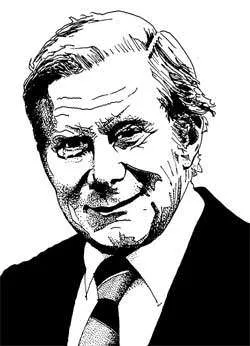
The Reverend Mr. Opitz is a member of the staff of the Foundation for Economic Education, a seminar lecturer, and author of the book, Religion and Capitalism: Allies, Not Enemies.
One of the great entertainers of our time is Victor Borge. It is somewhat ironic that Borge achieved his fame as a comedian, although he was also a concert pianist. In one of his comedy routines, Victor Borge told stories of his uncle, who was a very bright man. Borge’s uncle was so smart that he invented a cure… for which there was no known disease!
Every time some population expert mounts his podium to address the world and says to us: “There are too many of you out there,” I think of Victor Borge’s uncle. The population expert views with alarm a “problem” which is largely nonexistent—where it actually does exist it is less acute than other problems—and his proffered solution, Zero Population Growth, would cure nothing.
The problem, as visualized by proponents of ZPG, is too many people. We are menaced by “the population bomb,” “the population threat,” “the fertility explosion,” a plague of people. The human race has always had to contend against the Four Horsemen of the Apocalypse: Conquest, War, Famine, and Death. To which we now add a fifth horseman, People! “The gravest issue the world faces over the decades ahead… short of thermonuclear war itself…is… population growth.” The words I have just quoted are those of Robert S. McNamara, President of the World Bank, from an address delivered at the Massachusetts Institute of Technology, April 28, 1977.
“Indeed, in many ways,” Mr. McNamara continues, “rampant population growth is an even more dangerous and subtle threat to the world than thermonuclear war, for it is intrinsically less subject to rational safeguards, and less amenable to organized control.
“The population growth of the planet is not in the exclusive control of a few governments, but rather in the hands of literally hundreds of millions of individual parents who will ultimately determine the outcome.”
Mr. McNamara has harsh words for “societies that procrastinate while dangerous population pressures mount.” No government, obviously, “can afford to let population pressures grow so dangerously large that social frustrations finally erupt into irrational violence and civil disintegration,” and so governments must intervene to “improve access to modern means of fertility controls.” In practice, this means that governments must provide “a broad selection of the current contraceptives… as well as sterilization, and—where the society desires it—abortion.”
Mr. McNamara is not an extremist; compared to other ZPG’ers, his statement of the issues is calm and his advocacy of further governmental interventions and controls is the typical “liberal” panacea; the “liberal” confronts something he doesn’t like and his stereotyped response is: “There ought to be a law.”
There have been studies of population trends ever since Thomas Robert Malthus penned his celebrated Essay in 1798. Malthus feared that population would always impinge on subsistence; no matter how great the increase in the production of foodstuffs, population would increase at a faster rate, and mankind therefore faced perpetual misery. Malthus looked through the wrong end of the telescope, and so his prophecy makes a certain amount of sense as history. Look backward over the centuries when this planet housed a mere few hundred million people, and it is true that most people went hungry most of the time, only to perish during the periodically recurring famines.
What Is Overpopulation?
If you define overpopulation as more people on the planet than a given area can sustain, then the world until modern times has nearly always suffered from overpopulation! Before the Europeans came to this continent this land mass was inhabited by less than a million Indians. Food was nearly always in short supply and starvation was a constant threat. There was an imbalance between food supply and the number of mouths requiring to be fed; such an imbalance is the only meaningful definition of overpopulation. Pre-Columbian
But then some important developments occurred in western nations as political liberty flowered in the eighteenth century. Serfs and slaves became free men with a right to enjoy the fruits of their labor—so they produced more. It was a period marked by science, inventions, and technology—with progressive increases in agricultural and industrial production as a consequence. Wages doubled, redoubled and doubled again. The entrepreneur—the man able to combine capital, labor and resources to best satisfy consumers—was accorded status and prestige. Work acquired a new dignity, thrift was praised, increasing prosperity and material wellbeing was enjoyed by the multitudes. The immense productivity of the American people during the past two centuries has resulted in a situation where famine is no longer a threat in this land, and where 215 million people live well on the same acreage that once barely sustained a million. We feed the world with our surplus, proving Malthus a lousy prophet!
Demographic Hysteria
Scholars have been studying population trends for the better part of two centuries; students who specialized in the subject began calling themselves “demographers” about a hundred years ago. But this scholarly discipline, demography, began to go hysterical about a generation ago, largely because of theso-called baby boom which came along in the aftermath of World War II. That boom lasted just long enough to cause a spate of prognostications about a planet in the year 2000 with standing room only. The baby boom burst, birth rates began to decline; and so the alarmists had to change their tune: the birth rate is not declining fast enough!
Mr. McNamara, in the speech cited earlier, tells us that a “significant decline in fertility… has occurred in 77 of the 88 countries for which estimates are available.” The world-wide fertility rate has fallen off nearly 13 per cent over the past two decades. But a 13 per cent decline in the birth rate is not enough to satisfy Mr. McNamara, who declares that “Unless governments through appropriate policy action, can accelerate the reduction in fertility, the global population may not stabilize below 11 billion. That would be a world none of us would want to live in.” Eleven billion people is just over twice the number of people now inhabiting the globe. How does Mr. McNamara know that none of us would want to live in such a world?
Mr. Colin Clark, for one, would not mind living with 11 billion people, nor, indeed, with many more. Colin Clark is a celebrated economist and one of the world’s leading statisticians. Fortune magazine, in its December 1960 issue, published an article by Colin Clark entitled “Do Population and Freedom Grow Together?” His thesis was that economic progress and political freedom are often stimulated by population growth. Estimating the number of people this planet can sustain—if we use our intelligence—he made this startling statement:
Today the best agriculturalists in
The Intelligence Factor
The critical factor for a nation is not the number of people it contains, nor even its population density: the critical factor is the amount of intelligence the people bring to bear on their institutions, especially in the way they organize agriculture and industry. Take the unhappy country of
There are indeed a lot of people in that subcontinent, nearly 700 million of them; but the territory is vast.
I have stressed the alarmist and hysterical note typically struck in the writings of the proponents of Zero Population Growth—those who speak of people as a plague, a threat, an impending disaster. These writers prophesy that people are driven to breed senselessly and prolifically—unless governmental controls are imposed to prevent this calamity.
I have cited a tiny bit of the evidence on the other side, merely to cast some doubt on the ZPG thesis that there is a demographic crisis which provides a new rationale for governmental intrusion into affairs once regarded as most private and personal—a couple’s decision as to the size of their future family. Mr. McNamara is horrified that this decision is in the hands of “literally hundreds of millions of parents.” He thinks it should be turned over to the same people who operate the Post Office!
Built-in Safeguards
On the parallel question—as to the optimum number of people who shall walk the face of the earth—every one of us is aware that quality is more important than quantity and we do not like unhealthy urban concentrations of people. The very last thing any of us would want to see is a globalized
A “Believe It Or Not” cartoon points out that if all the progeny of a single pair of oysters were to live and go on reproducing for a year there’d be a mass of oysters three times the size of the earth. Or something like that. But as a matter offact, nature does not behave that way. I offer you a passage from a 1968 book by Arthur Koestler, The Ghost in the Machine:
In recent years biologists have discovered that every animal species which they studied—from flower beetles through rabbits to baboons—is equipped with instinctive behaviour patterns which put a brake on excessive breeding, and keep the population-density in a given territory fairly constant, even when food is plentiful. When the density exceeds a certain limit, crowding produces stress-symptoms which affect the hormonal balance; rabbits and deer begin to die off from “adrenal stress” without any sign of epidemic disease; the females of rats stop caring for their young, which perish, and abnormal sexual behaviour makes its appearance. Thus the ecological equilibrium in a given area is maintained not only by the relative distribution but also by a kind of intraspecific feedback mechanism which adjusts the rate of breeding so as to keep the population at a stable level.
I realize that human beings are not geared into nature’s rhythms by instinct, in the same manner as the other orders of creation. Our species is unique. With a portion of our being we transcend nature; we possess reason and free will. By the responsible exercise of our rational faculties and our power of choice, we have the ability to arrive at a decision after reflecting on the evidence. It is by taking thought that we human beings make our accommodation to the demands of nature and the requirements of our society. This is what it means to be a free and responsible human being; to be inner directed and self-directed in the pursuit of our life goals is a mark of a free person.
The Road to Tyranny
This brings us to what I regard as the crux of the population controversy. The evidence does not sustain the doomsday thesis that the planet will soon have standing room only; but suppose it did. The dire prophecies of the proponents of ZPG about “the population bomb” will never eventuate, but if we do believe these people and accept their remedy, we’ll be saddled with a monstrous and tyrannical government. Farewell to freedom, then, as the bureaucracy mushrooms, spawning a multitude of snoopers, spies and enforcers. Citizens would be tested, tagged, ticketed. There’d be dissent and the suppression of dissenters; there’d be rebellions to put down. Mr. McNamara tells us that we would not like living on a planet with 11 billion people, and I would tell Mr. McNamara that the government he would invoke would be Brave New World and 1984 combined—impossible to live with! It would crush the individual.
Many people are concerned today, and rightly concerned, with the Soviet dissidents. We believe that the rights of these individuals are being violated, that something in each of these persons, which does not belong to the State, is being appropriated by the State. What that something is in each person may be called by different names—a portion of divinity in him, his soul, his sacred prerogatives, his rights. Whatever you choose to call this inner being of persons, which belongs to them simply because they are persons, we believe it should be held inviolate. The Soviet philosophy views the matter differently; the Soviet citizen is a product of the
We take the opposite view, that the State or the government exists to serve citizens—in very limited ways. Governments are instituted to secure individuals in the rights which are theirs because the Creator so endowed them. “The God who gave us life,” declared Jefferson, “gave us liberty at the same time.” The government of a free people must not itself invade the rights of any person, and the law provides penalties for anyone who transgresses the rights of another.
The Rule of Law
The essential function of the government of a free society, in harmony with the moral code, is to use lawful force against criminals in order that peaceful citizens may go about their business. The use of lawful force against lawbreakers for the protection of law-abiding citizens is the earmark of a properly limited government. Standing in utter contrast is a government’s use of tyrannical force against peaceful citizens—whatever the excuse or rationalization. It’s the contrast between the rule of law and oppression.
People should not be forced into conformity with any social blueprint; their private plans should not be overridden in the interests of some national plan or social goal. Government, the public power, should never be used for private advantage; it should not be used to protect people from themselves. Well, then, what should the law do to peaceful, innocent citizens? It should let them alone!
And this is precisely what the ZPG people do not intend; they do not intend to let anyone alone!
The idea of the intrinsic value, merit, or sacredness of the individual human person has suffered a drastic devaluation in the modern world. The human being once thought of himself as God’s special creation, a favorite of the Almighty.
But the religious vision of the totality—call it Theism—gave way to the world view of Materialism.
According to the Materialist there is nothing in the universe that shares man’s values or responds to his aspirations. Man is a waif in an alien universe, buffeted by forces he cannot comprehend, doomed at last to complete his pointless journey with as little distinction as he began it, his proudest achievements reduced to dust and forgotten. The mood of our time is begotten by this world view, and the mood is a compound of sadness, resignation, rebellion, defiance and despair. The mood is anti-life, and especially anti-human life.
A Sense of Life
Only a society harboring a deep undercurrent of hostility to human life and its continuance could treat abortion casually, as a mere matter of personal preference. And the idea of Zero Population Growth could not possibly make any headway in a society with healthy values, where people experienced a genuine lust for life, appreciated the vast promise in every newborn child, loved life for its joys and took its pains in stride, and experienced life as a venture in destiny.
A profound sense of life is not be found within the world view of Materialism, or Secularism, or Humanism—choose your own label.
We can recapture a profound sense of life only within the religious world vision of Theism. Faith in man can be rebuilt only around faith in God. Easy to say the words; what do they mean?
To believe in God is to act on the premise that a Creative Intelligence is at work in the universe; fulfilling its purposes through nature, in history, and above all by means of persons. This is the basic theistic premise and some primary implications are to be drawn from it: the totality is a coherent whole, i.e. a universe; history has meaning; human life has a purpose; individuals count. To say “God exists” is to affirm that the whole show makes sense.
To reject God, on the other hand, is to deny that any Creative Intelligence manifests itself in nature, history or persons. To deny God is to affirm that everything which exists is the mere end result of blind forces operating on dead matter over immense time. Accept this premise and it follows that there’s no meaning to the whole; there’s no cosmic purpose for human life, i.e., no discoverable pattern in the nature of things which offers man a clue as to how he should conduct his affairs.
No person can believe in the human enterprise, or find a purpose for his own life, if he rejects the belief that the cosmos makes sense. When people cannot make sense out of things, they come to feel that theyare at the mercy of fate. In our day fate takes the form of material forces or historical trends which use people and use them up. Persons cease to believe that they are free beings, capable of making the significant choices which shape their own future. Having accepted the notion that human beings are the mere chance end products of natural forces—like everything else in nature—they lose heart; they lose faith in their own capacity to think, to understand, to plan, to project their dreams and realize them. I take it as axiomatic that external disorder and social strife is a reflection of disorder in the mind and soul. The calamities of today grew out of the bad ideas and misplaced affections of yesterday, for people tend to act out their ideas. As we believe so will we become. As we are within, so will our society be: for it is in the nature of the human condition as such that man forever seeks a harmony within himself, that is, an ordered soul; and secondly, he works for an outer order of society.
The critical question then is not the number of people who shall inhabit the earth; the critical question has to do with our understanding of human nature and destiny, the purpose of life, and the meaning of it all. If we are sound at this point, then we can deal nobly with the issues of life. And with God’s help, we might make it.