
Free markets bring prosperity to everyone.
Governments around the world have recently begun imposing massive sales taxes on their citizens and claiming that in doing so they are “protecting” them. The additional taxes their citizens must pay are called “tariffs.” At the end of the Second World War, there began a long trend toward removing extra taxes on trade, which helped to create waves of unprecedented prosperity. Lifespans and living standards rose across the globe. How easily we now take for granted what only a few generations ago seemed miraculous; how easily we fail to remember what made those seeming miracles possible: free enterprise, freedom to innovate, and freedom to trade. All of those are under serious attack around the world today.
Enterprise is now smothered with paperwork, restrictions, and controls; “precautionary principle” restrictions and costly regulatory burdens restrict innovation; and trade is burdened by huge taxes on consumers—including the many producers who import raw supplies—and by a vast array of sometimes very ingenious “non-tariff” barriers concocted by special interests. The U.S. administration has imposed on American consumers, without congressional debate or authorization, the highest taxes since the disastrous Smoot-Hawley tariffs of 1930–34 that played such a terrible role in crashing the American and global economies in the Great Depression.
Policies Rest on Theories; Theories Rest on Fundamental Assumptions.
A common fundamental assumption that is inimical to freedom is called “zero-sum” thinking, or sometimes the “win-lose” mindset. It says that in interactions the sum of the gains equals zero. If Melissa gains by ten units when interacting with Tony, then Tony must lose ten units. Profits are seen as “taken” from others; exchange is seen as a field of combat; harmony is possible only among the predators, who will soon, in any case, turn on each other. If that’s all you can imagine, as many political leaders today reveal, then universal mutual gain and peace are unimaginable, for every gain must be someone else’s loss.
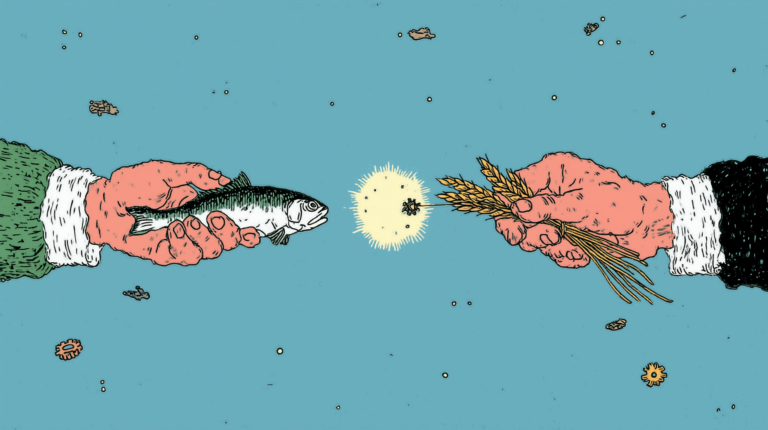
Truly zero-sum interactions almost never happen in the real world; mainly, they’re found on blackboards. Advocates of free enterprise rest their advocacy on a wider view of interactions. Interactions can be “positive-sum.” That’s what characterizes voluntary exchange. We see them all around us in free societies. Parties agree to exchange because each of them values what he or she gets in exchange more than what he or she gives up. The journalist John Stossel identified the “double thank you” as a clue to mutual benefit; when people exchange in a store, the customer and the merchant both say, “Thank you” to each other. It’s rather striking when you think about it, because usually when someone says, “Thank you” to another, the response is, “You’re welcome.” In voluntary exchange, each side benefits, and each side is grateful for the exchange.
There is another kind of interaction that zero-sum thinkers don’t understand but which positive-sum champions of free enterprise and free trade understand well: negative-sum interactions, and those are easily observable. In a negative-sum interaction, the sum of the gains is less than zero; either one loses far more than the other gains (as when a robber shoots a victim to steal $50; the robber gets $50, but the victim suffers a far greater loss) or both of them end up losers, which is a common outcome in involuntary interactions, notably wars, including “trade wars.”
Mutual Gain Knows No Borders
Gains from trade are what make society possible. Love and friendship, rather than being the foundation of society, are the wonderful potential fruit of mutual benefit. If every interaction had a winner and a loser, those people could never be friends, could not truly love each other, for the gain of one would have to bring harm to the other. It is when we can benefit one another that the most beautiful consequences of mutual benefit—love and friendship—become possible.
We trade with our neighbors. We trade with people on the other side of town. We trade with people we will never meet from hundreds of miles away in our own countries. We trade with people we will never meet in countries on the other side of the planet. We trade with people whose languages we do not understand. We trade with people of different religions, customs, and sports passions. The fundamental economic and moral principles of trade are not affected by distance, language, religion, customs, or sports. They rest on mutual advantage. When a Vermonter exports maple syrup to a Floridian and imports oranges from the Floridian, there is no essential difference between that exchange and one between a Canadian and a Floridian.
Trade creates intertwined interests. Complex and prosperous societies are those in which people depend on each other in myriad ways—for food, clothing, entertainment, transportation, medical care, teaching, and more. That mutual dependence is a source of harmony, not a loss of autonomy. As Frédéric Bastiat, one of the greatest champions of freedom who ever lived, noted, “The one thing that people overlook is that the sort of dependence that results from exchange, i.e., from commercial transactions, is a reciprocal dependence. We cannot be dependent upon a foreigner without his being dependent upon us.”
A Tax on Imports Is a Tax on Exports
A sales tax imposed on Floridians who purchase Canadian maple syrup may please the Vermont producers (unless they are serious about principles), but it is still a tax imposed on Floridians. It will likely raise the price the Vermont maple syrup producers can charge. In the end, the Floridians will pay more. What’s more, however, it will restrict the Canadian market for Florida oranges, even if the Canadians are rational and refrain from “retaliating” by imposing such a tax on themselves. Why? Because a tax on imports has in the aggregate the same impact as a tax on exports. Exports are what you have to send to get imports. After all, what you want are the imports, not the exports, which you have to send away in order to get the imports.
It’s possible—at great cost—to produce oranges up north and maple syrup in Florida, but it’s a lot better for people to exchange Florida oranges for maple syrup from Canada or Vermont. When the Canadians find that Floridians are not buying their now more expensive (price paid to Canadian producers + the tax taken by Uncle Sam) maple syrup, they will not have the U.S. dollars to buy those oranges, meaning that the Floridians are less able to sell to the Canadian market. The market for oranges has just shrunk, which means lower income for Florida orange producers. The country as a whole is not better off. Taxing imports is, in effect, quite like directly taxing exports. (In economics, that’s called the “Lerner Symmetry Thesis.”)
Taxes on Trade Don’t Create Jobs, But They Do Lower Wages and Living Standards
Imposing taxes on imports doesn’t create or protect jobs in the aggregate. Some industries might hire more people, but exporting industries end up laying off people. Some people might find their incomes rise, but at the expense of their fellow citizens, who must now pay higher prices (meaning that their real incomes fall) and who have fewer options than when they could buy from people in other countries. You export when you find that you can get higher prices from foreigners than from your neighbors. By taxing imports you tax the domestic exporters, meaning the higher prices exporters could charge abroad are lost to them.
Populist politicians focus on material goods because they think that only what you can touch or hold is real. But services generate value, as well. A doctor who saves your life is rendering a service that you cannot touch, hold, or weigh on a scale, but it is nonetheless of greater value than a shoe or a lightbulb or a spark plug that you can touch, hold, or weigh on a scale. Many wealthy countries export a great many services—insurance, medical technology, banking, and more—that populists scoff at as insignificant. Yet all material goods are actually valued not because they have weight but because they render services to us.
Shoes render me the service of keeping my feet safe and warm, as the lightbulb renders the service of enabling me to see when it is dark. The great free-enterprise economist J. B. Say, a friend and advisor of Thomas Jefferson, pointed out, “Material products derive their value from the services they render, and not from the substance of matter itself. It is the service which constitutes the value, and not the material form which serves as its vehicle.”
“Trade Deficits” = “Investment Surpluses”
A common error of those who wish to tax their fellow citizens for importing goods is to claim that if a country runs a “trade deficit,” it means that the country is “losing money.” The word “deficit” is part of the problem, as what sounds like a negative term seems to lead some people to assume that it must be negative in all respects. In fact, it comes from a simple accounting identity. Savings minus investments equals exports minus imports, or S – I = Ex – Im. It’s derived from the definition of Gross Domestic Product:
GDP = Consumption + Government Expenditure + Investment + (Exports – Imports)
Those who skipped economics or accounting think it’s an equation for economic growth (it’s not; it’s an accounting identity), and they focus on the “minus imports” part. Reduce imports and you increase GDP, they say. Yet the reason that the identity has “minus imports” is because imports are already counted in Consumption, Government Expenditure, and Investment; we put Canadian maple syrup on our pancakes, bureaucrats use imported paper clips to hold together their paperwork, and carpet-making businesses import German machines to make the carpets they sell. (The formula just avoids counting the imports twice.)
Some algebra turns that accounting identity into S – I = Ex – Im, meaning that if your imports are greater than your exports (a “trade deficit”) then investment in your country is greater than your domestic savings. In other words, a “trade deficit” is another way of describing a “capital surplus.” The headline “Our Trade Deficit Goes Up” is functionally the same as “Foreigners Invest More in Our Economy,” which is not a bad thing.
“Protectionism” Only Protects Cronies
The common term for imposing taxes and other restrictions on consumers of goods of foreign origin is “protectionism,” which is unfortunate, because it implies that there is some “protecting” going on, as if buying Canadian maple syrup is an act of violence against which protection is needed. Who is being protected? Not the consumer, who has to pay higher prices for a smaller selection of goods and services. Not the exporter, whose market has just been reduced and who suffers losses. Who is protected? Those who lobby the state to impose taxes on people who buy from their competitors. We know them as special interests, cronies, or (to use the awful term adopted in political economy) “rent-seekers.” They seek to gain at the expense of others, not by offering gain for gain but by depriving others of the right to seek their own gain. They profit from the losses, not the gains, of others.
The Possibility of National Security Exceptions
There might be some cases in which, in anticipation of a break in international trade, it would be wise to have the domestic capacity to produce various goods needed for the defense of the nation, for protection from a pandemic, and so on. Those possibilities are exploited mercilessly by special interests to argue that taxes and restrictions on furniture, baby socks, and tomatoes are all needed to protect national defense, but there may be some plausible cases. In those cases, however, imposing taxes on imports to foster local production is perhaps the most inefficient and the most harmful way to realize such capacities.
Consider steel, which has a variety of uses in national defense, although fewer than before as military tech is turning toward lightweight drone weapons delivery systems, for example. Far better to identify what would be needed for national defense and stockpile it or invest in that capacity, rather than to impose costs on every industry and every job that consumes steel, as taxes and restrictions on the importation of steel do.
Atlas Network Partners Work for Liberty, Rationality, Prosperity, and Peace
On every continent, Atlas Network partner organizations are working for free enterprise, freedom to innovate, and freedom to exchange. In Sri Lanka the Advocata Institute helped lawmakers to formulate and then assisted in the implementation of a three-part reduction of tariffs and a dramatic simplification of the complicated system previously in place. In Pakistan, the Policy Research Institute for Market Economy helped the government with a five-year tariff reform plan that abolishes or reduces thousands of import duties and simplifies the tariff structure, while the Experts Centre for Market and Policy Research has empowered Pakistanis to generate their own electricity by reducing restrictions on solar panel importation, by enabling private investment in power generation, and by allowing people to introduce their own reliable meters.
Partners in Africa—where trade has been heavily restricted for many decades—are implementing the African Continental Free Trade Area (AfCFTA), educating the public and lawmakers about the benefits of wider and freer markets; in Cameroon, for example, the Cameroon Economic Policy Institute’s “Trade for You” project is training cohorts of both businesspeople and bureaucrats on the implementation of liberalized trade; and in Burundi the Center for Development and Enterprise removed the onerous passport requirement for cross-border trading, raising incomes to tends of thousands of mostly female traders, eliminating assaults traders suffered from crossing at night to avoid the passport checks, and lowering prices for consumers.
In Argentina, Atlas Network partners such as Libertad y Progreso worked with the government to reduce currency controls, known locally as “Cepo Cambiario,” and to allow Argentines to obtain U.S. dollars without restrictions. Trade barriers have been lowered or eliminated. As President Milei stated when he opened the Argentine Congress on March 1 of this year,
Opening markets will open the doors of the world to Argentine companies so that they can sell our products to 8 billion people, in an international context where what Argentina has to offer will be in great demand.
I also want to put an end here to another fallacy and that is the issue of the infant industry, an infant that is at least 90 years old. Or, let’s say, to protect industry X, because it generates jobs. That is another lie. Because if in the process of opening up the economy, a better quality or better-priced product enters and a company goes bankrupt, it is also true that consumers now have more money in their pockets and can spend it in other sectors of the economy. Therefore, employment will be reallocated and will go to sectors where it is more productive and where there are higher wages and, therefore, there is greater welfare for all. Therefore, enough of the protectionist lie, because, in the end, it is nothing more than a scam between politicians and rent-seeking businessmen.
In the United States, many Atlas Network partners have worked to document the harm caused by imposition of taxes on American consumers, as well as by other trade barriers. For examples, the Cato Institute’s Herbert A. Stiefel Center for Trade Policy Studies has produced a tsunami of research, while the Liberty Justice Center has won at the U.S. Court of Appeals a 7–4 ruling against the presidential administration’s unilateral imposition of taxes on American consumers without congressional authorization. This imposition was despite the American Constitution explicitly and exclusively delegating the power to tax (Art. I, Sec. 8, Clause 1) and the power to regulate commerce (Art. I, Sec. 8, Clause 3) to Congress and Congress alone. The case has been granted review by the Supreme Court, and arguments were heard in November.
Trade, prosperity, and peace are intimately linked. As Charles Montesquieu, a French thinker who had a huge impact on the formation of the American republic, noted, “The natural effect of commerce is to lead to peace. Two nations that trade together become mutually dependent: if one has an interest in buying, the other has an interest in selling; and all unions are based on mutual needs.”
In other words, when two groups come into contact with one another they either fight or they trade. Fighting is almost always a negative-sum interaction; both lose. Trading is a positive-sum interaction; both gain.